
Also known as: Menires da Pedra Escorregadia, Sepultura da Pedra Escorregadia, Necrópole da Pedra Escorregadia
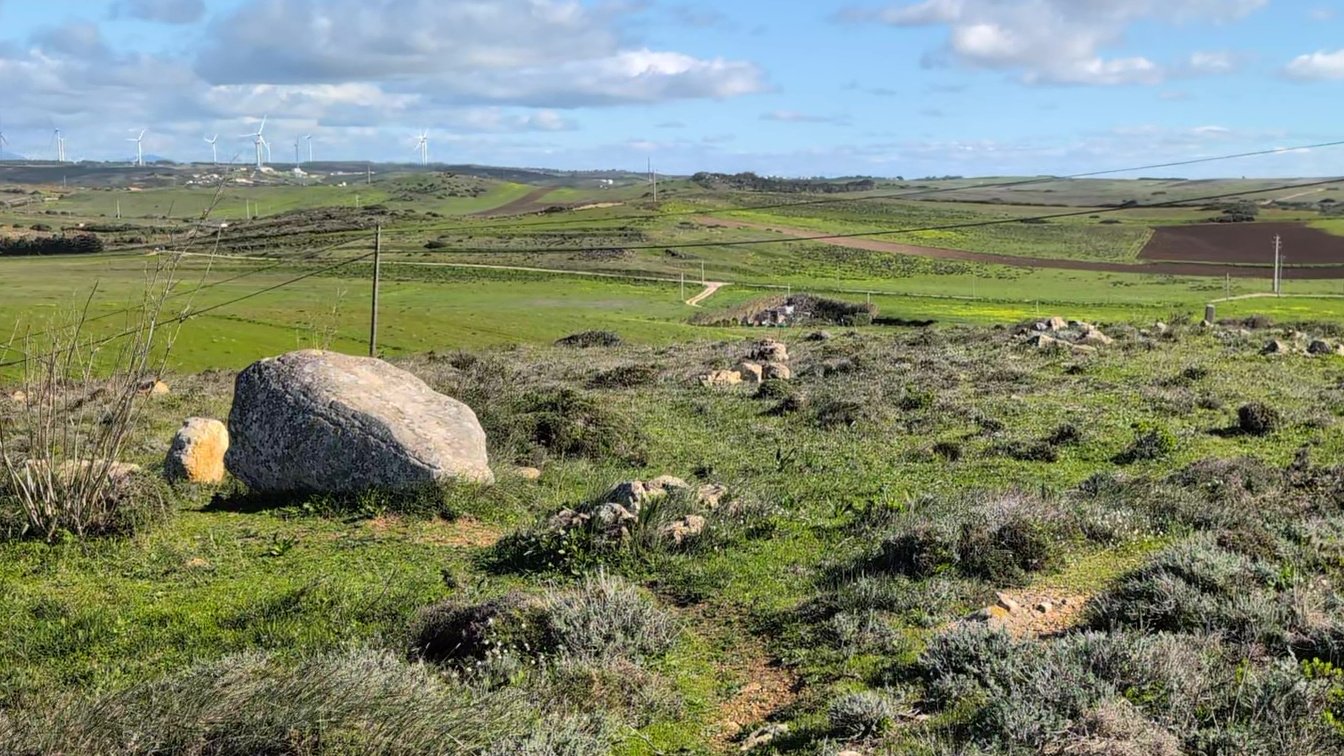
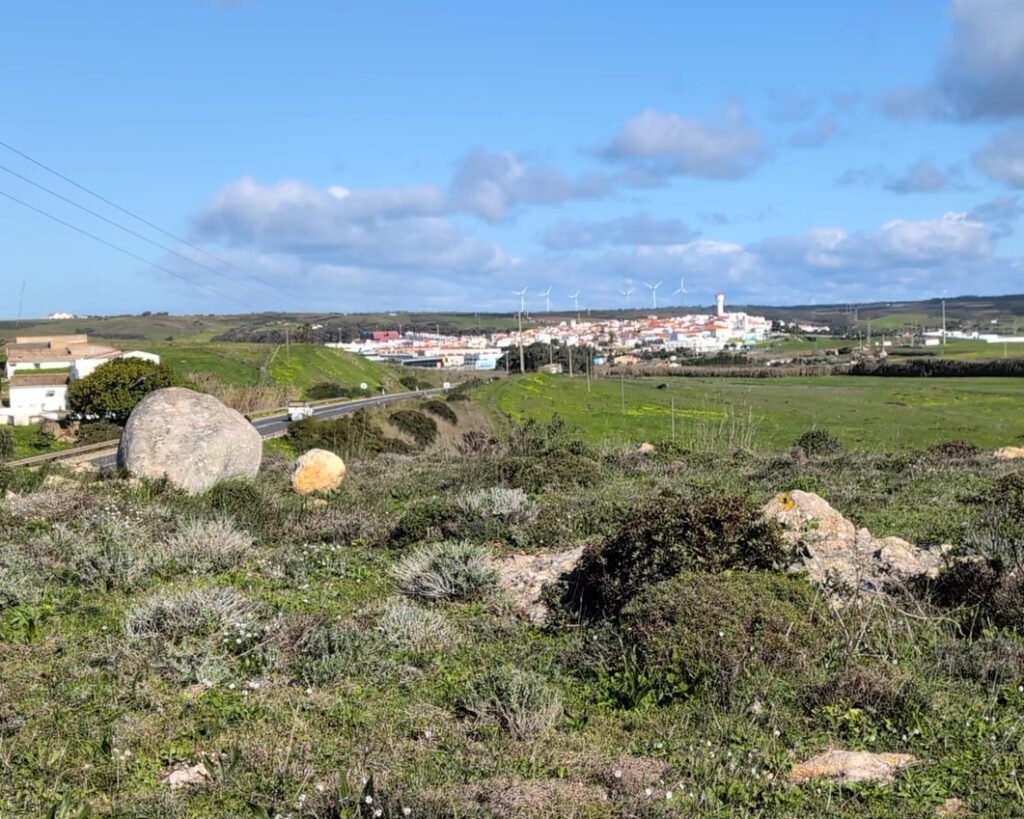
Stand on the hilltop, and listen to the cars racing past on the road below. On this hill, the stones have stood still for many thousands of years. Looking around the view, you can see to the ocean in several directions. This place was significant to our ancestors many thousands of years ago.
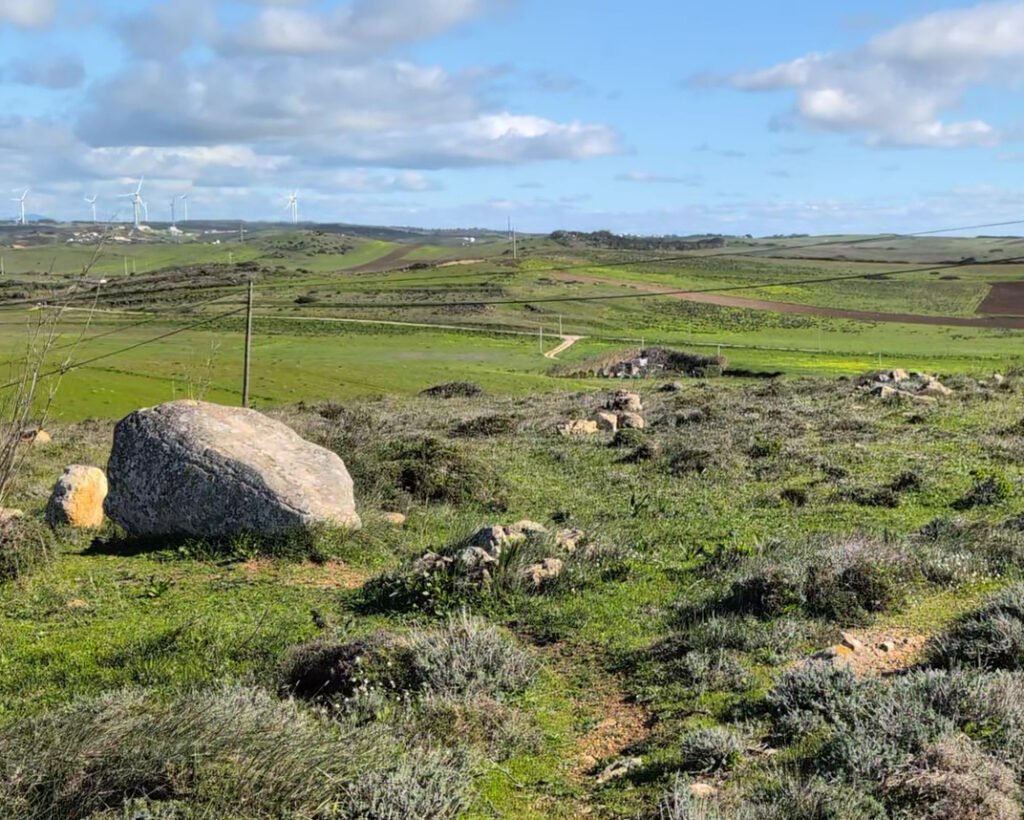
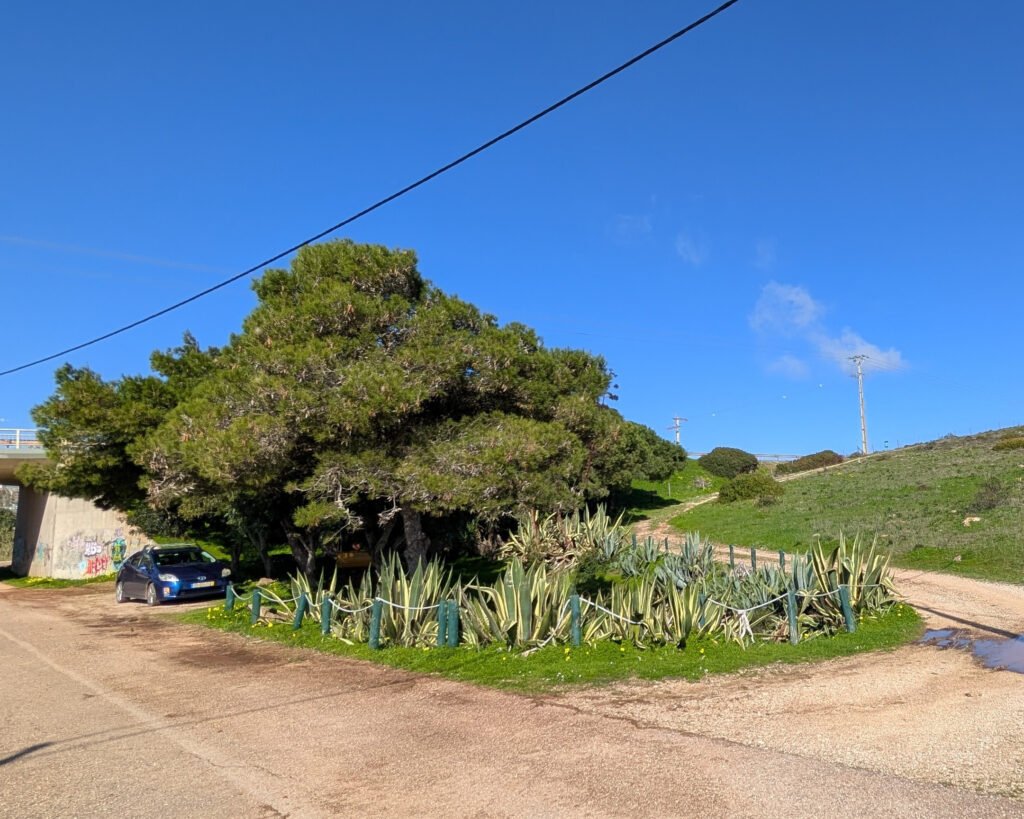
This site (translated as “slippery rock”) has several fallen stones (“menhirs” in English, or “menires” in Portuguese) and a collective tomb.
Menires
There are supposedly three menires1, but I could only find two.
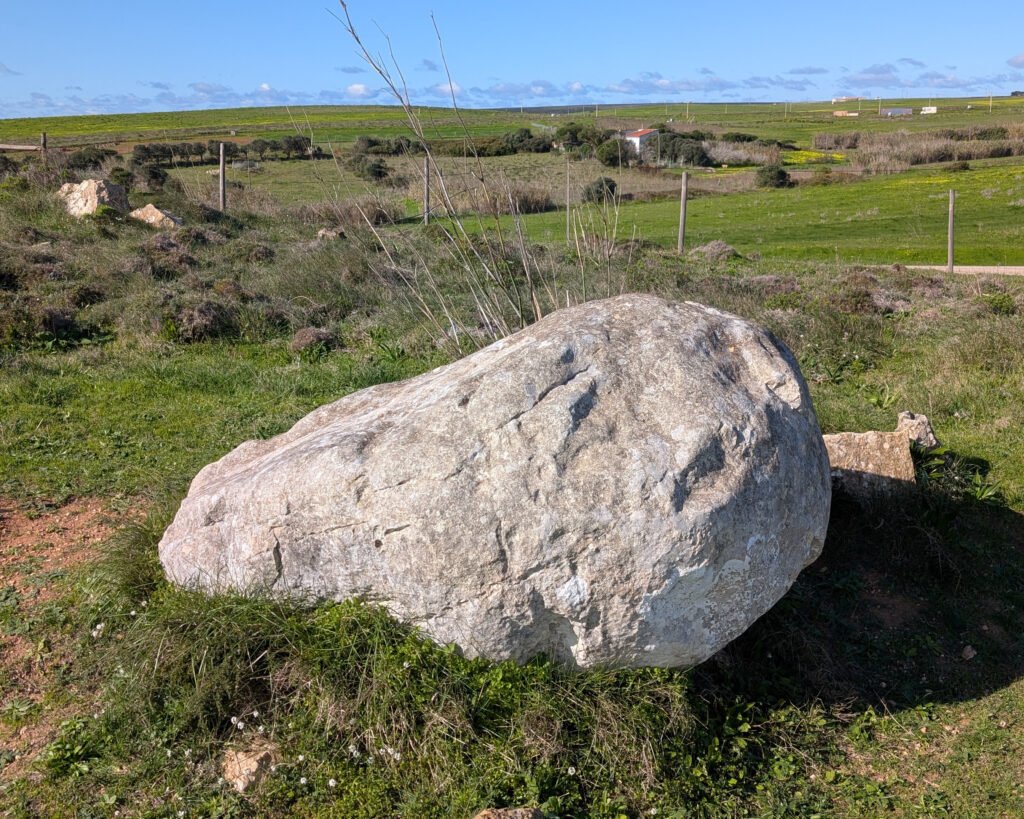
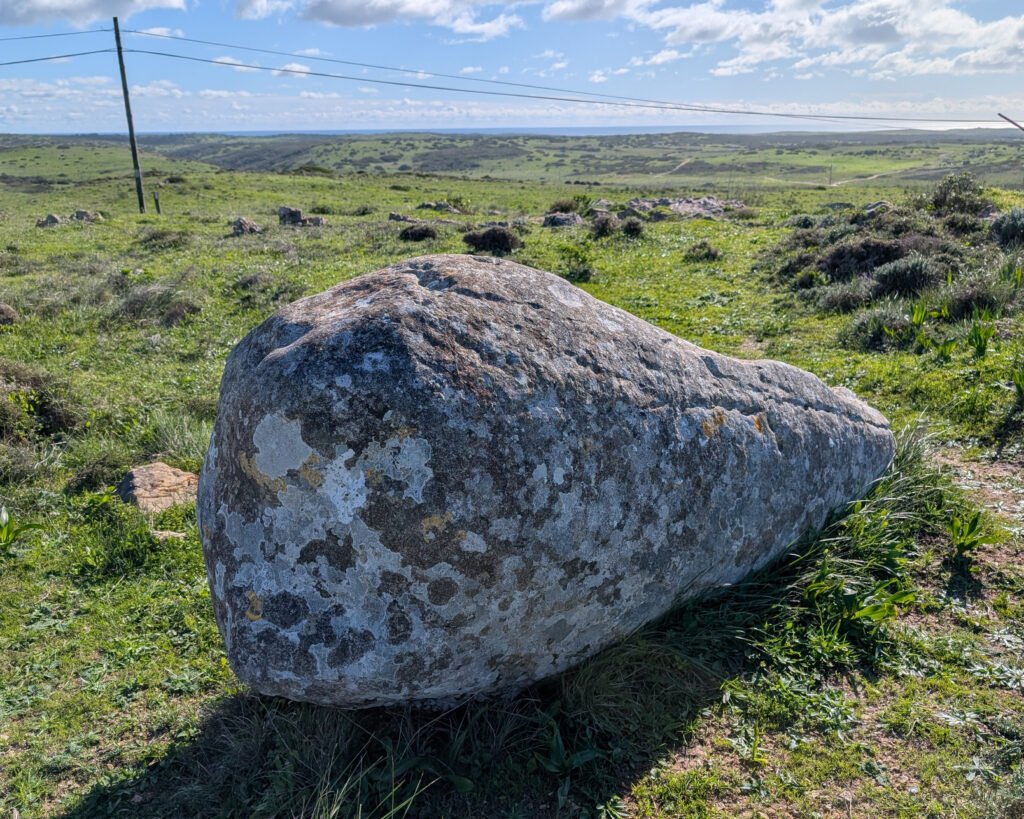
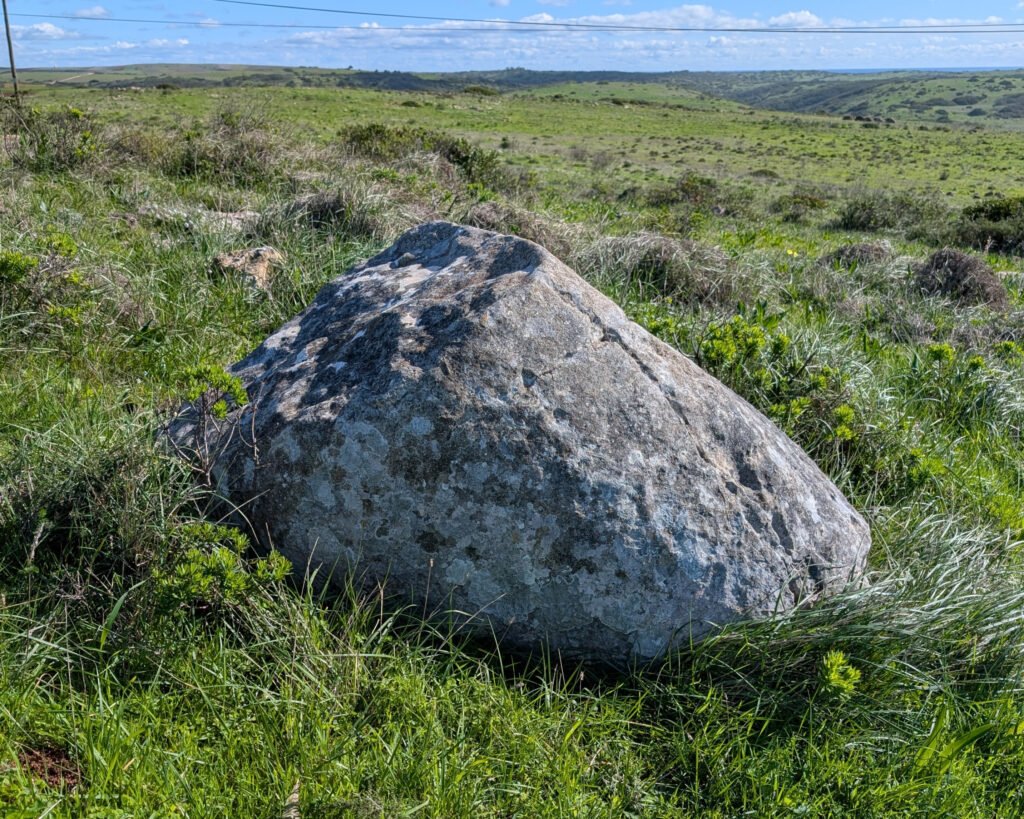
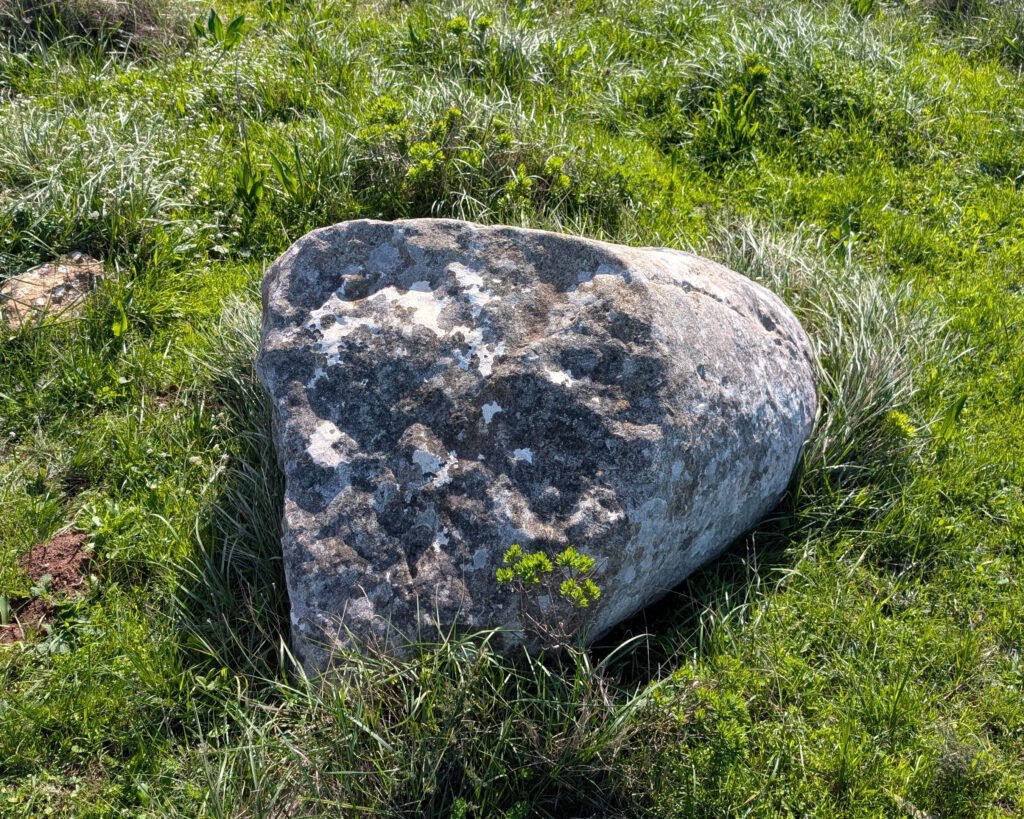
Both are cylindrical, carved from limestone. They are both broken and fallen. They were carved in the late Neolithic, about six thousand years ago.
The first menhir, on the top of the hill, is about 2m long. It has carvings in the shape of a series of ellipses along one side2. They are hard to see, but can be felt. The second menir, on the hillside beside the trail, is very broken.
Collective Tomb:
This is a chambered tomb (“necrópole” or “sepultura/sepulcro” in Portuguese – meaning a tomb or cemetary) which was use for collective burials or entombments. There are eight upright stones forming a chamber of about 2.3m across, and more forming a 1m corridor facing east. No traces of the cover were found.
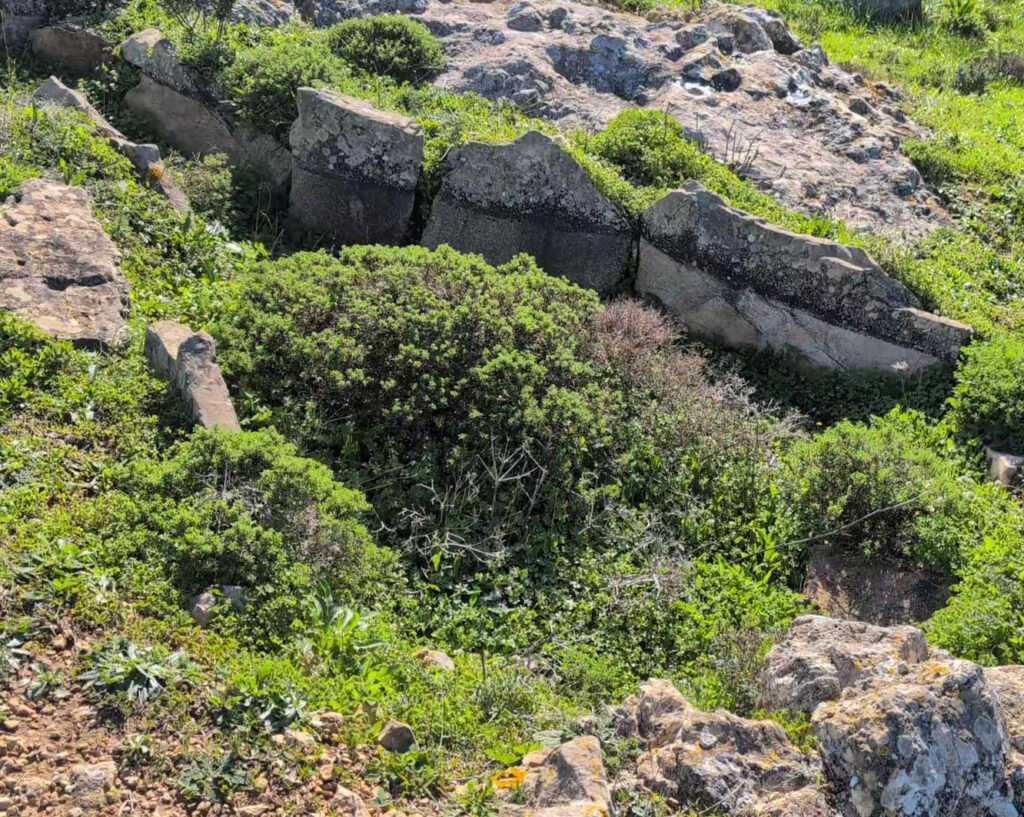
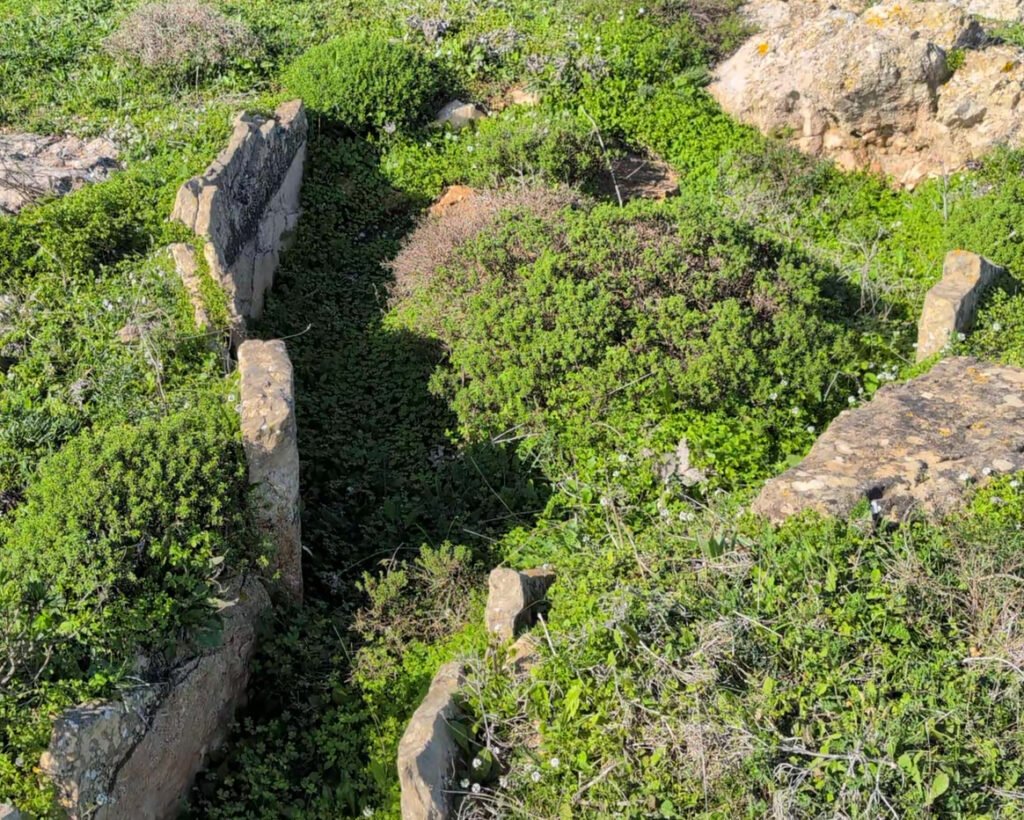
It was excavated in 1991, and the remains of ten individuals were found, along with stone tools and ceramic fragments. These allowed the tomb to be dated to 3300-2460 BC. This was later than the building of the menires, which suggests that the site was being reused or used for a long time.
Location
In Portugal’s Algarve region, district of Faro. The site is in the municipality of Vila do Bispo, just south of the town of Vila do Bispo. The site is on top of a hill immediately beside the N238, the main road between Vila do Bispo and Sagres.
Access
Head south out of Vila do Bispo past the Lidl supermarket. A little more than 1km out of town, there’s a left turn through a tunnel under the main road heading to Sagres. (The sign is below.) Go through that and just on the other side of the tunnel there’s a parking area next to a small wooded park with a swing. The Pedra Escorregadia site is just up the hill from this park, a short walk along a dirt road.
Signage
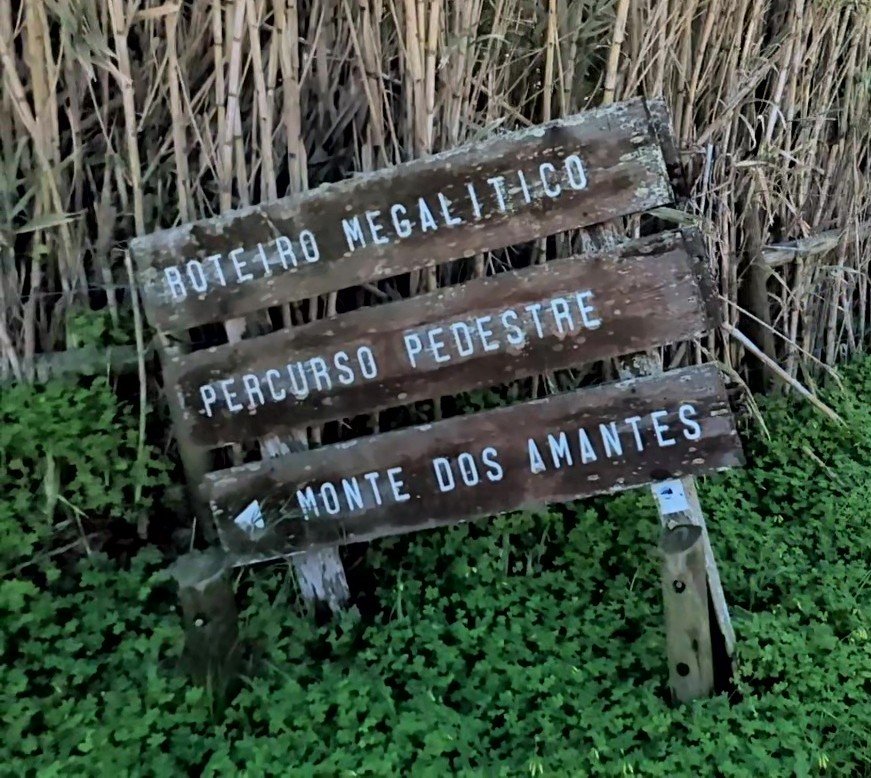
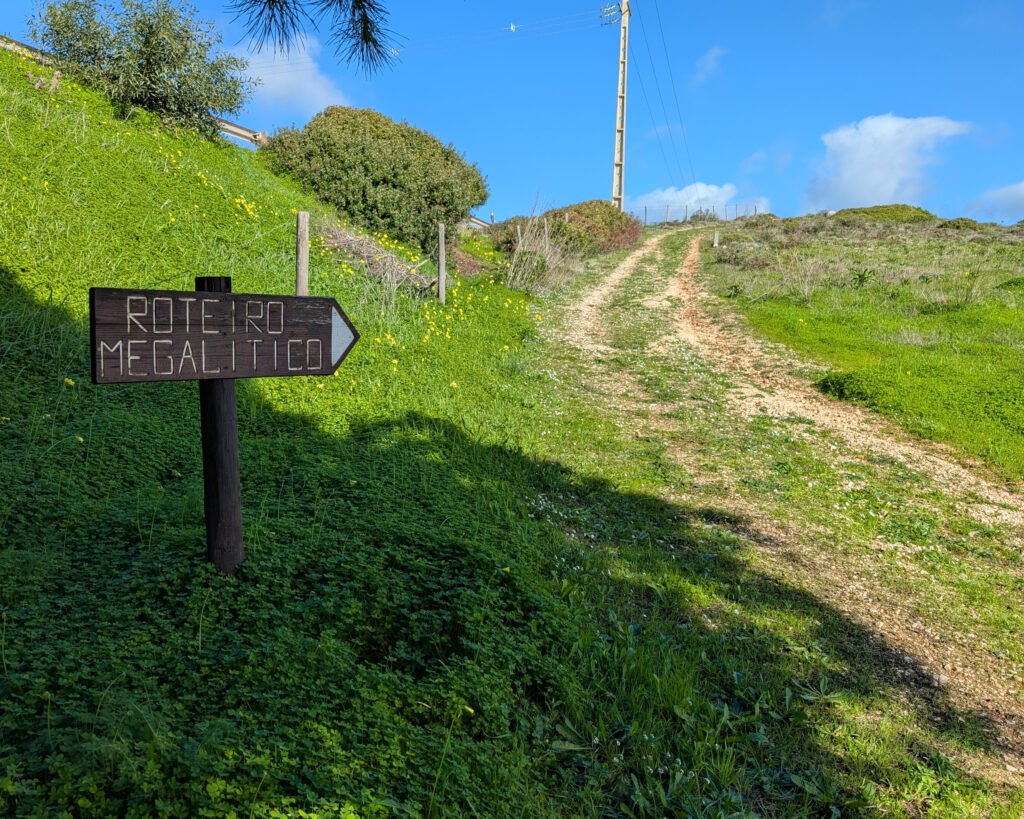
At the turn where the road goes under the main Bispo-Sagres road, there is a sign pointing out the “Roteiro Megalítico” (Megalithic Route) and “Percurso Pedestre” (Pedestrian Trail) for Monte dos Amantes. On the track behind the wooded park, there’s a sign pointing up the hill for the “Roteiro Megalítico.”
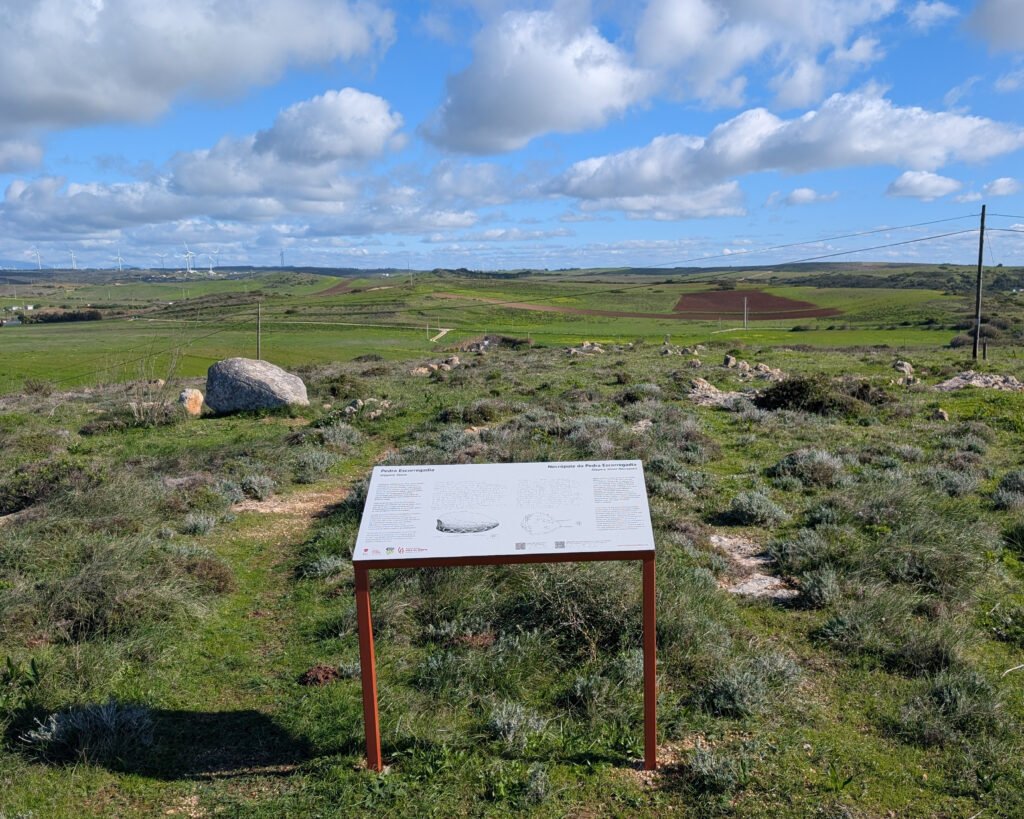
At the top of the hill, there’s an information board with descriptions of the menires and the tomb.

Links
- Article about the menires (in Portuguese) from Wikipedia
- Entries (in English) in the Megalithic Portal
- Blog posts (in Portuguese) by archaeologist Ricardo Soares
- 3D models (no language) by Luis Câmara on Sketchfab
- VIdeo (no language) of the tomb during the 2nd excavation in 2019, by the Vila do Bispo Museum
- Video (in Portuguese) by RTP from 1985 showing various menires (including Pedra Escorregadia)
- Map, “À Descoberta dos Menires – Roteiro do Monte dos Amantes” (in Portuguese) from Town Hall of Vila do Bispo
- Description (in Portuguese) from Archaeologist’s Portal of Directorate-General of Cultural Heritage
- Designation (in Portuguese) as being “in the process” as a Property of Public Interest by the Directorate-General of Cultural Heritage
- Entry (in Portuguese) in the database of the Directorate-General of Cultural Heritage
Nearby
The Cromeleque de Amantes 1 is a short walk (about 600m along a dirt road) from the site. The museum in Vila do Bispo (“Celeiro da História”) is an excellent source of information, including maps of the route.
Sources
- GOMES, Mário Varela, SILVA, Carlos Tavares da e MARTINS, Isilda Maria Pires (1987). Levantamento arqueológico do Algarve: concelho de Vila do Bispo. Lisboa: Delegaçao Regional do Sul. S.E.C. https://www.academia.edu/124029507/Levantamento_arqueol%C3%B3gico_Vila_do_Bispo Accessed 15 January 2026. ↩︎
- Gomes, Mário Varela. “Megalitismo Do Barlavento Algarvio – Breve Síntese.” Setúbal Arqueológica, vol. 11-12, 1997, pp. 147–190, maeds.amrs.pt/publicacoes/setubal-arqueologica#faq-9. Accessed 14 Jan. 2026. ↩︎
Pingback:Cromeleques de Amantes - Prehistoric Portugal