
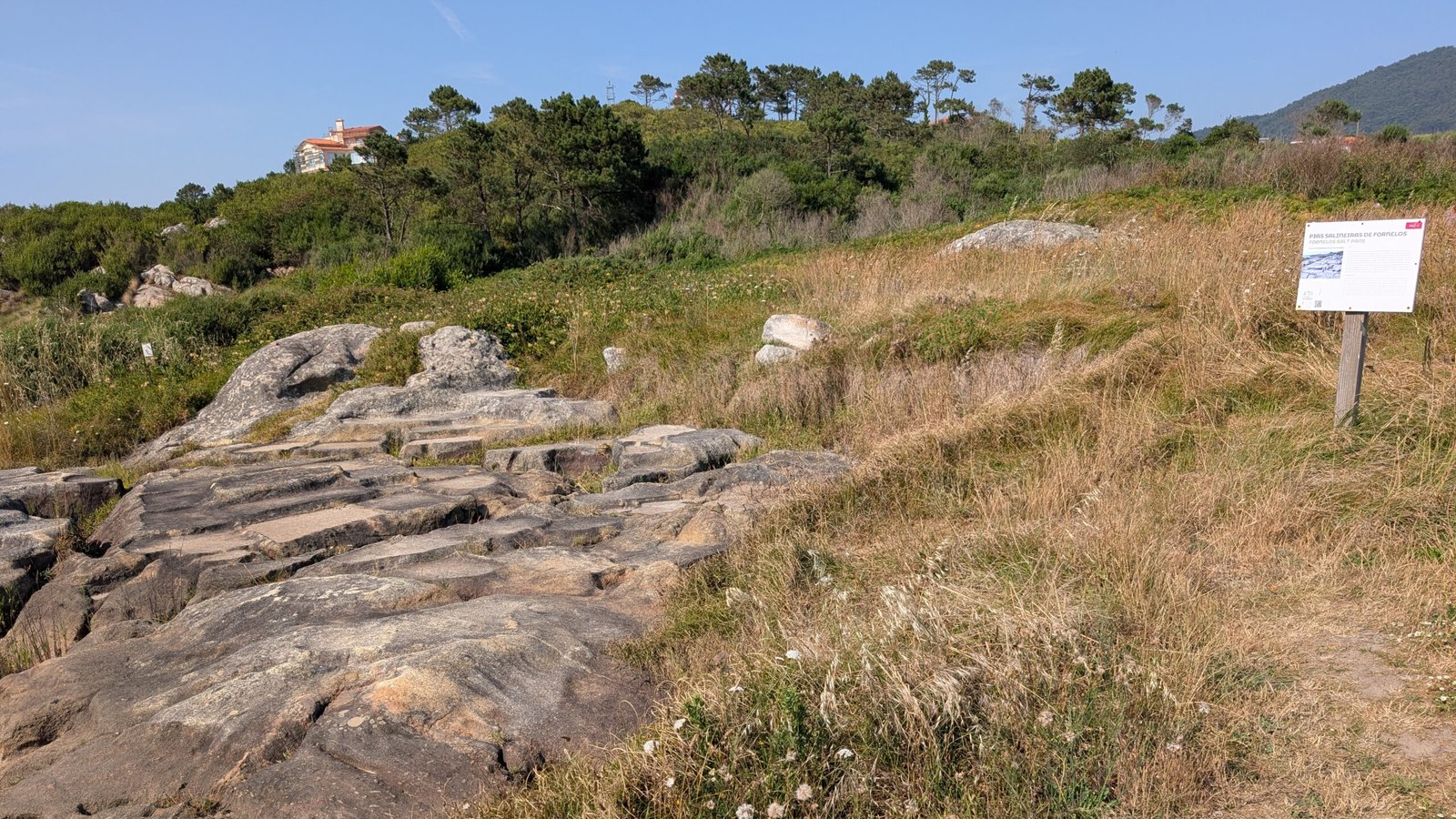

Also known as: Salinas de Fornelos English name: Salt pans of Fornelos
Walking around a beach area that’s filled with boulders, cliffs, and more, it’s very easy to ignore some of the rocks. But do at least look more closely at any that seem out of the ordinary. Ignore these oddly-shaped stones and you’ll miss thousands of years of human use!
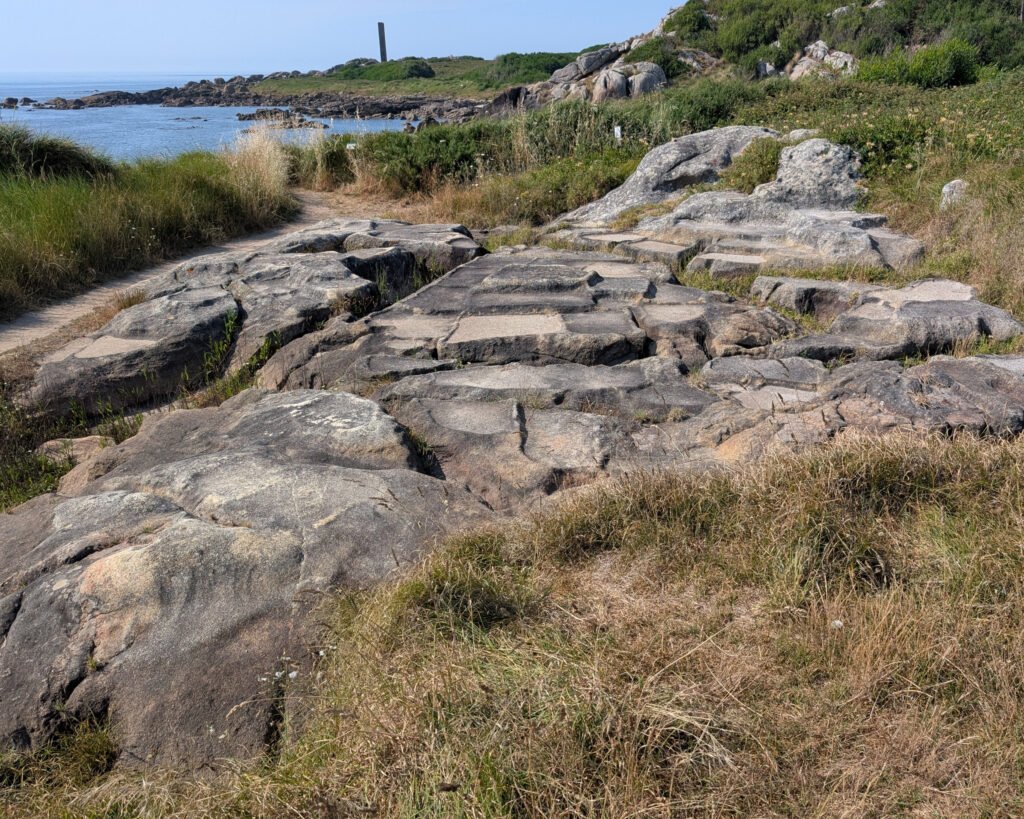
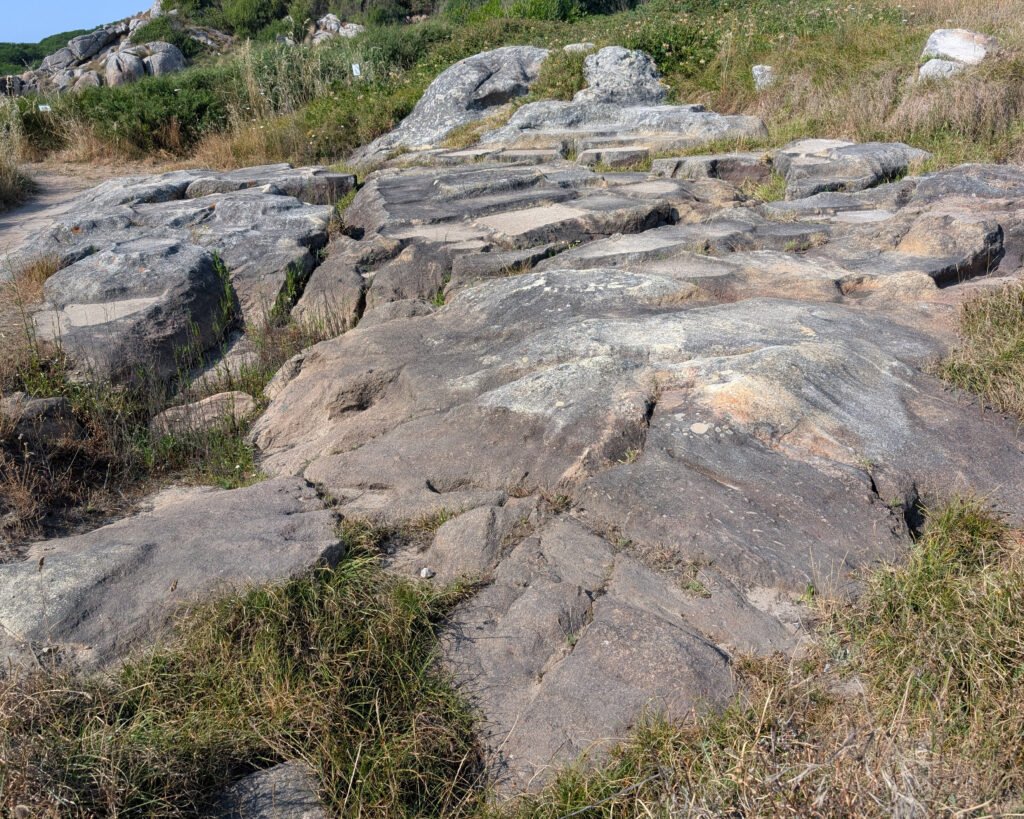
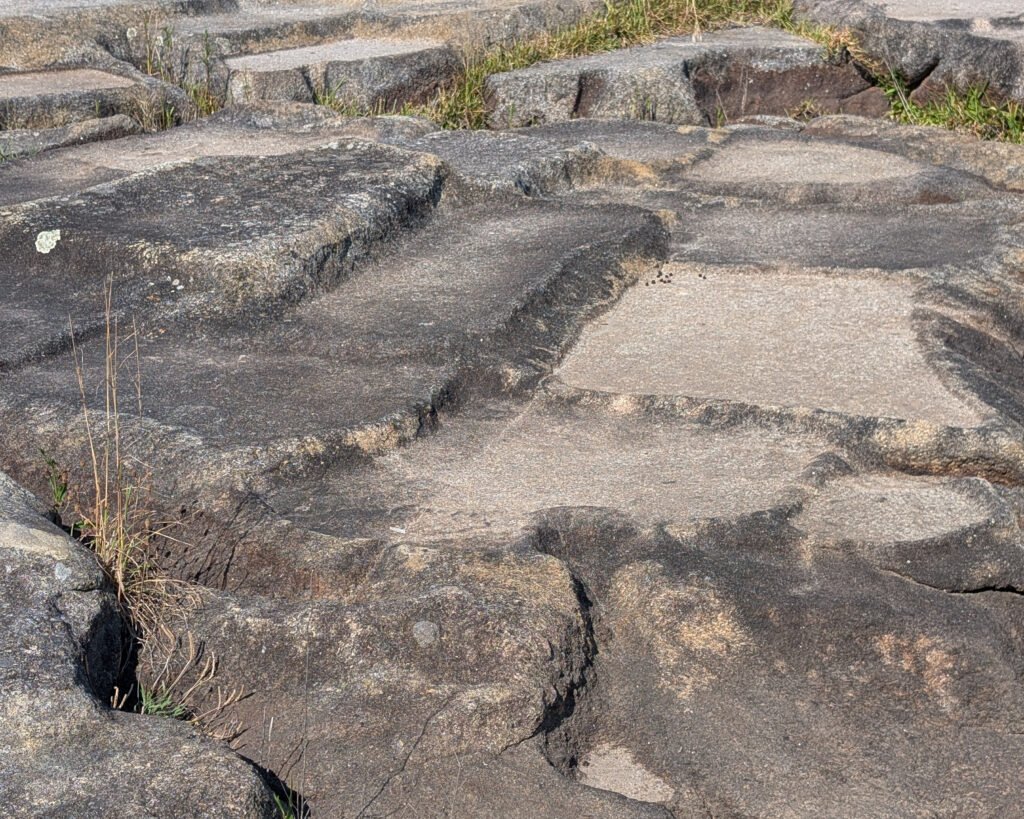
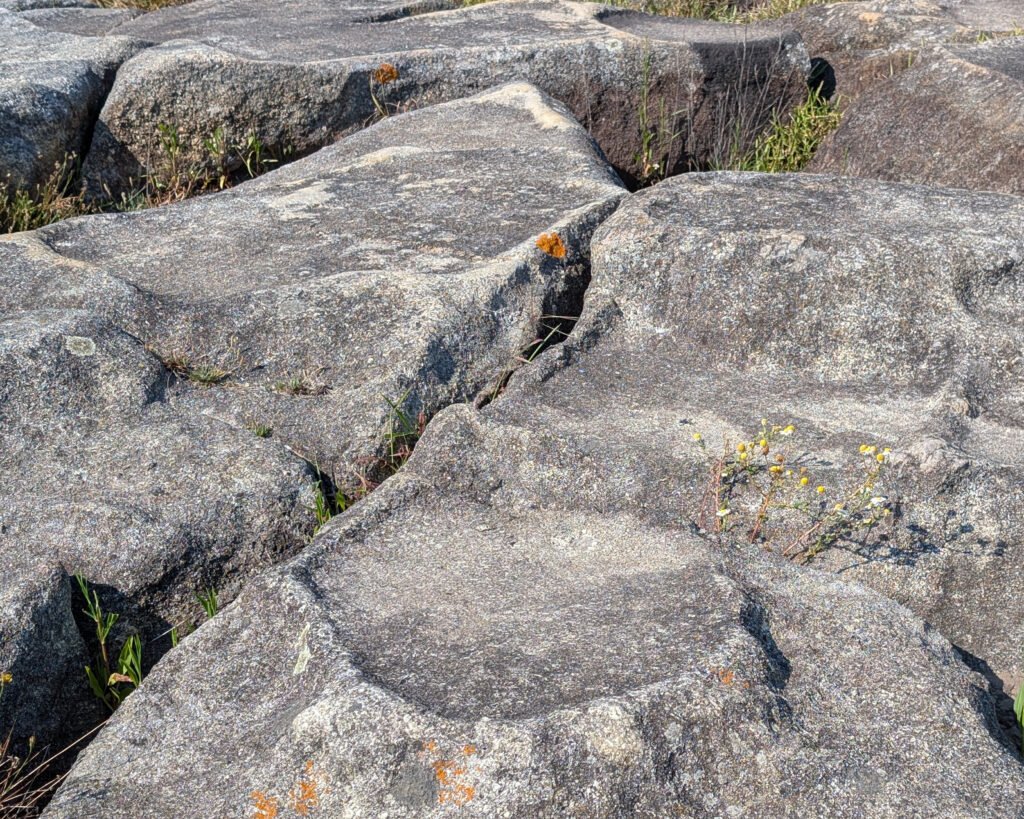
These carved stones are called pias salineiras (“salt pans” or literally “basins of the saltworkers”) or salinas (“saltworks”). The flat areas were shaped to hold seawater, which then would leave the salt when the water evaporated. The use of salinas during the Iron Age is well documented1, and portable pans have been found in several castros (Iron Age hillforts). There is also some evidence2 that salt pans had been used during the Bronze Age. They very likely would have also been used through the Roman period …and maybe into more recent times.
These salinas are located just above the high tide line, so they were probably filled manually. There are several castros in the area that may have used them (one in Montador, the hill beside this beach). The large Cividade de Afife/Âncora, about 6km away, was also probably an important consumer of the salt.
This area is also a local Natural Monument, the Montador Cliff (Alcantilado de Montador). The formation of the Montador cliffs and hill, as well as it being a “cemetery of ancient beaches,” makes this an interesting locale in geological terms.
Location
These salt pans are in the far north of Portugal, in the Minho just south of Spain. They are in the district of Viana do Castelo, near the town of Carreço. They are located just south of the beach of Fornelos, north of the Carreço beach.
Coordinates: 41.746941, -8.876777
Access
You can drive pretty close to the site, and then walk a short way. It’s fairly easy walk along a limited access road to Fornelos Beach.
Signage
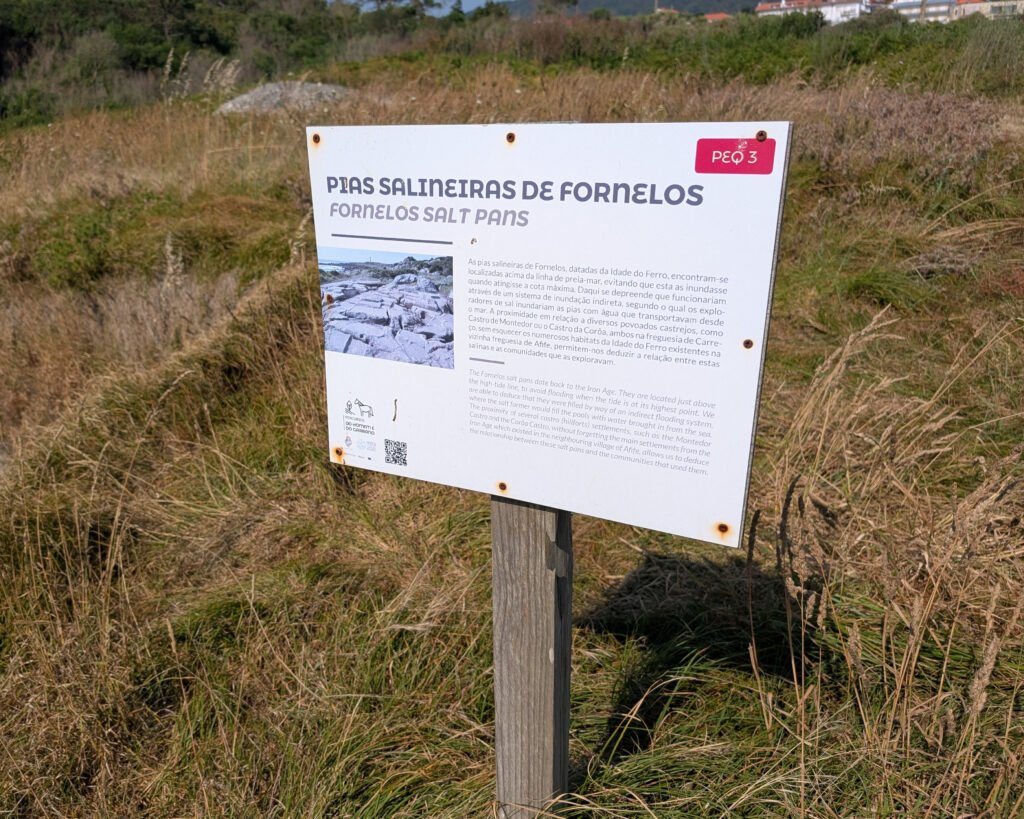
There are road signs directing cars to the Praia de Carreço. From there, head north to Fornelos. When you reach the end of the road, there is a wide, flat path (it’s a road with limited access) that heads north towards Fornelos. At the end of this road, you’ll see the salt pans, with an informative sign.
Links
- Description (in Portuguese or English) by Geoparque Litoral de Viana do Castelo
- Description of the Natural Monument (in Portuguese or English) by Geoparque Litoral de Viana do Castelo
- Description (in Portuguese with many languages) from the Câmara Municipal (Town Hall) of Viana do Castelo
- Article (in Portuguese) from Olhar Viana do Castelo
- Video (in Portuguese) by CMIA (Center of Monitoring and Interpreting of Environment) of Viana do Castelo (which includes demonstrations of how the salt was collected)
Nearby
There are several sites in the area with rock engravings, collectively known as the Gravuras Rupestres de Montador or Gravuras Rupestres de Carreço. The nearest are the engravings of Fornelos, which are on a rock across the small Fornelos beach from the salt pans.
The archaeological museum in Afife has a portable salina on display, as does the Casa dos Nichos in Viana do Castelo. There is also a salina in the rocks on the hill of the Castro de Santo António in Afife.
Sources
- Bettencourt, Ana M. S., et al. “A Exploração de Sal No Noroeste de Portugal Durante a Proto-História. Novos Dados E Interpretações.” Exploração Histórica Do Sal: Um Mineral Comestível, Rio Maior – Portugal, Atas do IV Congresso Internacional do Sal, 2025, pp. 137–148, https://www.researchgate.net/publication/398275475_A_EXPLORACAO_DE_SAL_NO_NOROESTE_DE_PORTUGAL_DURANTE_A_PROTO-HISTORIA_NOVOS_DADOS_E_INTERPRETACOES. Accessed 29 Aug. 2026. ↩︎
- BETTENCOURT, A.M.S.; LUZ, S.; OLIVEIRA, N.; SIMÕES P.P.; ALVES, MIC; ABAD-VIDAL. E. (2020). “Produção de sal marinho na Idade do Bronze do Noroeste Ibérico. Alguns dados para uma reflexão”, in J.M. Arnaud; C. Neves; A.Martins (eds.), Arqueologia em Portugal 2020 – Estado da Questão. Lisboa: Associação dos Arqueólogos, 987- 1000. DOI: https://doi.org/10.21747/978-989-8970-25-1/arqa71 Accessed 29 Aug. 2026. ↩︎