
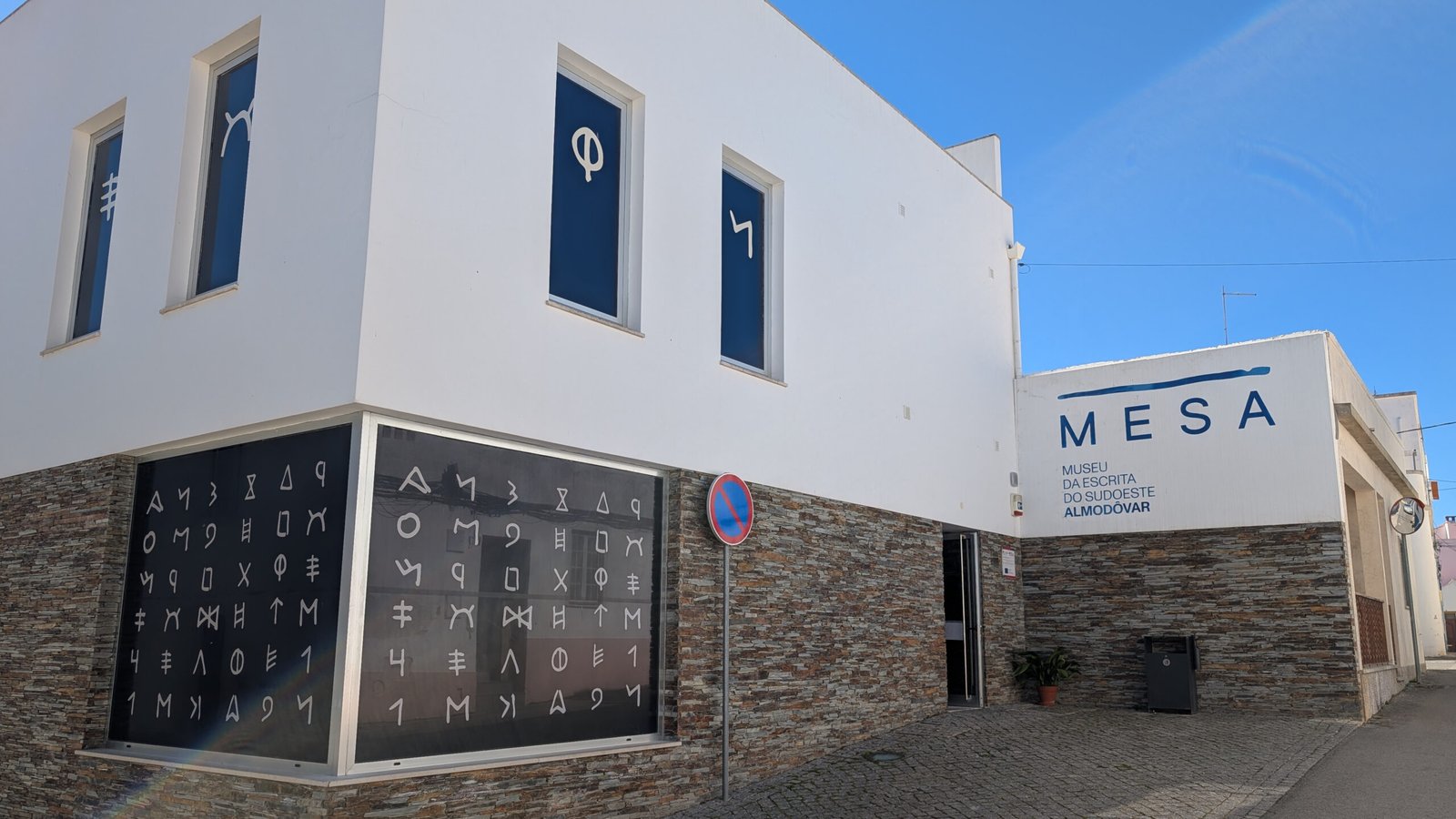

Portuguese: Museu da Escrita Sudoeste de Almodôvar (MESA)
The characters tease you: they look familiar, and they obviously convey a message. What is it? It’s impossible to say. Someday we may decipher all the symbols, but for now they remain enigmatic, leaving us to wonder at the people who lived here before the Romans.
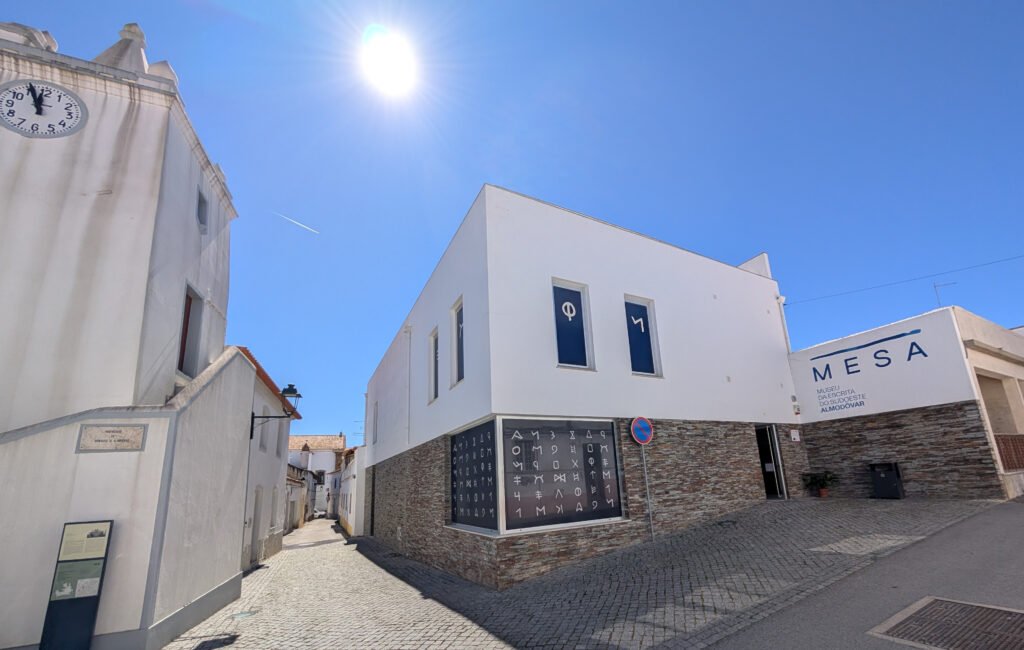
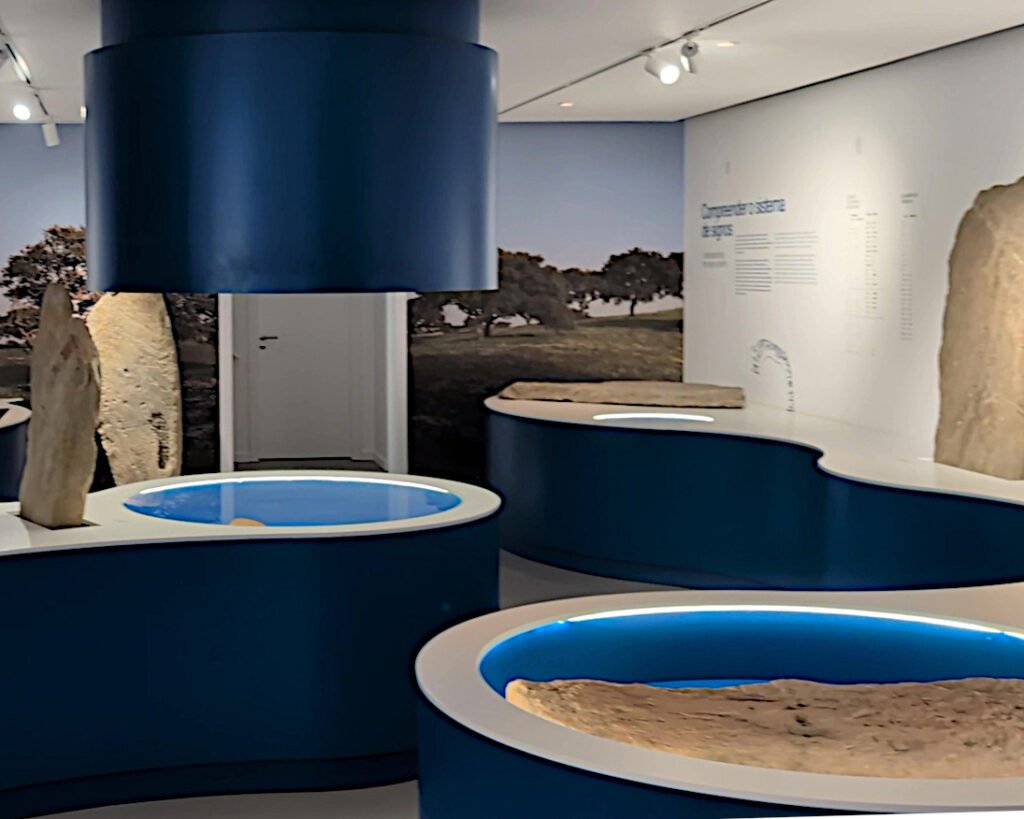
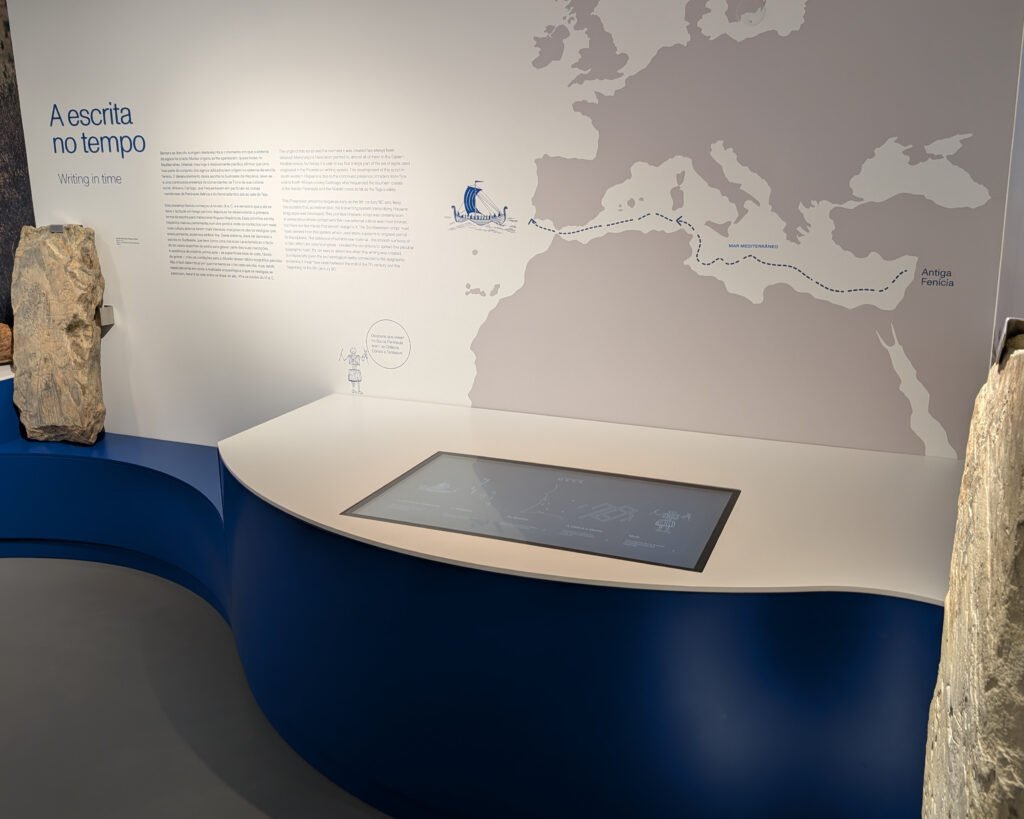
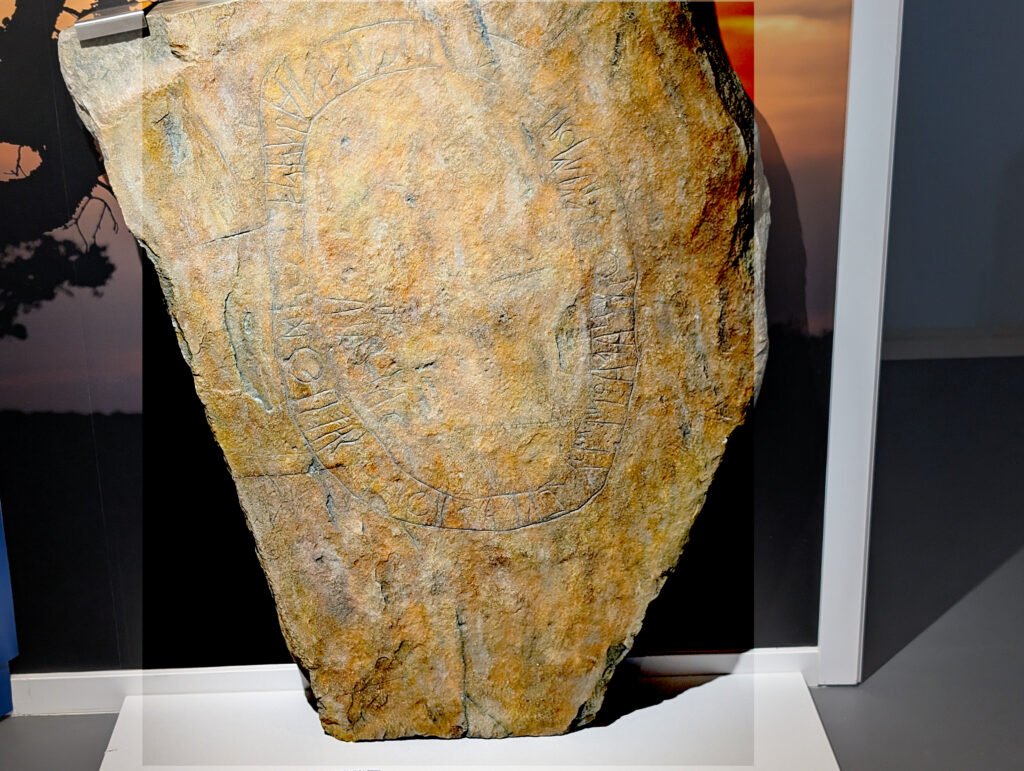
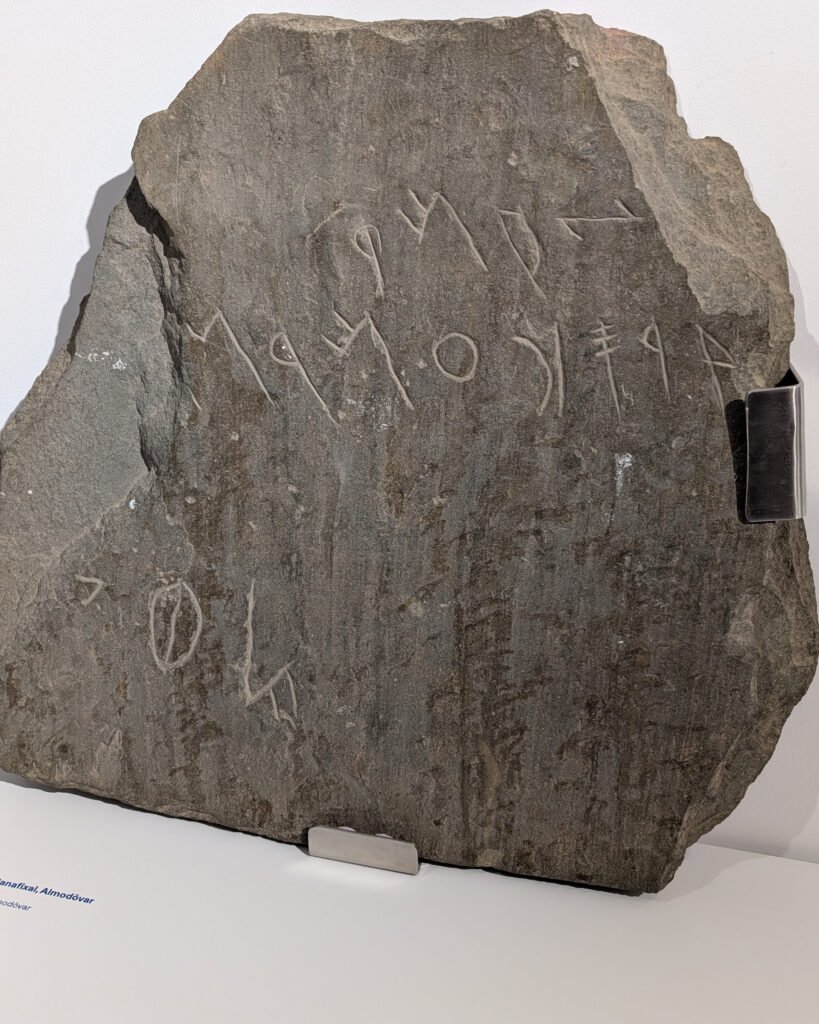
This museum is in a beautiful, recently renovated, modern building in the centre of Almodôvar’s historic heart. It is beautifully laid out and tells the story of the writing while displaying many examples of the script (including both original and replicas). It’s clearly presented in both Portuguese and English, and includes interactive touchscreens, a short movie, and more. The museum is designed to present not only the writing, but also its context in the Alentejo countryside. It’s a centre of study as well, promoting further exploration of the script.1
The Southwestern Script (Escrita do Sudoeste)
The Southwestern Script is one of three main writing systems used in the Iberian Peninsula from the end of the Bronze Age through the Iron Age to the time of the Roman occupation. The usual dating is from 800-400 BC, but many of the stone inscriptions were discovered out of context and therefore may have been engraved much earlier. They were used to record local languages spoken in the area before the Romans conquered the area and brought in written and spoken Latin.
The Southwestern script is sometimes referred to as “South Lusitanian” or “Tartessian” (or given other names based on ethnic groups living in the area that is now Portugal), but it is properly designated the Southwestern script as evidence for it is found exclusively in the southwestern area of the Iberian Peninsula (almost exclusively within the Alentejo and Algarve) and it is unclear how it may be connected to any ethnic group in the area2.
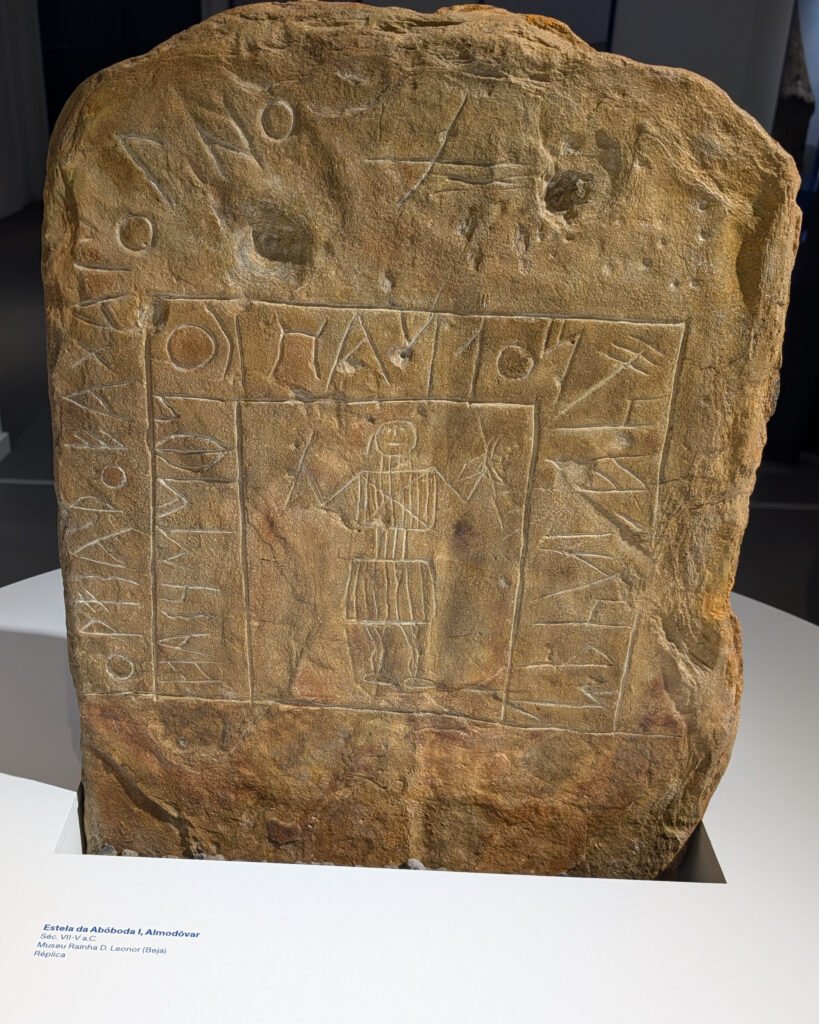
Most examples of this script is found on stone stelae3 (“estelas” in Portuguese), slabs designed to be used as funerary monuments, presumably as markers of graves or monuments to individuals who had died and were entombed or buried there. This is not definitely known, as their exact archaeological context is usually not known, but many have been found in or near funerary structures.
The display of the stele of Abóboda I (replica), below, shows how the stone would have been originally erected, with the bottom part buried in the ground.
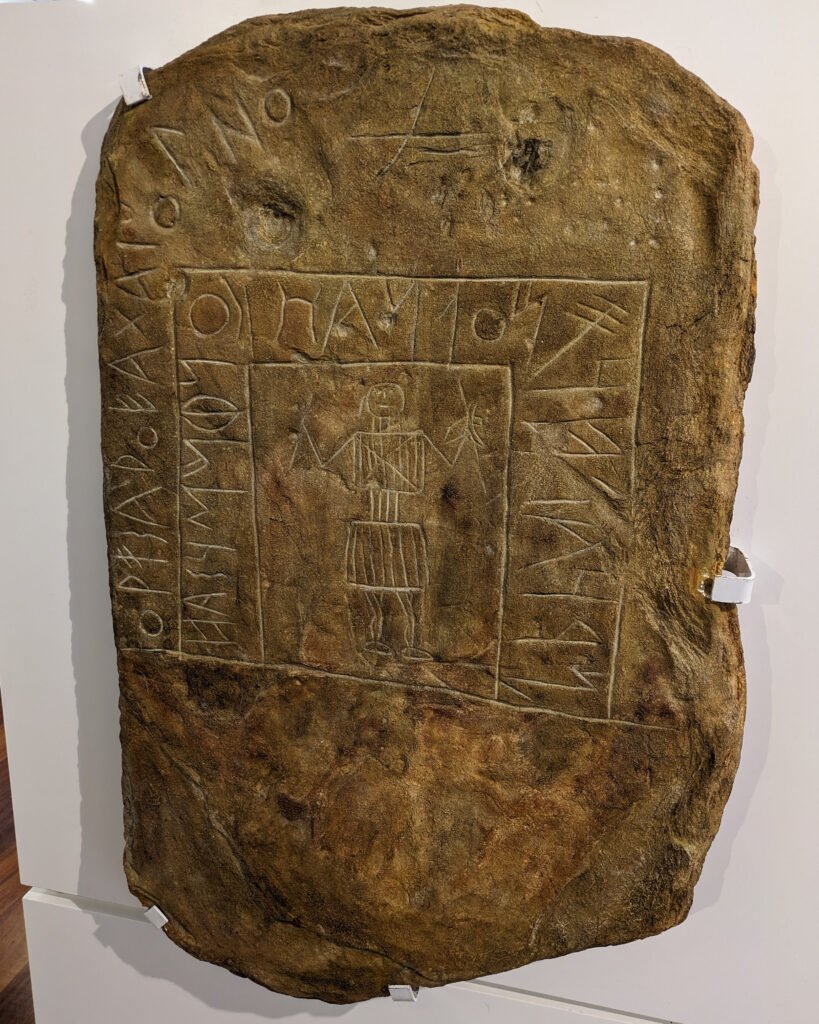
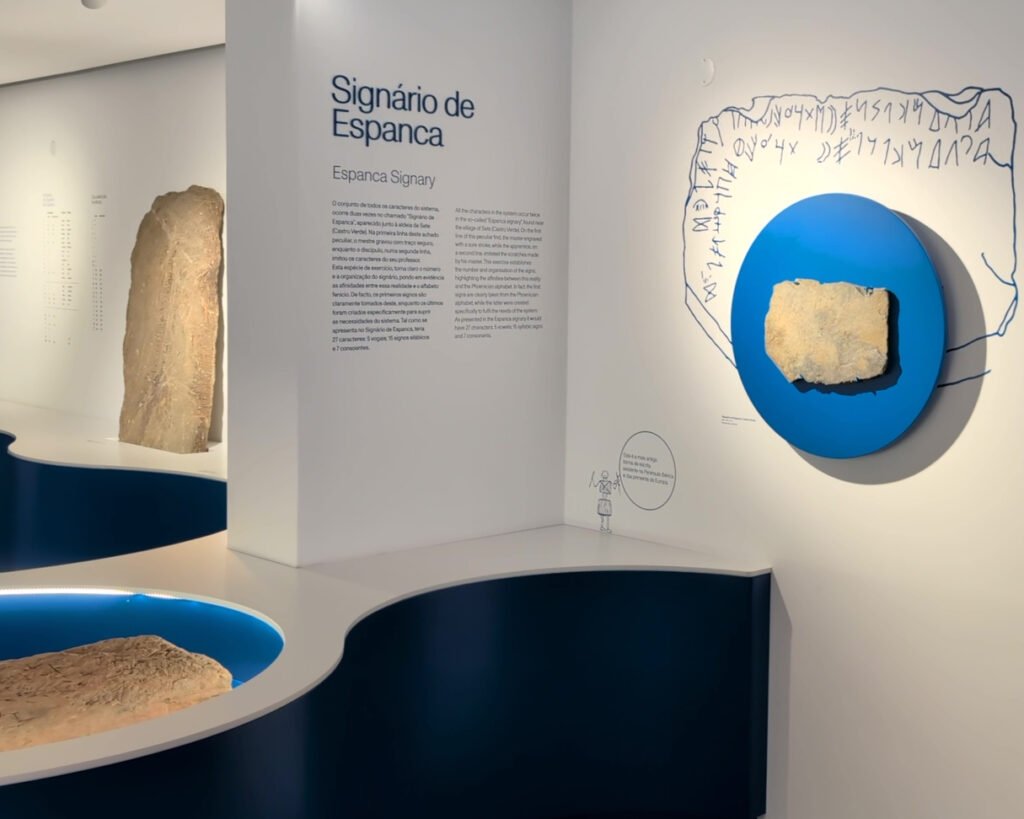
The writing itself was sometimes written left to right, but sometimes went the other way. It’s often inscribed within straight lines, and only occasionally are separations between words used. The writing has not been fully decoded, but there is a stone, the “Signary (or Table) of Espanca” (found in Castro Verde, north of Almodôvar), shows two lines of characters written right to left. The top line is neat and regular, while the bottom line is less even: this is interpreted that a master scribe made the top line and a student copied that below. This seems to be an “alphabet” of the language …although some signs are seen in stelae but not here. Some researchers state that this indicates that the Espanca signs may not be specific to the Southwest Script.4
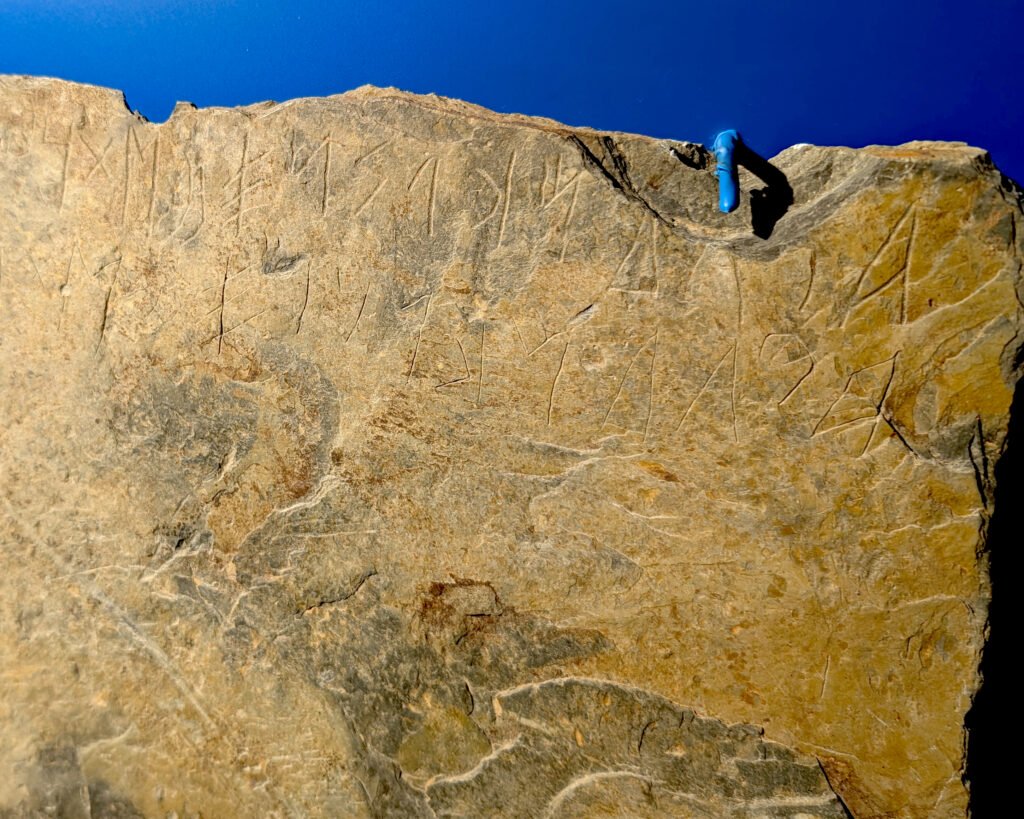
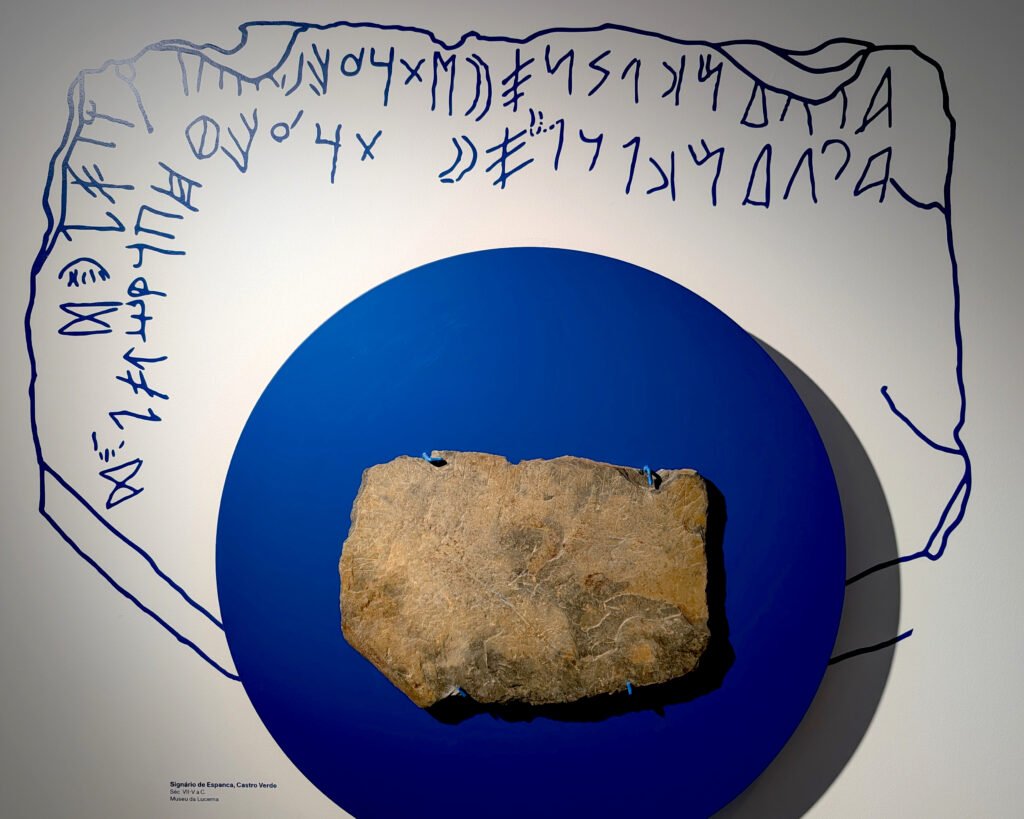
The signs in the writing seem to have an origin with the Phoenician alphabet. There are some additional signs as well: note that the term “signs” is frequently used, rather than “letters,” because this system of writing seems to be a syllabary (or semi-syllabary) in which symbols represent syllables rather than individual sounds. (If you are interested in the details of how the language may have been structured, I suggest you read Miguel Valério’s paper – linked below.)
While several of the signs in the Southwest Script have been deciphered (largely through their similarity to Phoenician letters), not all of them have been. There are not enough examples of the writing (only around 100 or so) to fully decipher all the signs, and therefore the stelae are (currently) not able to be read.
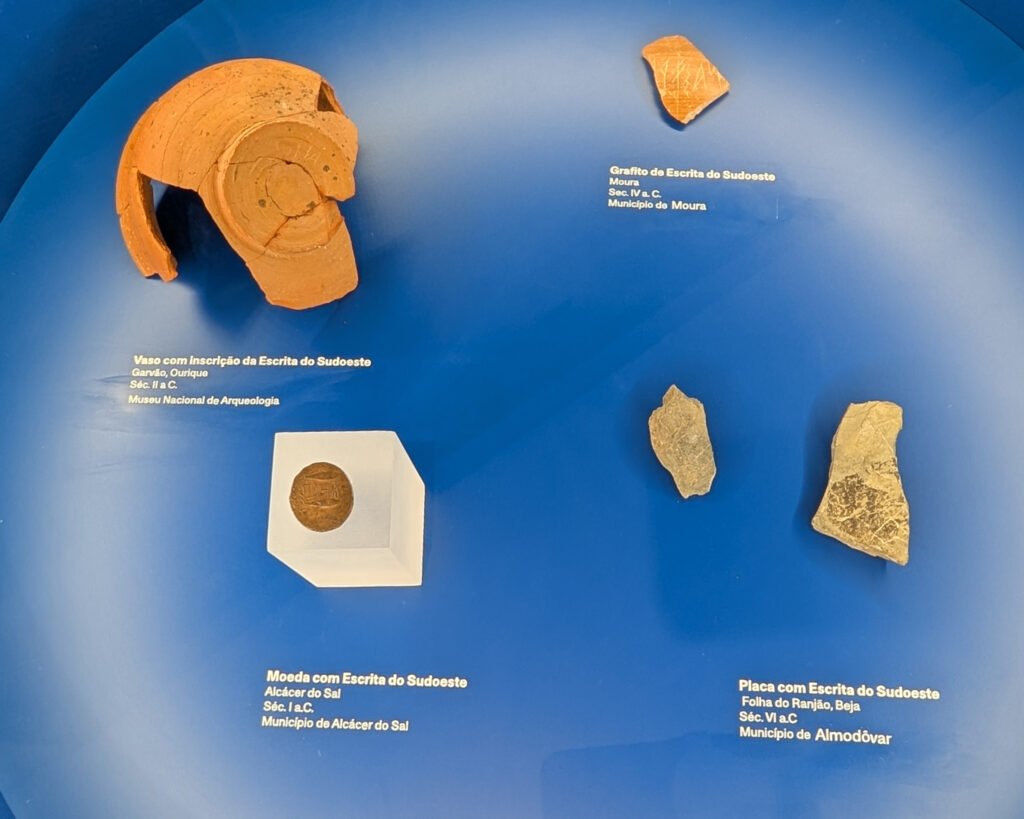
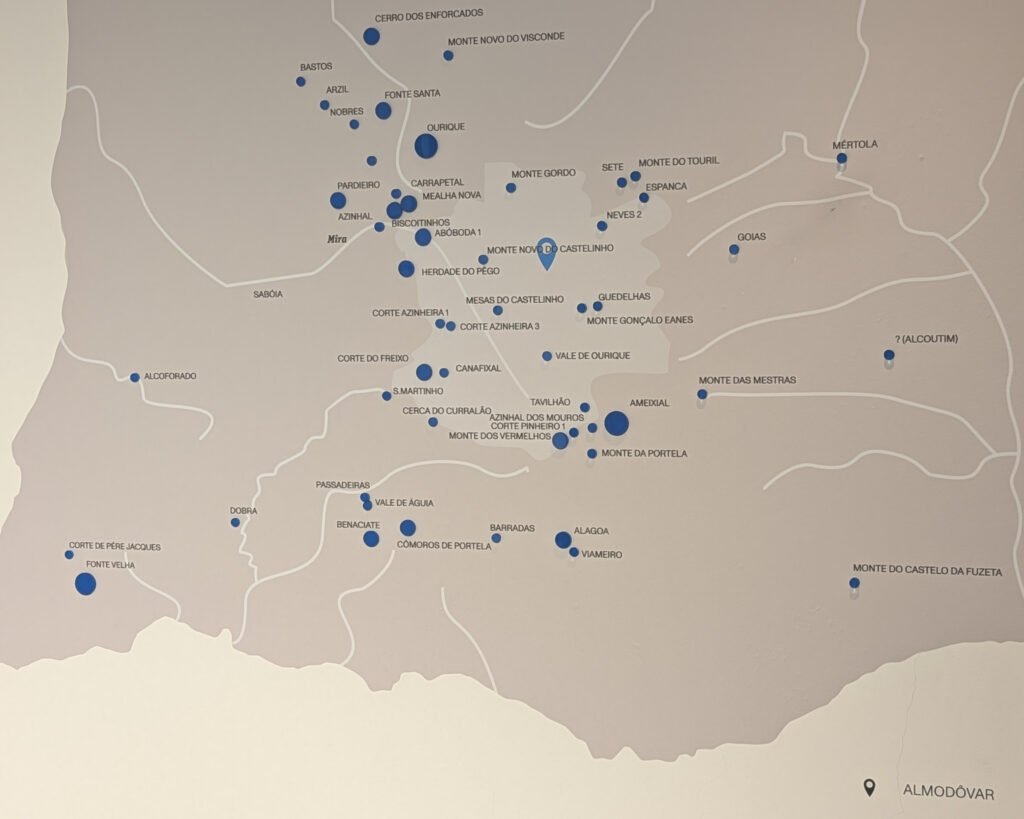
A few examples of the script are found on ceramics and even a coin. These smaller objects have sometimes been found further away, but nearly all the stelae have been found in the Almodôvar region, as the map shows.
Location
The museum is in the southern Alentejo, in the district of Beja. It’s in the municipality of Almodôvar, in the centre of the city itself. It’s in a modern building at 32 Rua do Relógio, right next to the Relógio (the clock tower).
Admission
Admission is free. The museum is open 10:00-17:00 in the winter, and 10:00-18:00 in the summer. It is closed on Mondays.
Signage
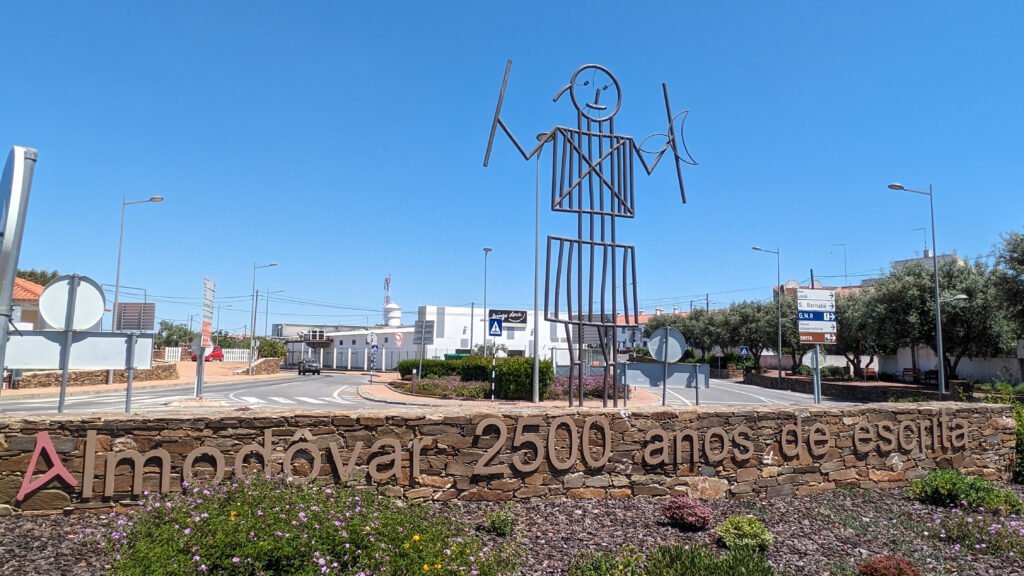
There are signs throughout the town pointing the way to the museum. You can drive to the museum, but the roads are narrow and parking is limited. It’s far easier to park somewhere on the outskirts of town and walk there.
Links
- Article (in Portuguese) from Wikipedia about the museum
- Article (in English) from Wikipedia about the Southwest Script
- Details (in Portuguese) about the museum from the town hall of Almodôvar
- The Facebook page for the Museum
- Information and video (in Portuguese) from Ensina RTP
- Article (in Portuguese) about the museum from National Geographic Portugal
- Description (in English) of the script from Omniglot
Nearby
The Iron Age archaeological site of Mesas de Castalinho is about 12km out of town, westwards towards the A2 motorway. There is also the huge Archaeological Circuit of Cola (with 15 sites from the Neolithic to the Middle Ages), about 35km eastwards, on the other side of the A2, towards Ourique.
Sources & notes
- “Aqui começa a nossa história” (Museum Guidebook), MESA: Museu da Escrita do Sudoeste, Almodôvar ↩︎
- Valério, Miguel. “Origin and Development of the Paleohispanic Scripts: The Orthography and Phonology of the Southwestern Alphabet.” Revista Portuguesa de Arqueologia, vol. 11, no. 2, 2008, pp. 107–138, dialnet.unirioja.es/descarga/articulo/3339686.pdf. Accessed 18 Apr. 2026. ↩︎
- “Stelae” (pronounced “steely”) is the plural of “stele” (prounounced “steeleh”) which is the term for an ancient monument, usually a tall slab of stone or wood, usually with some carvings on it. (See “Stele” in Wikipedia) ↩︎
- Ferrer i Jané, Joan, and Noemí Monculli. “Palaeohispanic Writing Systems: Classification, Origin and Development.” Palaeohispanic Languages and Epigraphies, edited by Alejandro G. Sinner and Javier Velaza, Oxford, UK, Oxford University Press, 2019, pp. 78–108, www.researchgate.net/publication/317226036_Palaeohispanic_writing_systems_classification_origin_and_development. Accessed 26 Apr. 2026. ↩︎