

NOTE: “Dinosaurs” in Portuguese can be either dinossáurios or dinossauros. This site is listed officially as “Pegadas de dinossáurios” but some sites refer to it as “Pegadas de dinossauros.” Also known as: Jazida de pegadas… (“Site of footprints..”)
English name: Dinosaur footprints of Vale de Meios
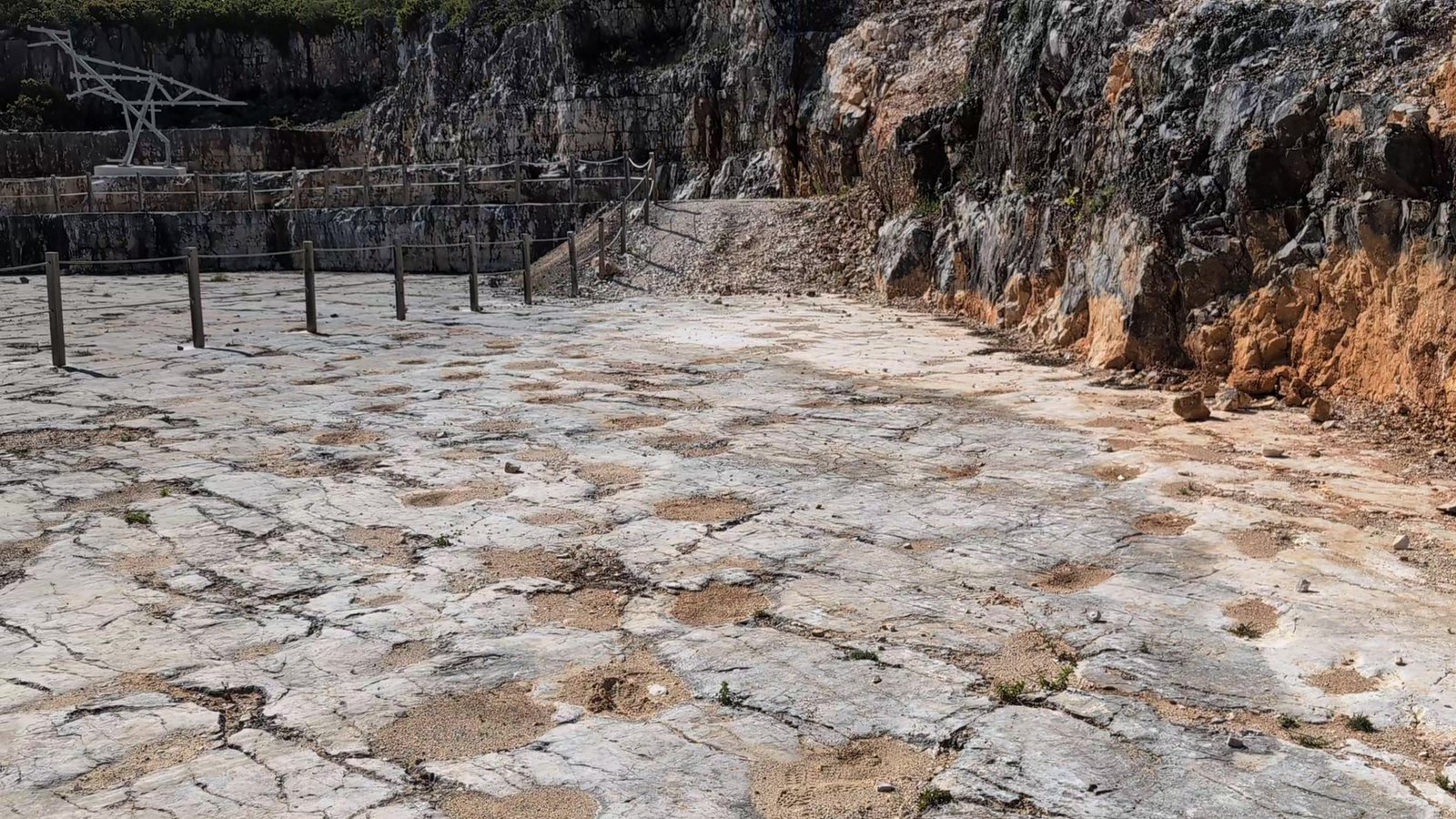
The rock quarry shelf stretches out before you, extending hundreds of meters. Holes in the stone, filled with dirt and with weeds growing in them, make it seem like a strange stony planting box. Look closer, and many of the holes have distinctive shapes, and they seem to be arranged in rows. It soons become clear that you are looking at the fossilized footprints of giant creatures that walked here millions of years ago when this mountainous area was actually the edge of an ocean.
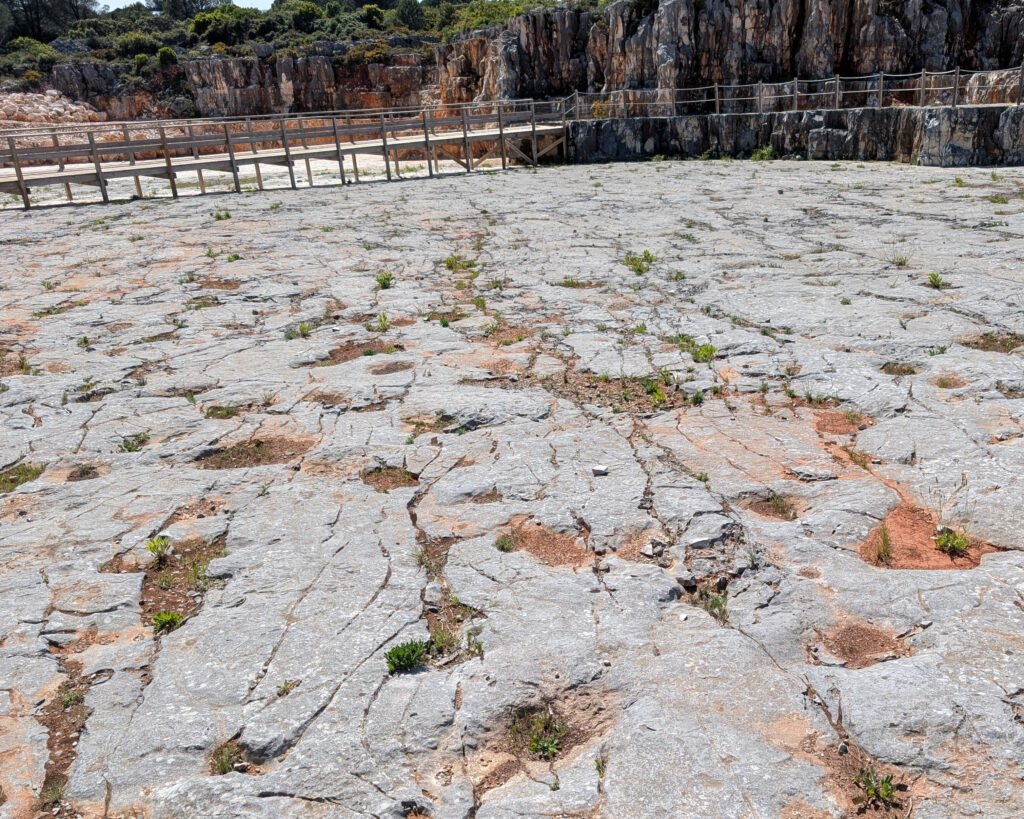
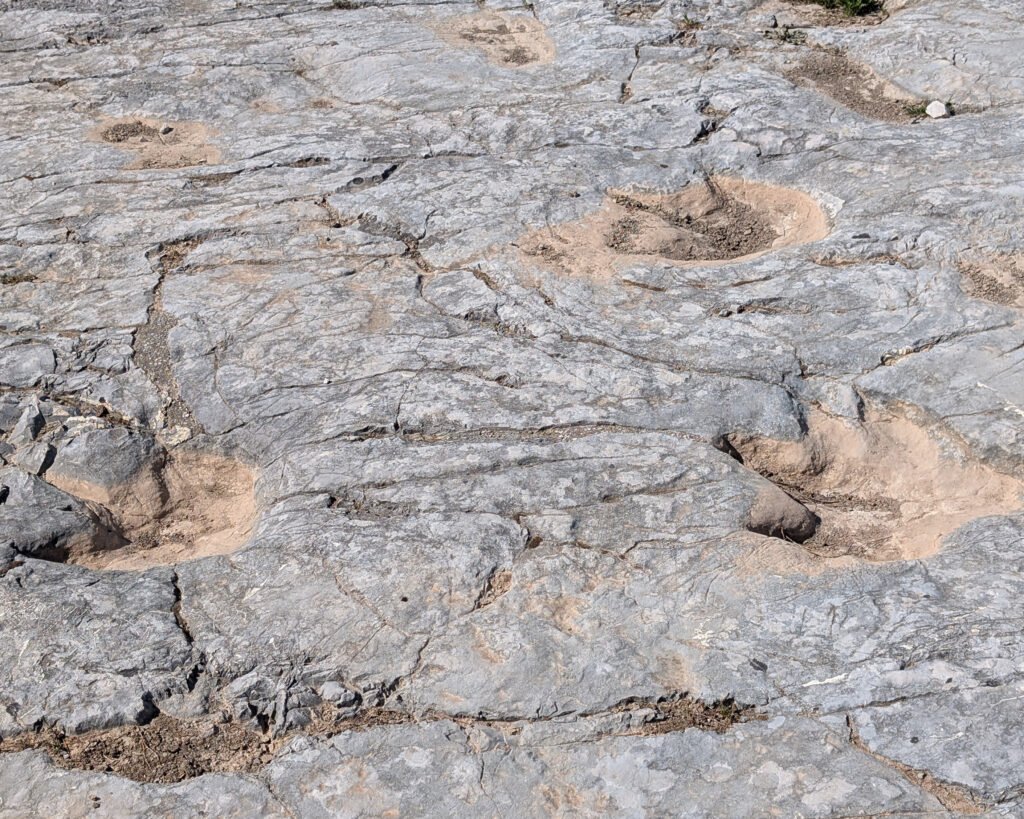
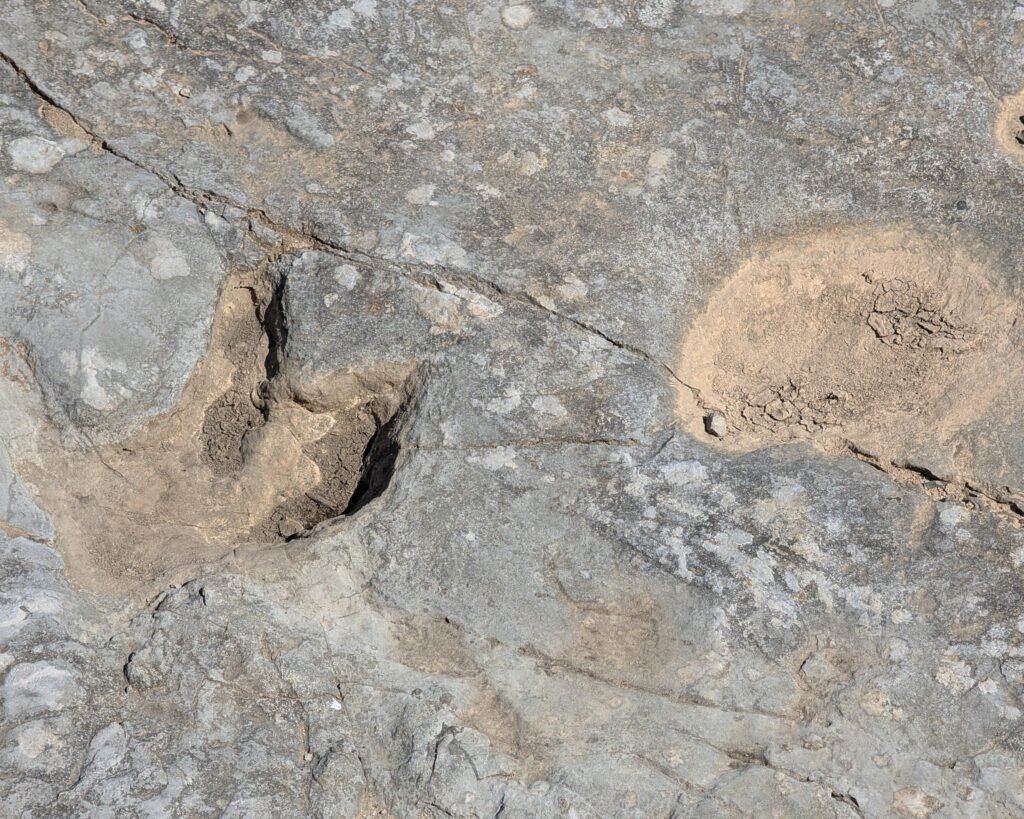
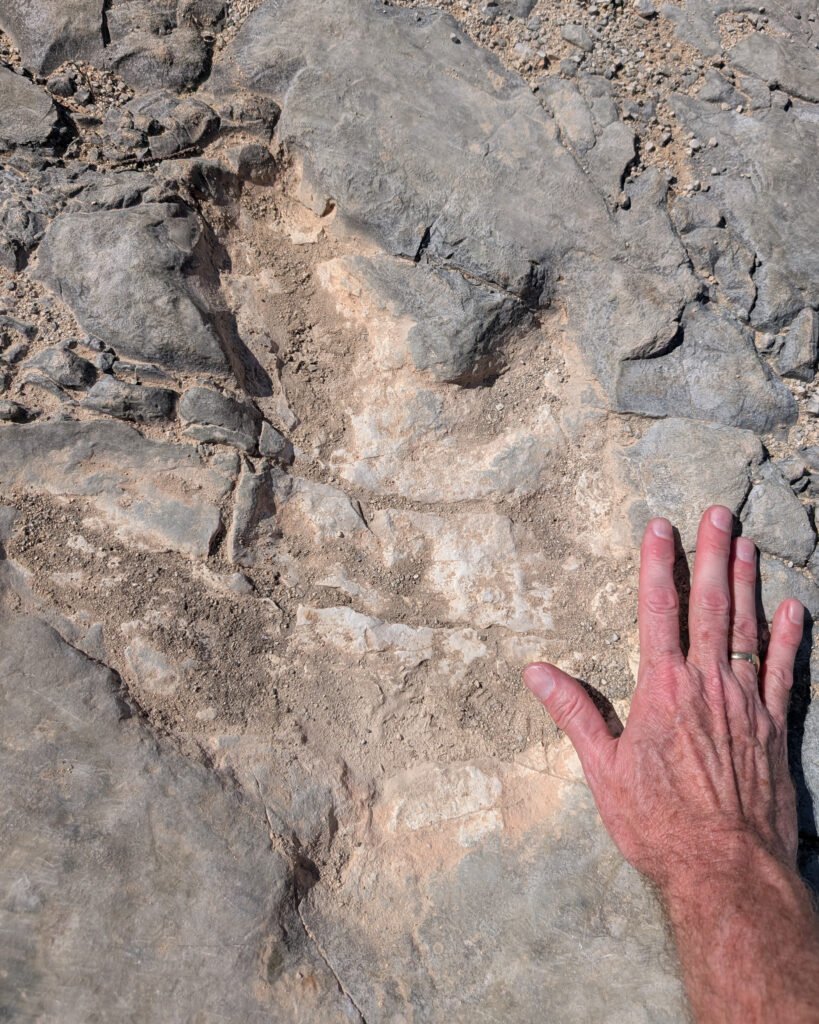
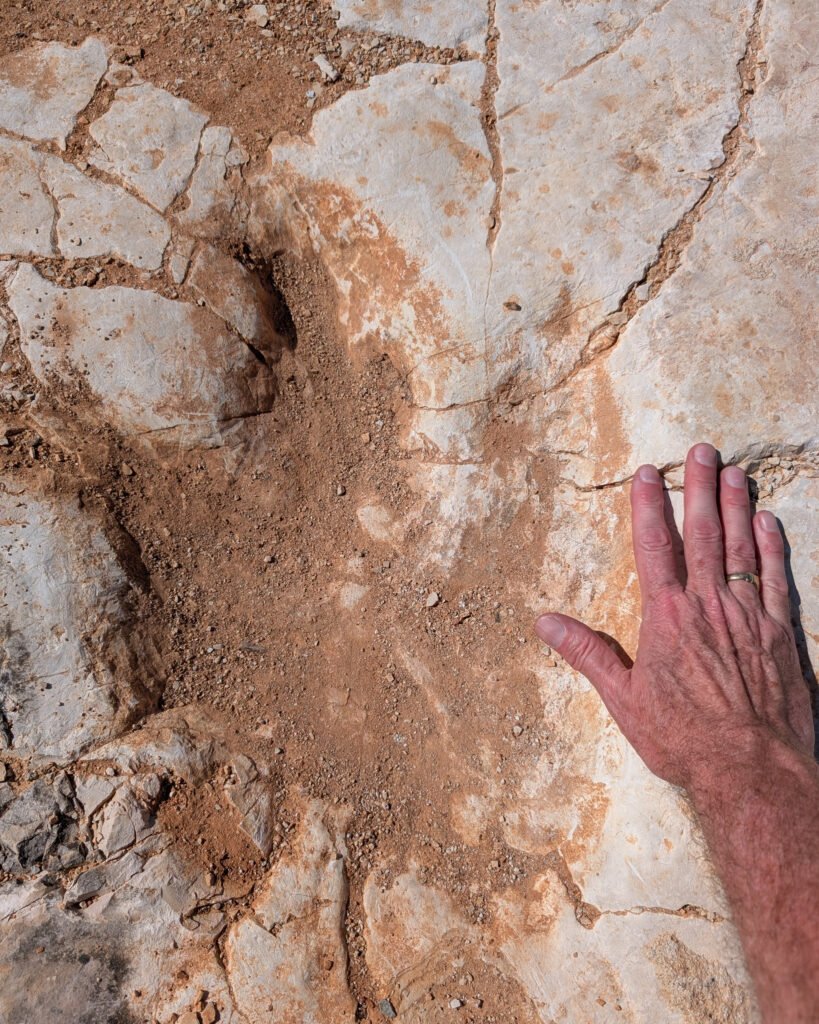
This tracksite was discovered in 19981 in a rock quarry, and has many hundreds of fossilized dinosaur footprints (in Portuguese, “Pegadas de Dinossáurios”) dating to around 170 million years ago, the Middle Jurassic period.
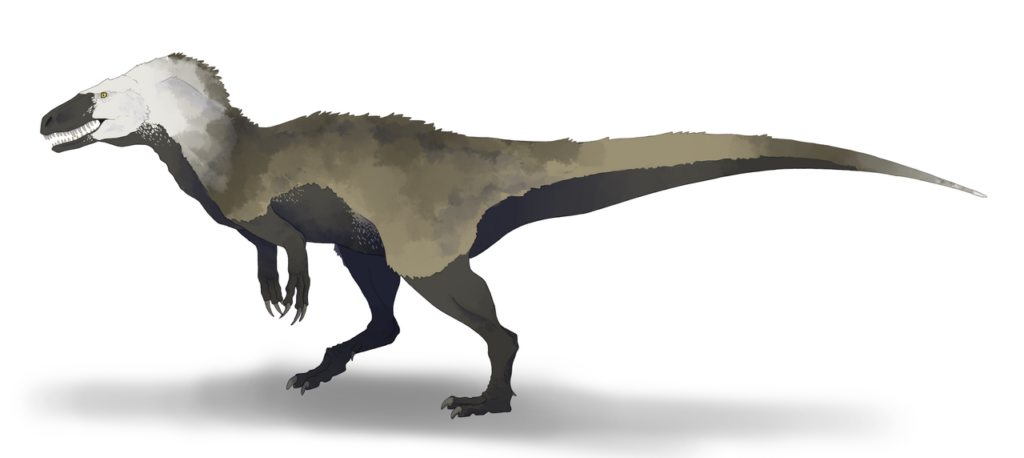
There are more than 700 tracks of theropod dinosaurs (bipedal three-toed carnivorous dinosaurs, such as Allosaurus). These are organized in around 80 trackways. These were formed as dinosaurs walked along a coastal area, leaving tracks in an inter-tidal flat2. The studies show that the dinosaurs were 2-3 meters high at the hip, and moving at about 5-6km/hr. It is not clear what species of theropod these tracks were laid by.
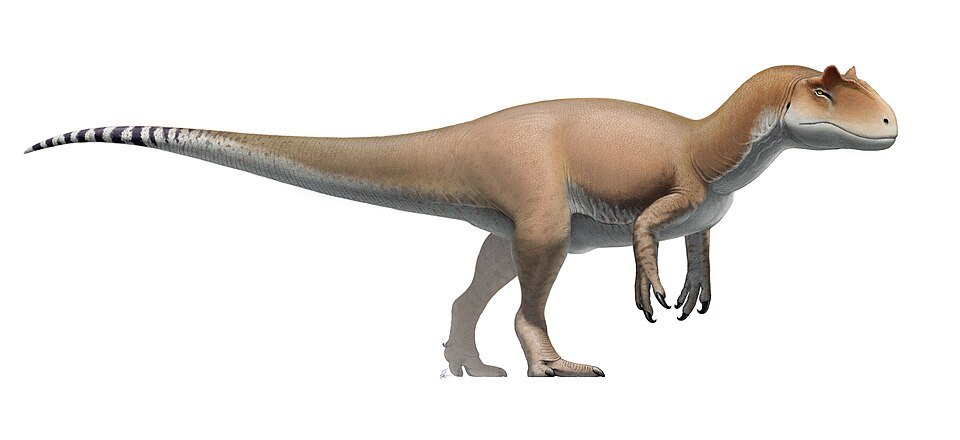
(image by Fred Wierum, CC-BY-SA, Wikimedia Commons)
(image by Audrey M. Horn, CC-BY-SA, Wikimedia Commons)
This is the largest tracksite of theropods in the Iberian peninsula, and is a recognized and listed geological heritage site.
The theropod tracks are also crossed by sauropod tracks (large four-legged dinosaurs).

(image by Alamotitan, CC-BY-SA, Wikimedia Commons)
Note: it is NOT known what exact type of theropods or sauropods made these tracks. The images above are for illustration of what a theropod or a sauropod looks like. The tracks belong to the Middle Jurassic, and the dinosaurs illustrated belong to the Upper Jurassic …there is 20 million or more years between them.
Location
The tracksite is in the Santarém district, in the municipality of Santarém. It’s in the parish of Alcanede. It’s located in the Serras de Aire e Candeeiros, in a quarry about 1km north of the village of Pé da Pedreira.
Protected area: The site is within the Natural Parque of Serras (“Mountains”) de Aire e Candeeiros. Please do not disturb the site or remove fossils from the area.
Coordinates: 39.457728, -8.821078
Access
There is a paved road leading directly to the site. It has been landscaped with a wide parking area – provided by the stone company. There are roped-off pedestrian walkways with stairs crossing the tracksite.
Signage
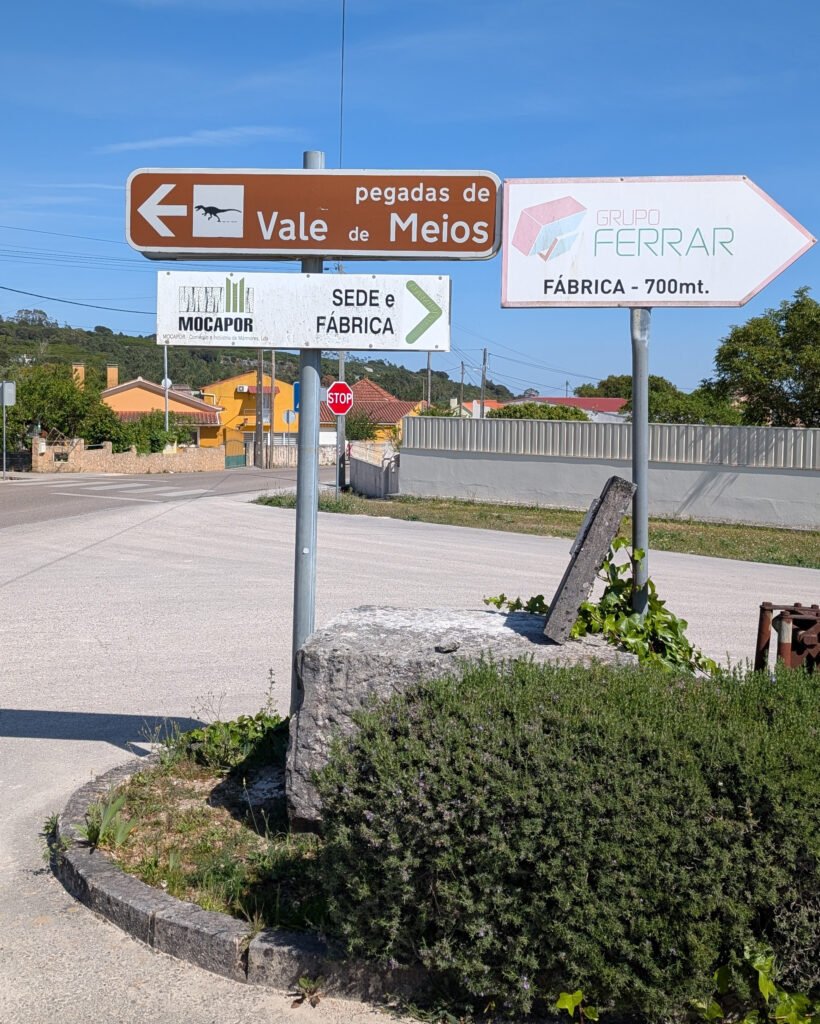
There are signs to the tracksite on the road running through Pé da Pedreira.
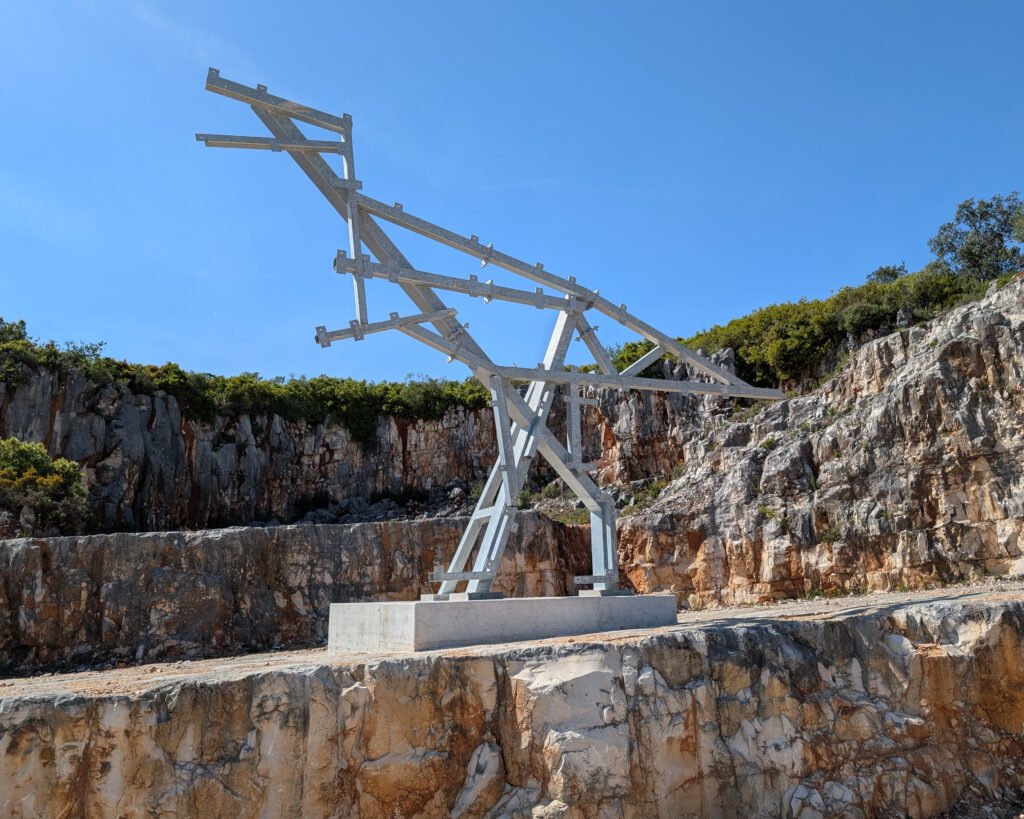
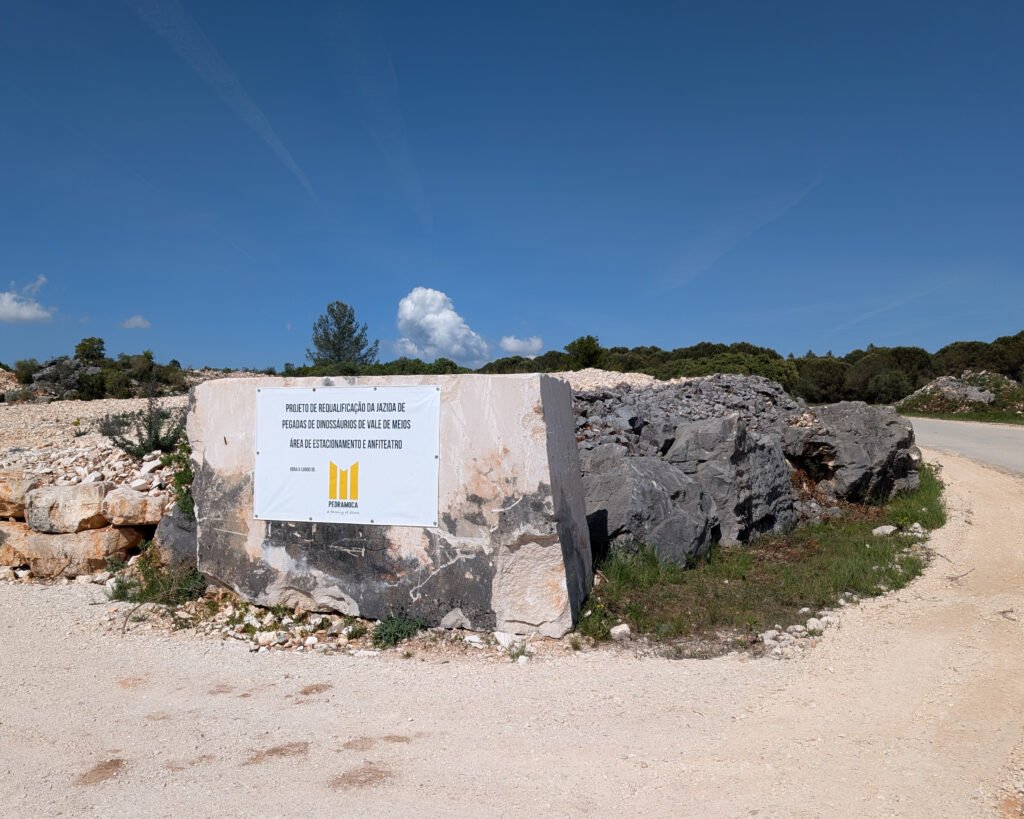
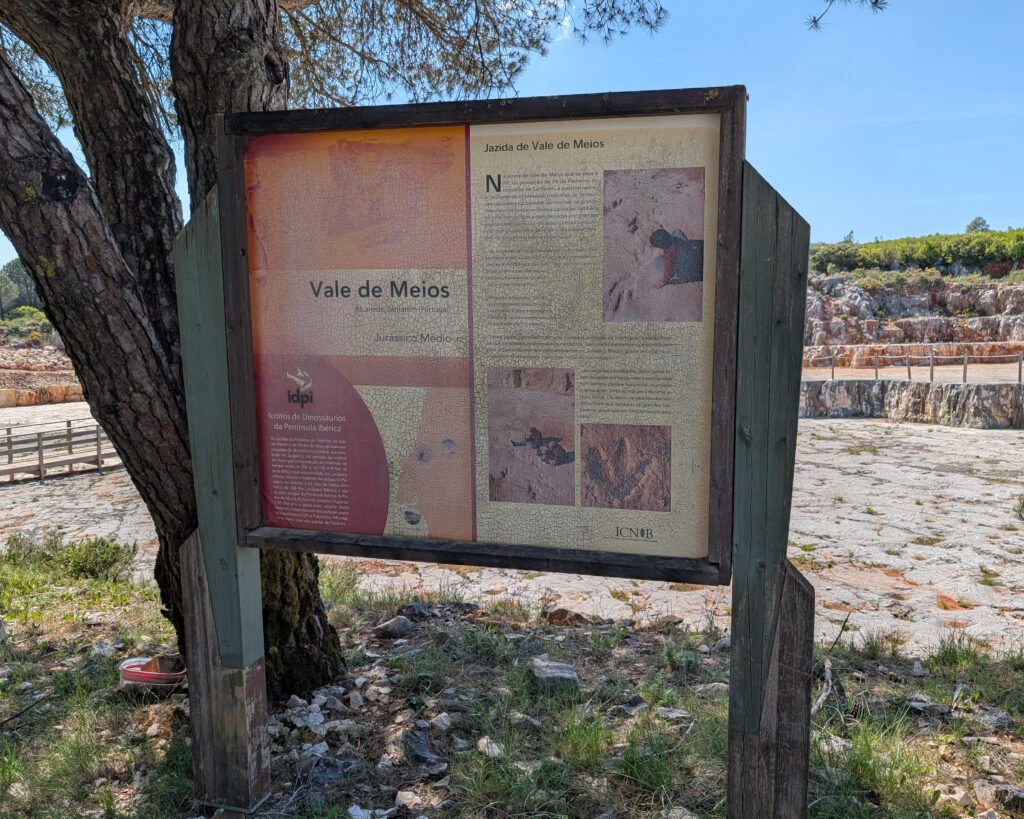
Once you reach the site, there is a sign indicating the car park, and an information sign above the main section of the tracksite.
Links
- Description (in English) from Natural.PT
- Description (in Portuguese) from Serras de Aire e Candeeiros
- Description (in Portuguese) from Portugal em Pedra
- Description (in Portuguese) from the Parish of Alcanede
- News article (in Portuguese) from Público about the discovery
- Video (no language) from Portugal em Pedra
- Description (in English) of the Geoheritage Site by IUGS (International Commission of Geological Sciences)
- Designation (in Portuguese) of the site as a Property of Municipal Interest by the Director-General of Cultural Heritage
- Brief post (in Portuguese) about visitable sites in Portugal from the Lusodinos blog.
Nearby
The Monumento Natural das Pegadas de Dinossáurios, which is the biggest and most famous dinosaur tracksite in Portugal, is about 40km to the northeast, between Ourém and Torres Novas. Within the Serras de Aire e Candeeiros, there is also the Praia Jurássica (Jurassic Beach) – which is fenced off and can only be visited by arrangement – as well as the Dolmen-Chapel of Alcobertas.
Sources
- Firmino, Teresa. “Descobertos Trilhos de Dinossauros Carnívoros Em Portugal.” PÚBLICO, Público, 10 Apr. 2003, www.publico.pt/2003/04/11/jornal/descobertos-trilhos-de-dinossauros-carnivoros–em-portugal-200063. Accessed 19 Apr. 2026. ↩︎
- Lopes, L., Sá, A., Carvlho, J., Mergulhão, L., Cachão, M. & Galopim de Carvalho, A. (2024) Middle Jurassic dinosaur footprints from the Serras de Aire and Candeeiros. In: Abstract book of 37th International Geological Congress 2024, Busan, Korea, 25-31 august, 2024 http://hdl.handle.net/10400.9/4403 ↩︎
- Antunes, Miguel Telles, and Octávio Mateus. “Dinosaurs of Portugal.” Comptes Rendus Palevol, vol. 2, no. 1, Jan. 2003, pp. 77–95, www.sciencedirect.com/science/article/pii/S1631068303000034, https://doi.org/10.1016/s1631-0683(03)00003-4. Accessed 16 Sept. 2020. ↩︎
- Antunes, Miguel Telles, and Octávio Mateus. “Dinosaurs of Portugal.” Comptes Rendus Palevol, vol. 2, no. 1, Jan. 2003, pp. 77–95, www.sciencedirect.com/science/article/pii/S1631068303000034, https://doi.org/10.1016/s1631-0683(03)00003-4. Accessed 16 Sept. 2020. ↩︎
- Antunes, Miguel Telles, and Octávio Mateus. “Dinosaurs of Portugal.” Comptes Rendus Palevol, vol. 2, no. 1, Jan. 2003, pp. 77–95, www.sciencedirect.com/science/article/pii/S1631068303000034, https://doi.org/10.1016/s1631-0683(03)00003-4. Accessed 16 Sept. 2020. ↩︎