There are many specialised terms in archaeology and prehistory. It’s also useful for English speakers to know what many of the Portuguese terms are, if only to help read road signs!
Each term is listed along with (the Portuguese equivalent) a definition.
Prehistoric Ages
- History (história): the study of the past, specifically human activity. It is studied through written records, so it does not include prehistory.
- Prehistory (pré-história): the human past before written records. In Portugal, written records began with the Latin language brought by the Romans, who invaded and conquered the Iberian Peninsula between 218 and 27 BC.
- Protohistory (proto-história): the period of time before historic records began in an area, but other cultures were writing about that area. The earliest written descriptions of the Iberian Peninsula were made around the 6th century BC.
- BC/AD (a.C./d.C): terms used to differentiate dates. BC means “Before Christ” and AD means “Ano Domine” (or “Year of the Lord.”). These terms are used on this website, not because of Christian affinity, but because in Portuguese the terms a.C. (antes de Cristo “before Christ”) and d.C. (depois de Cristo “after Christ”) are almost always used. The non-Christian terms BCE (“Before the Common Era”) and CE (“Common Era”) do have Portuguese equivalents (AEC “Antes de Era Comum” and EC “Era Comum”) but they are hardly ever used.
- Archaeology (arqueologia): the study of humans through examining material culture (buildings and artefacts). It can be used to study the historic period, but it is the main scientific method to study prehistory (along with anthropology and similar, related, fields).
- Paleolithic (Paleolítico): The “Old Stone Age.” This is the oldest period of human history, from the first use of stone tools by human beings around 3.3 million years ago, to the end of the Ice Age (or Pleistocene), around 11,000 years ago.
- Lower Paleolithic (Paleolítico inferior): The oldest section of the stone age, from about 3.3 million years ago, to around 300,000 years ago. There are stone tools found in the area of what is now Portugal that have been approximately dated to around 1 million years ago. The oldest human remains found in Portugal, the Aroeira 3 human cranium, are dated to around 400,000 years ago.
- Middle Paleolithic (Paleolítico médio): The middle section of the old stone age, from about 300,000 years ago to around 50,000 years ago. In the area that is now Portugal, this was the time of the Neanderthals, and evidence of their presence here (including fossilized footprints) have been found in various locations.
- Upper Paleolithic (Paleolítico superior): The most recent section of the old stone age, is typically aligned with Anatomically Modern Humans or Homo Sapiens. Homo Sapiens arrived in what is now Portugal around 35,000 years ago. This was a time of hunter-gatherers, people who lived in camps (tents or wooden structures), and the only permanent record they made which lasts to this day is rock engravings.
- Mesolithic (Mesolítico): The “Middle Stone Age.” This is also sometimes called the epipaleolithic (epipaleolítico). This was a transition period from hunter-gatherer societies to settled agrarian cultures. In Portugal, this period lasted from around 12,000 BC to 6,000 BC. The main relic from this period are the Shell Middens (concheiros), particularly the enormous (and famous!) ones in Muge.
- Neolithic (Neolítico): The “New Stone Age.” 6,000-3,200 BC
- Chalcolithic (Calcolítico): The “Copper Age” (around 3,200-2,200 BC) began the Age of Metals, with the discovery of copper. This is notoriously a time of warfare and fortified settlements.
- Bronze Age (Idade de Bronze): The addition of tin allowed for the development of bronze tools and weapons. This age spanned around 2,200-800 BC in the area that’s now Portugal.
- Iron Age (Idade de Ferro): The final age of metals (around 800-175 BC in Portugal, or up to the Roman invasion) is most famous for the walled hillforts (castros) in the northern part of Portugal.
Megalithic Sites
Standing stones:
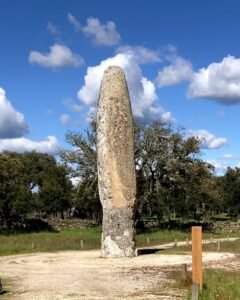
- Menhir (menir): A large upright megalithic stone, also called a “standing stone.” These are often shaped, and may have designs carved into them. A menhir may be erected by itself, or it may be part of a group.
- Obelisk (obelisco): Typically, these are shaped to have four sides. Generally not found in Portugal.
- Stele (estela): A stone monument, usually engraved, erected as a monument or marker.
- Cromlech (cromeleque): a group of standing stones, typically arranged in a circle (and also called “stone circles”). In Portugal, most cromeleques are either horseshoe-shaped or elliptical. They are also known by the term recinto megalítico, which means a megalithic enclosure.
- Note: in the UK and Ireland, “cromlech” can sometimes refer to a funerary megalithic tomb. This is not the case in Portugal. Cromeleque is always used for a group of menires.
- Alignment (alinhamento): A group of menhirs arranged in a line.
Funerary megaliths:
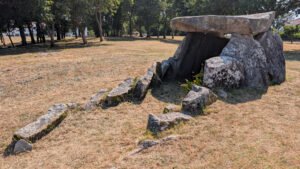
- Dolmen (dólmen, or more commonly anta; occasionally orca): a communal tomb, specifically a “portal tomb,” with walls made of large upright stone slabs (orthostats or esteios) forming a large chamber (câmara) accessed by a (typically) narrower and lower corridor (corridor). The top was covered with large capstone (chapêu) slabs.
- Note: The term anta is also used for a tapir, the South American animal. English translations can sometimes refer to “the tapirs of prehistory.” See my video about this.
- Tumulus (túmulo): an earthen mound (mamoa) which covered the dolmen.
- Cairn (cairn): a stone mound covering a dolmen (rare in Portugal).
- Tholos (tolo) plural tholoi (tolos): A communal “beehive tomb”, similar to a dolmen with the chamber and corridor walls made up of smaller stone slabs, stacked horizontally. The roof was a false dome made of increasingly smaller rings of stacked stones.
- Cist (cista): a smaller burial monument, typically for individual burials. These are rectangular boxes made of smaller stone slabs.
- Necropole (necrópole): a cemetary or “necropolis.” A group of funerary sites.
- Sepulchre (sepulcro or sepultura): a grave or tomb. (The word “sepulchre” is not common in English, but the Portuguese terms are commonly used.)
Settlements
- Settlement (povoado): a place where people lived
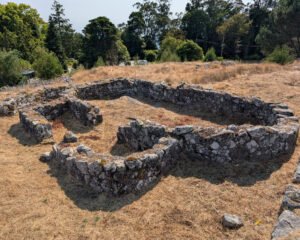
- Fortified settlement (povoado fortificado): a place where people lived, surrounded by a defensive wall.
- Hillfort (castro): a fortified settlement or a fortified camp located on an elevation. These are typical of the Iron Age, especially in northern Portugal and the Spanish area of Galicia. Typically, smaller ones are called castros, while larger ones (essentially proto-cities) are called citânias or cividades. (These terms come from the Latin term for a collection of people. The term castro is also used to refer to some earlier, Chalcolithic, fortified settlements.
- Ditch (fosso): Particularly in the Alentejo, many Chalcolithic settlements used ditches as defensive protection.
Art
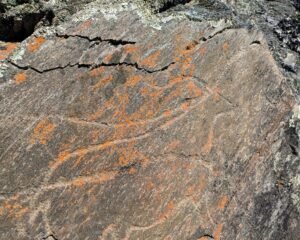
- Rock engravings (gravuras rupestres): images or symbols carved into stone. The most famous in Portugal are the outdoor engravings of the Côa Valley, but there are many other outdoor engraved rocks. Typically, these were made by pecking (making small holes in a stone using a pointed stone, hit by another), and then joined into a line making a shape by scraping between the holes. (The synonymous term petroglyphs/petróglifos does not seem to be used when describing Portuguese rock art.)
- Rock paintings (pinturas rupestres): images or symbols that are painted onto rock, typically with mineral pigments mixed with oils or fats. There is only one (so far) known site of “cave paintings”: the Gruta do Escoural. (It also has rock engravings.) There are various sites with paintings in mostly open stone shelters.
Caves
- Cave (gruta): a natural opening into rock, often used for shelter or entombments by ancient humans. Other Portuguese terms include caverna or furna. A shallow cave might be called an abrigo (“shelter”) or abrigo rochoso (“rock shelter”).
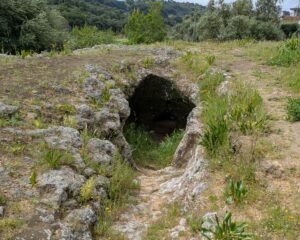
- Human-made cave (gruta artificial): in many places, ancient people carved holes into rock to use as a tomb or possibly for other purposes.
- Hypogeum (hipogeu) plural hypogea (hipogeus): an artificial or human-made cave, specifically made as a temple or tomb.
Dinosaur Fossils
- Paleontology (paleontologia): The scientific study of dinosaurs and prehistoric animals …basically all life before humans.
- Dinosaurs (dinossauros): an extinct group of warmblooded reptiles (or were they really birds?).
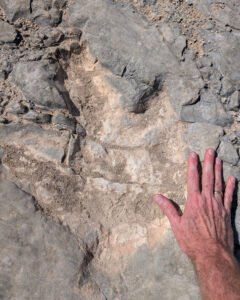
- Footprints (pegadas): many sites around Portugal show the footprints of dinosaurs.
- Fossil (fóssil plural fósseis): the remains of an animal that has been turned to stone (as minerals have replaced organic tissue over millions of years). Actual fossils of dinosaurs are removed from their locations and placed in museums, although new fossils are discovered regularly.
- Trace fossils or ichnofossils (icnofósseis): fossils that are not remains of an animal, but that show that an animal was there – such as footprints or other trails.
- Jazida: a site where fossils are found, specifically the geological section of stone. In English it’s sometimes called a “bone bed,” but the Portuguese use (as in jazida de pegadas das dinossauros) would generally translate to a “site.”