

Also known as: Monument megalítico da Pata do Cavalo, Monte da Boiças 1
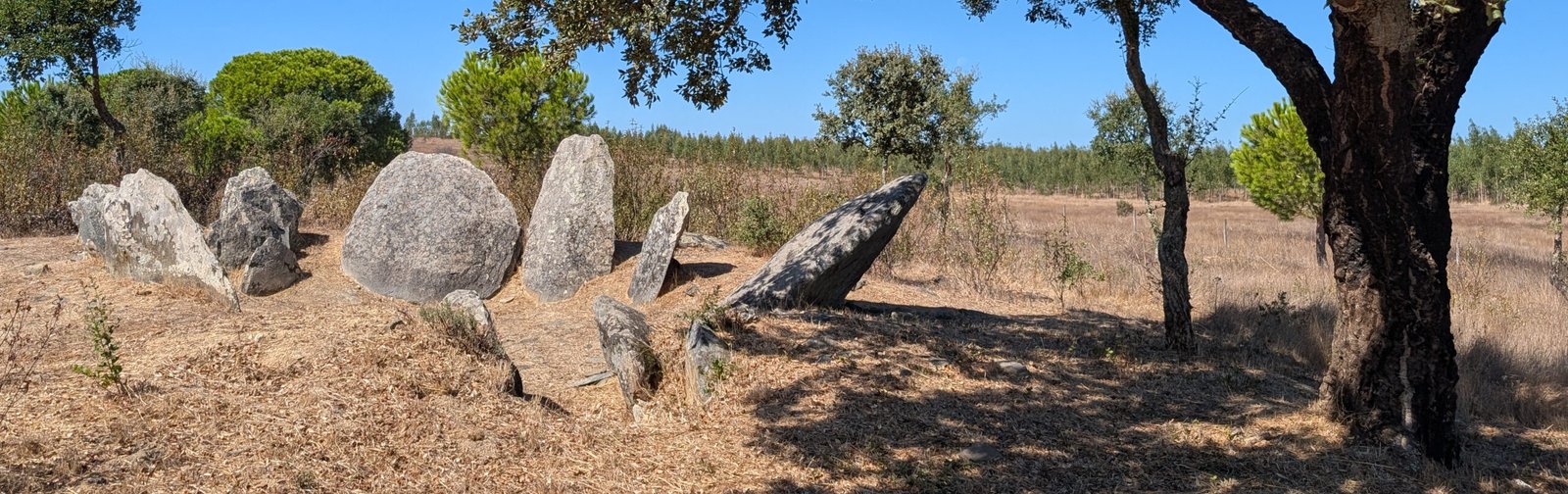
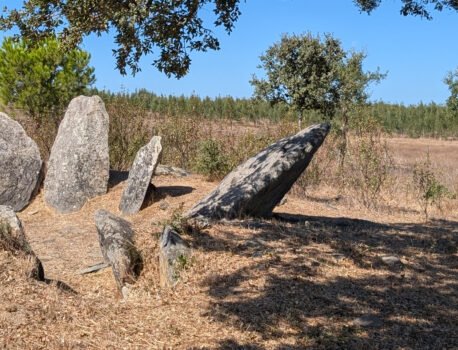
The grey stones stand splayed out, forming a rough circle beneath a spreading oak tree. These were put here by people thousands of years ago to form a sacred space. They remain an enigmatic record of our ancient ancestors’ presence here.
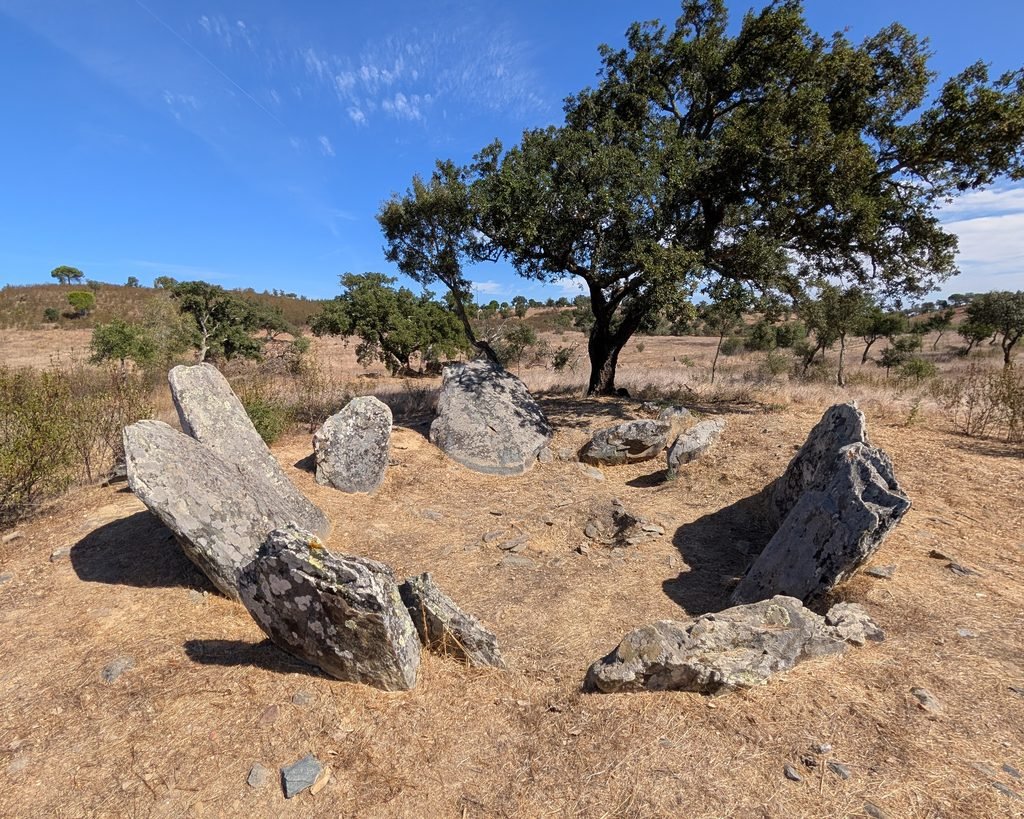
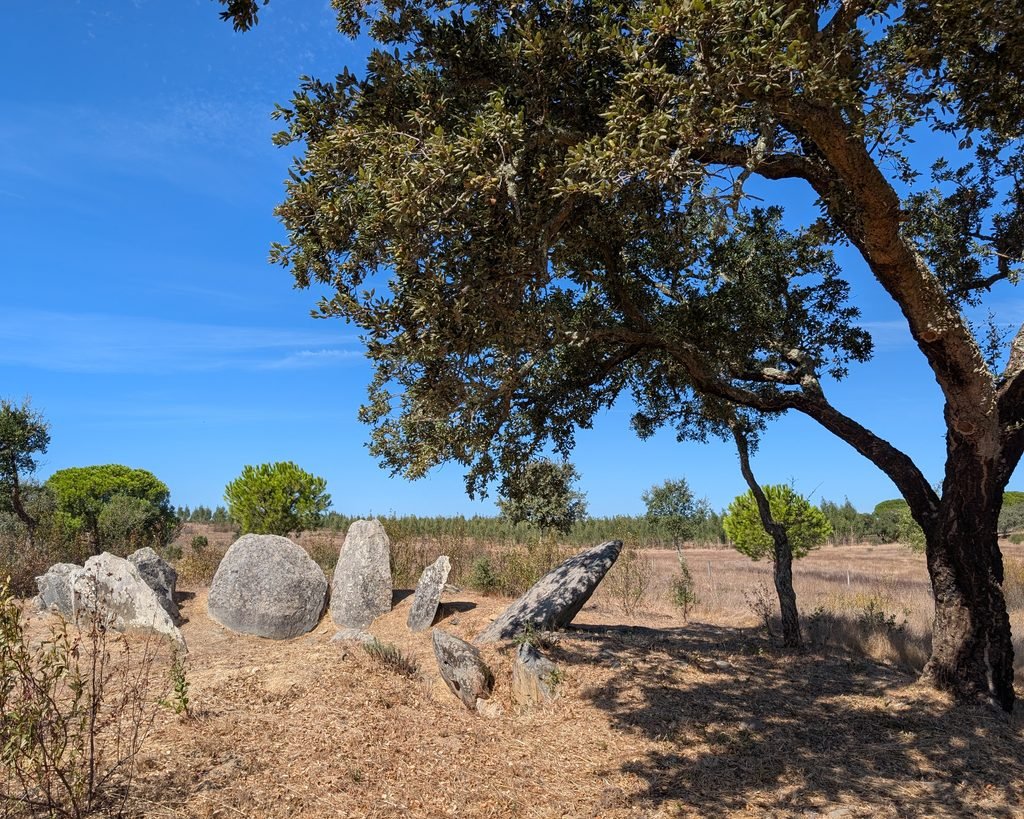
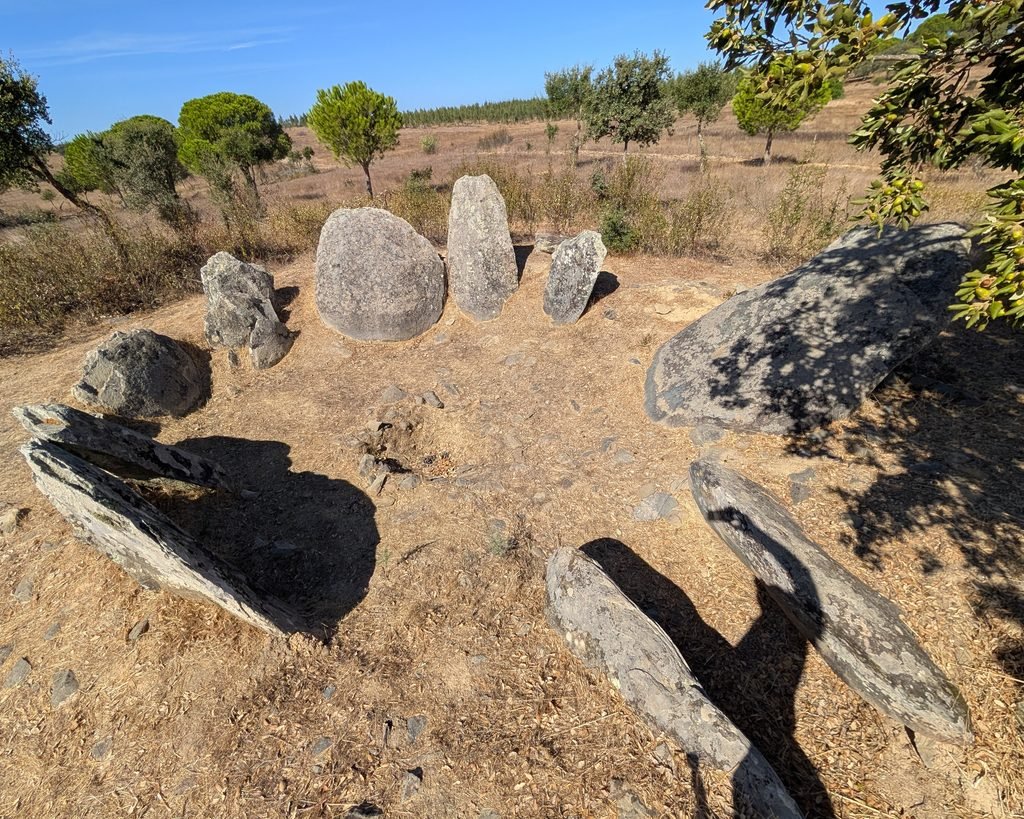
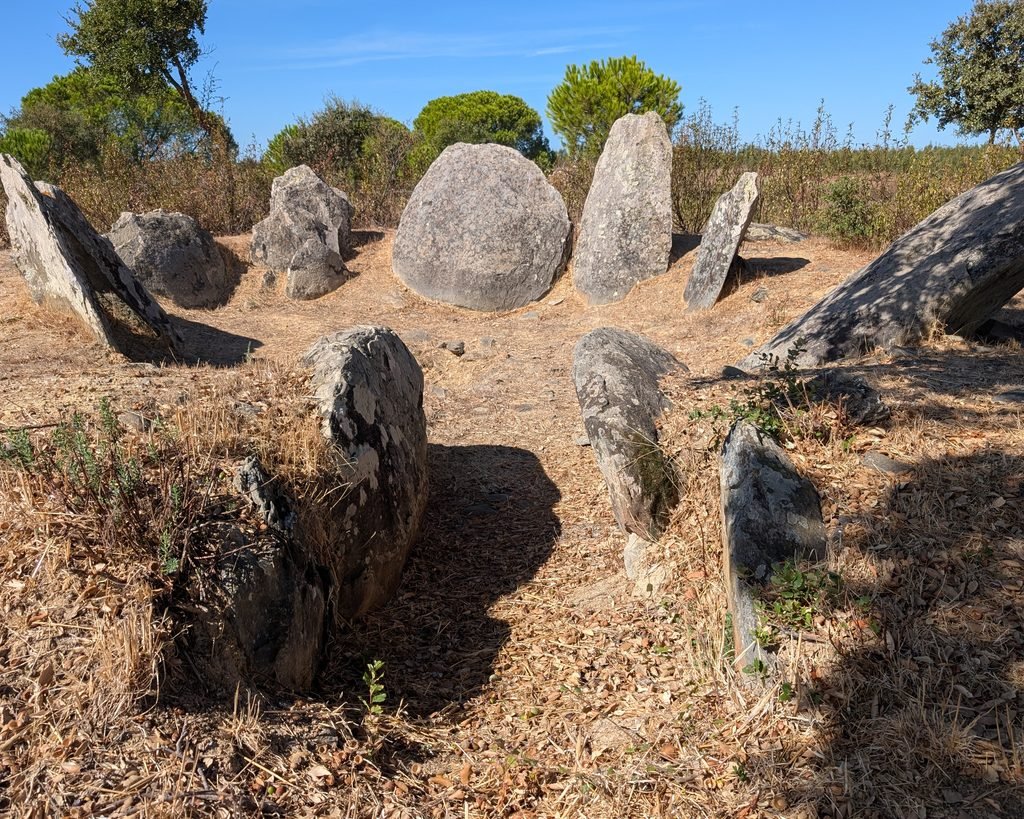
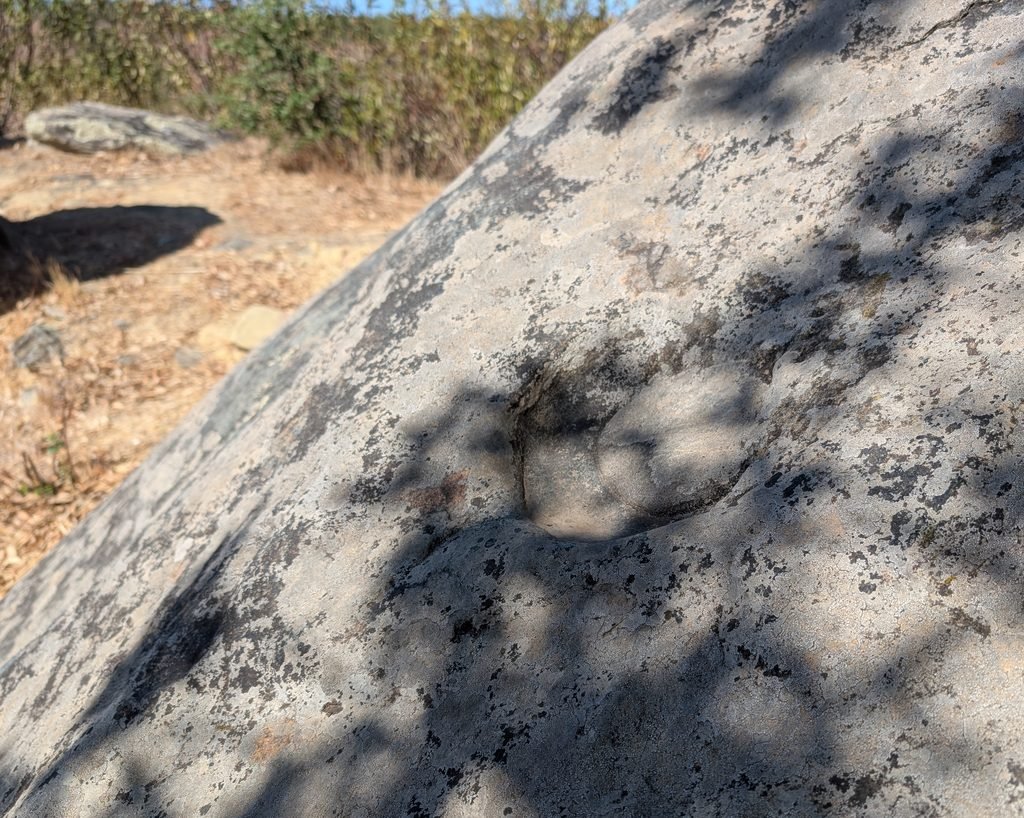
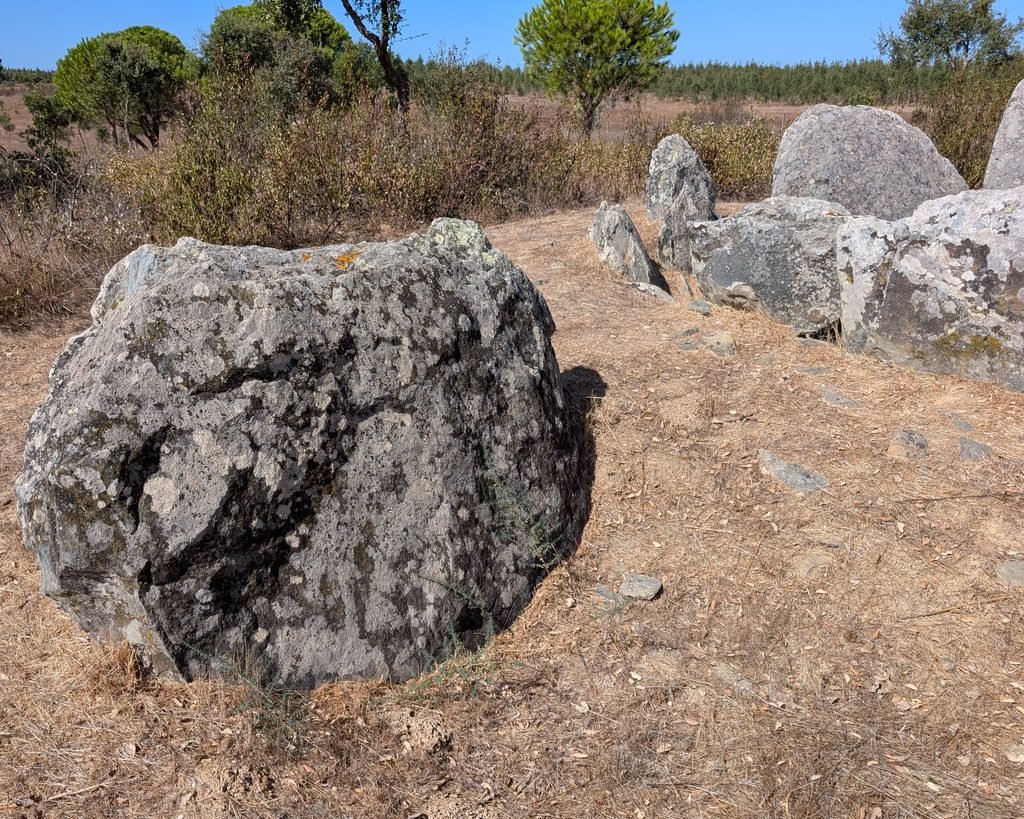
This monument is designated as a dolmen (“anta” in Portuguese), but there’s some suggestions that this may have been a tholos with a false dome. The chamber is huge: at least 4m in diameter. There’s a depression in the centre, indicating the use of a pillar to hold up the roof – which is common in tholoi. However, the huge upright stones forming the chamber (originally 9, with 8 remaining, of up to 2m in height) are not typical of a tholos.
It was identified and excavated in the 1950s, but there are references to monuments in the area as early as 1868. (There are some discrepancies in the naming and locations of monuments referenced, including reference to this as “Monte das Boiças 1,” and the archaeological database notes that this needs clarifying and reorganizing.1) Despite the fact that it had obviously been disturbed sometimes in the past and objects removed from it, a variety of artefacts were found during excavation: ceramic vessels, stone tools, and fragments of schist plaques.2 The materials collected, as well as its architectural characteristics, place this as between the Late Neolithic and Early Chalcolithic, around 3,500 to 2,500 BC.
Location
This monument is located in the Setúbal district, in the municipality of Grândola. It’s in the parish of Azinheira dos Barros.
Coordinates: 38.087280, -8.481899
Access
It’s along a dirt road, with a short walk to the monument. You can also follow the GR63 “Grande Rota do Balho” trail.
Signage
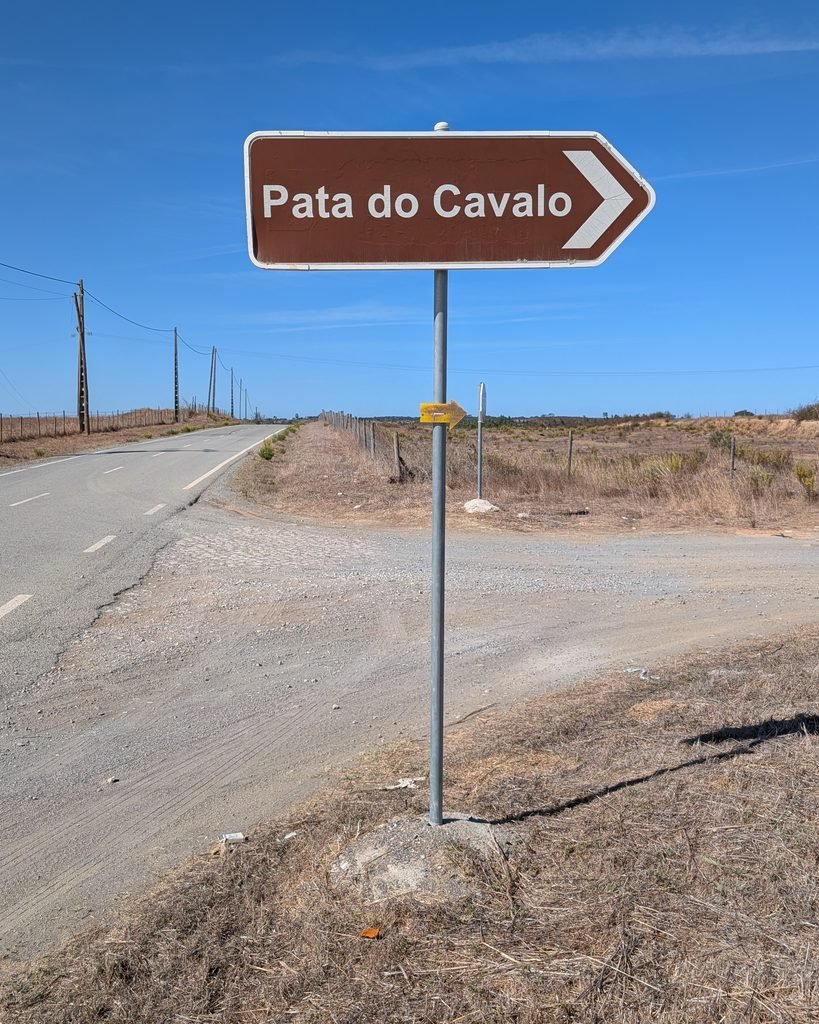
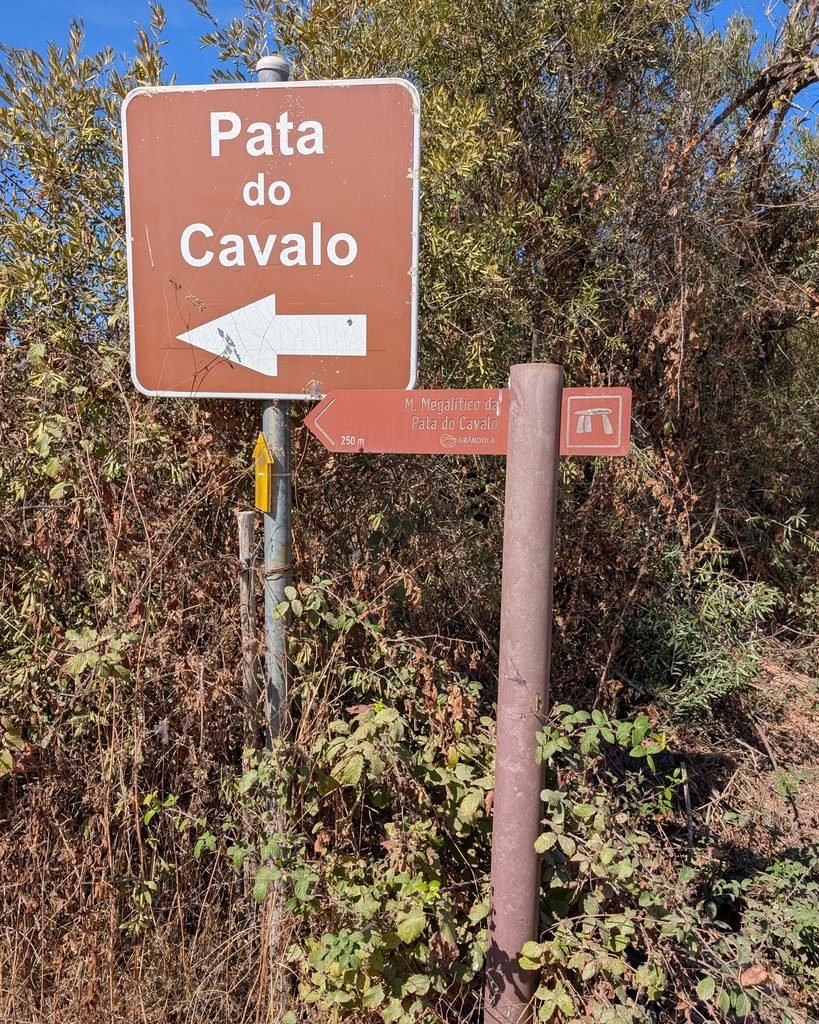
There are signs along the roads directing you to the monument, and an information plaque in Portuguese at the site.
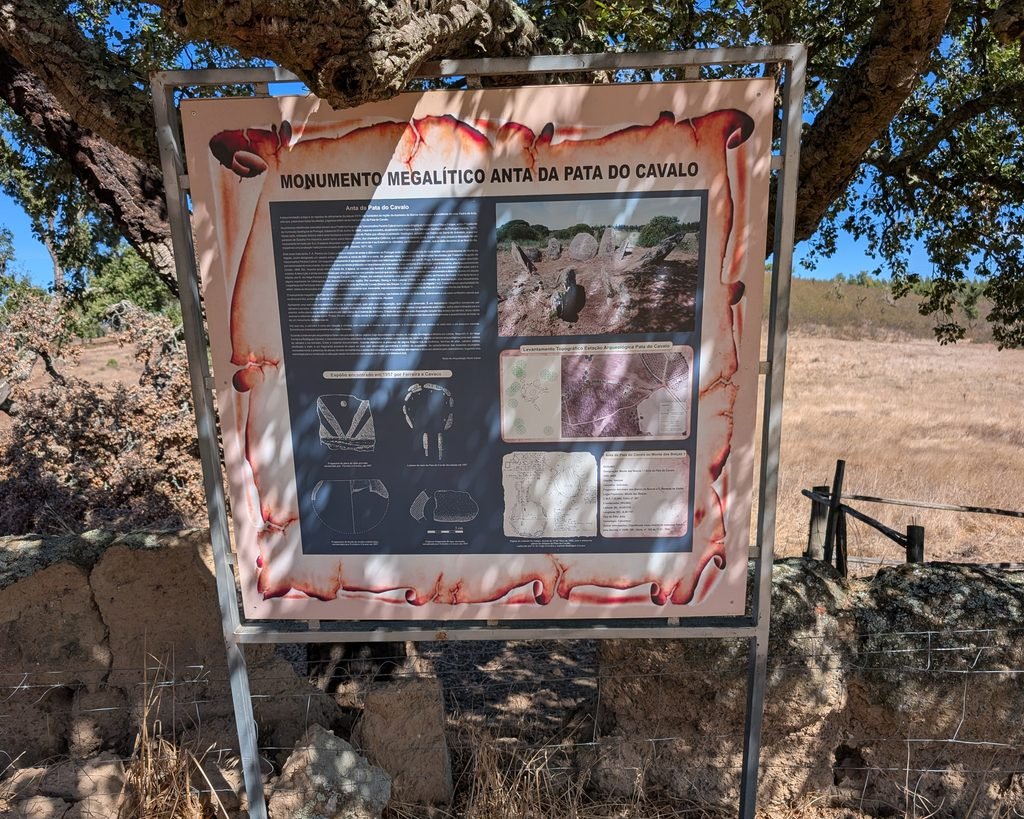
The information sign at the site is in Portuguese. There is a lot of description of early recordings of the site, from the 1800s through to the 1950s, with some discrepencies of naming. The main information reads: “The megalithic monument of Pata do Cavalo is located on the top of a gentle hill in the foothills of the Grândola mountains, overlooking a large natural amphitheatre which opens to the south, looking out towards the mining regions of Lousal and Aljustrel on the horizon. It has a huge and unique structure, both in its configuration as well as size. It’s made up of a chamber and corridor, differentiated in shape and height. The funerary chamber, formed now by 8 orthostats (originally 9) which are all leaning outwards, has a subcircular shape of around 4m in diameter. The circular shape leads many to describe this as a tholos, but careful analysis of the configuration and the size of the orthostats reduces the likelihood of this. The corridor is smaller than the chamber, with about 2m of length, and is formed by two shorter orthostats on either side. It is oriented East-Southeast. During excavations, various objects were recovered and are now located in the Geologic Museum in Lisbon. According to the archaeologists, the monument had already been excavated. Among the documented artefacts, notable mentions were various ceramic frangments, flint blades, other stone tools and a fragment of a schist plaque decorated with geometric shapes and a hole for hanging on a cord. The nature of the artefacts, particularly the schist plaque similar to others identified in Alentejo monuments dated with radiocarbon techniques, suggests the dating of this monument to the transition between the fourth and the third millennium BC.”
Links
- Article (in Portuguese) from Wikipedia
- Entry (in English) in the Megalithic Portal
- Description (in Portuguese) from the town hall of Grândola
- Hiking route & map (in Portuguese) of the GR 63 Grande Rota do Balho from Visit Grândola website
- Description (in Portuguese) from the Setúbal Region Network of Cultural Heritage (Rede de Património Cultural da Região de Setúbal)
- Description (in Portuguese) from Archaeologist’s Portal of Directorate-General of Cultural Heritage
- Designation (in Portuguese) as a XXX by the Directorate-General of Cultural Heritage
- Detailed information (in Portuguese) in the database of the Directorate-General of Cultural Heritage
Nearby
The area of Grândola has several interesting prehistoric sites, with five main ones being listed by the municipality. The archaeological museum in Grândola has more information. The Anta do Monte Serôdio and the Megalithic Monument of Lousal are both reasonably near, about 8km to the south.
There are two sites south of Melides, further away to the west: the Anta da Pedra Branca and the Bronze Age cists of Casas Velhas.
Sources
- C. Costeira, “Monte da Boiça 1/ Anta da Pata do Cavalo”, Portal do Arqueólogo https://arqueologia.patrimoniocultural.pt/index.php?sid=sitios&subsid=52442 ↩︎
- Inácio, Nuno, et al. “A Valorização Do Património Megalítico Do Lousal (Grândola).” Arqueologia Em Portugal: 150 Anos, 2013, pp. 205–211, www.academia.edu/8415290/a_valoriza%C3%A7%C3%A3o_do_patrim%C3%B3nio_megal%C3%ADtico_do_Lousal_Gr%C3%A2ndola_. Accessed 6 Oct. 2026. ↩︎