
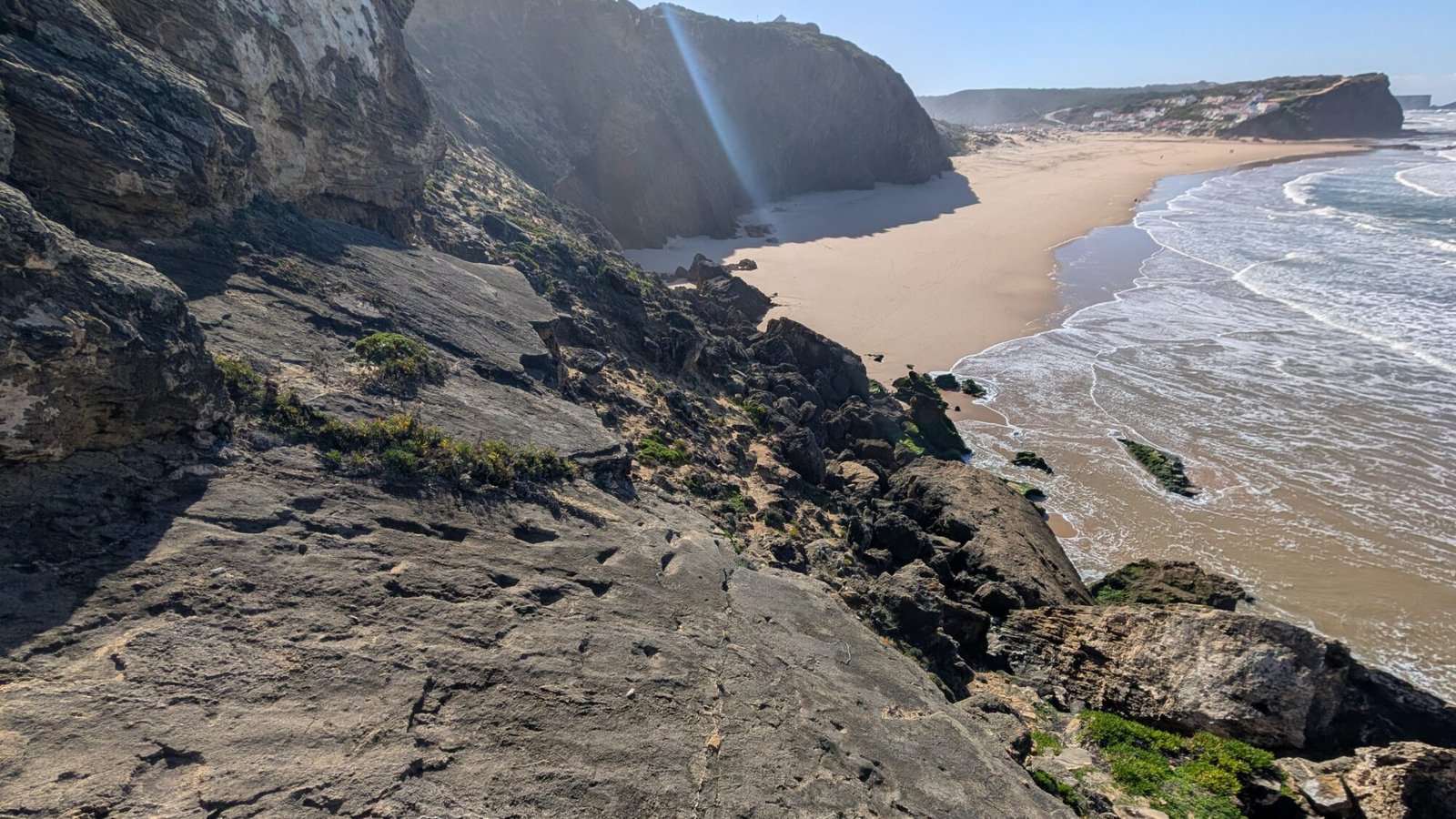
Sit on the edge of the cliff, looking out to sea. The wind blows in your face while the sun warms your back. Watch people walking along the beach. Watch fishermen walking along the cliffs. Then look down at the sandstone sheet below you. The marks in the stone are the footprints left by people walking on sand dunes here tens of thousands of years ago. Homo sapiens walk here now, but these were Neanderthals. Who will find our footprints tens of thousands of years from now?
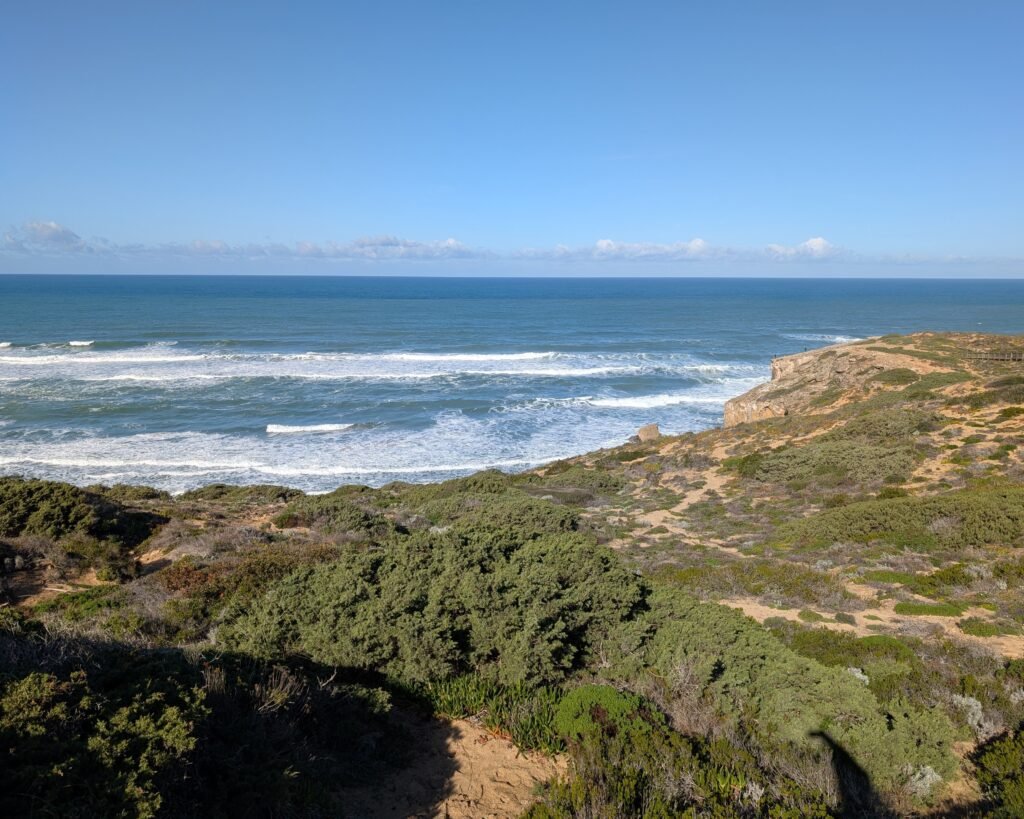
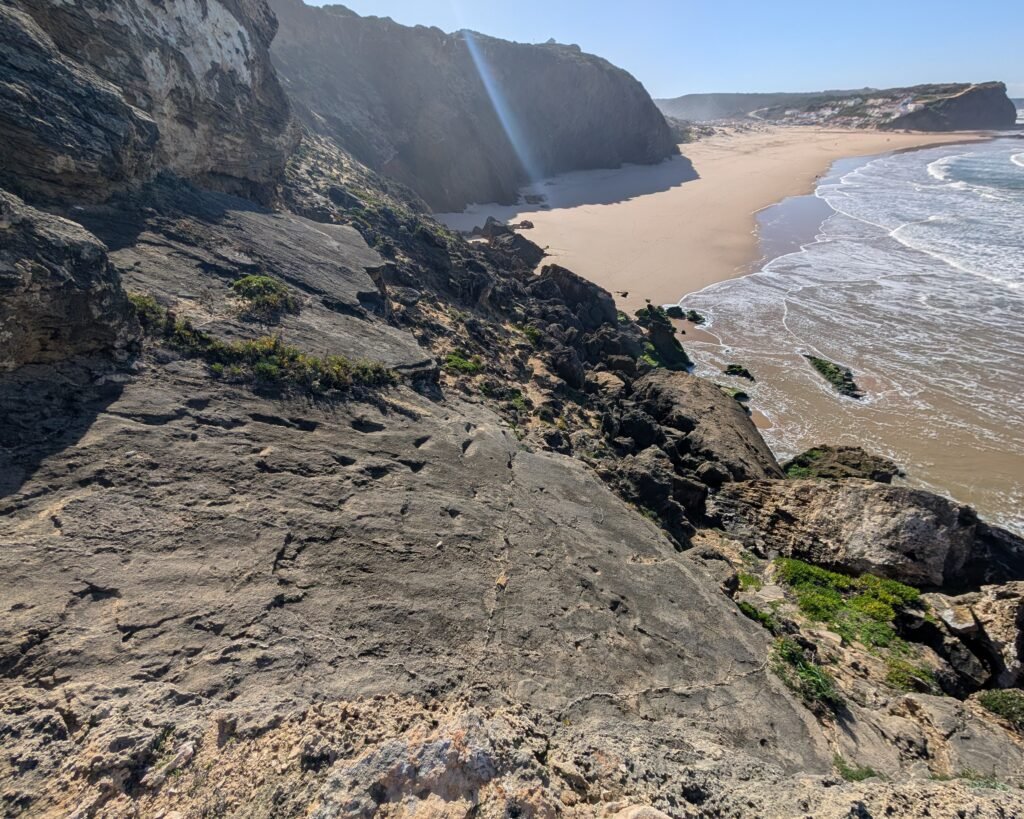
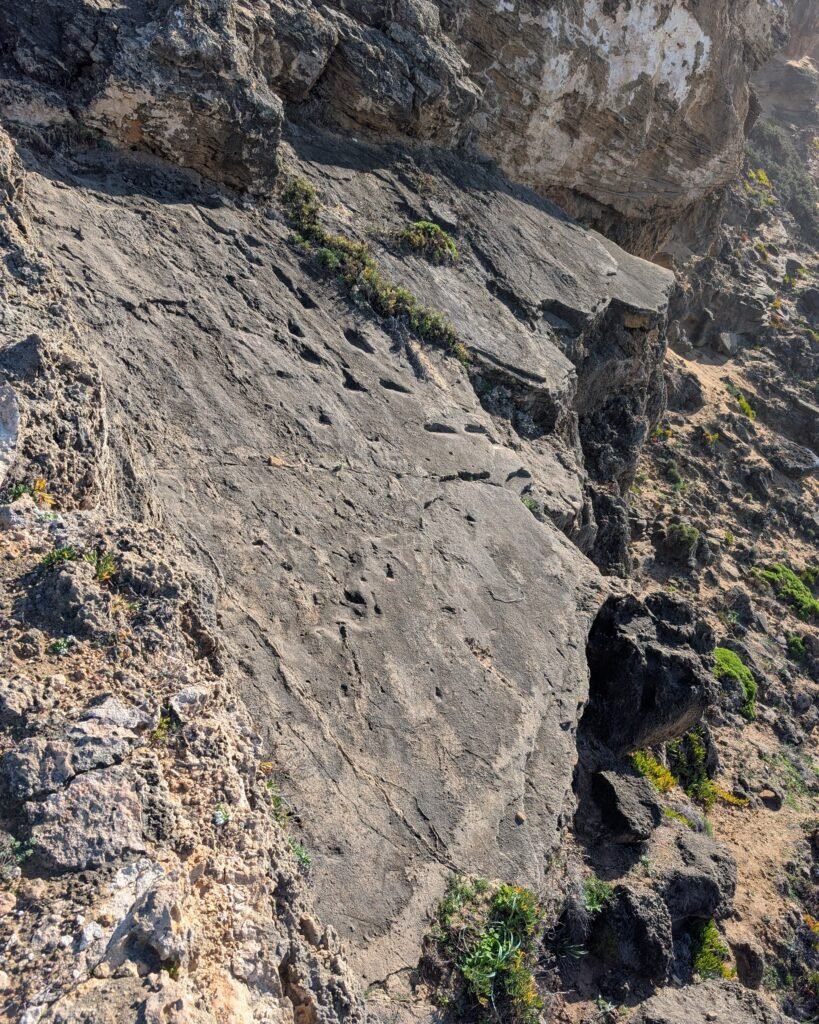
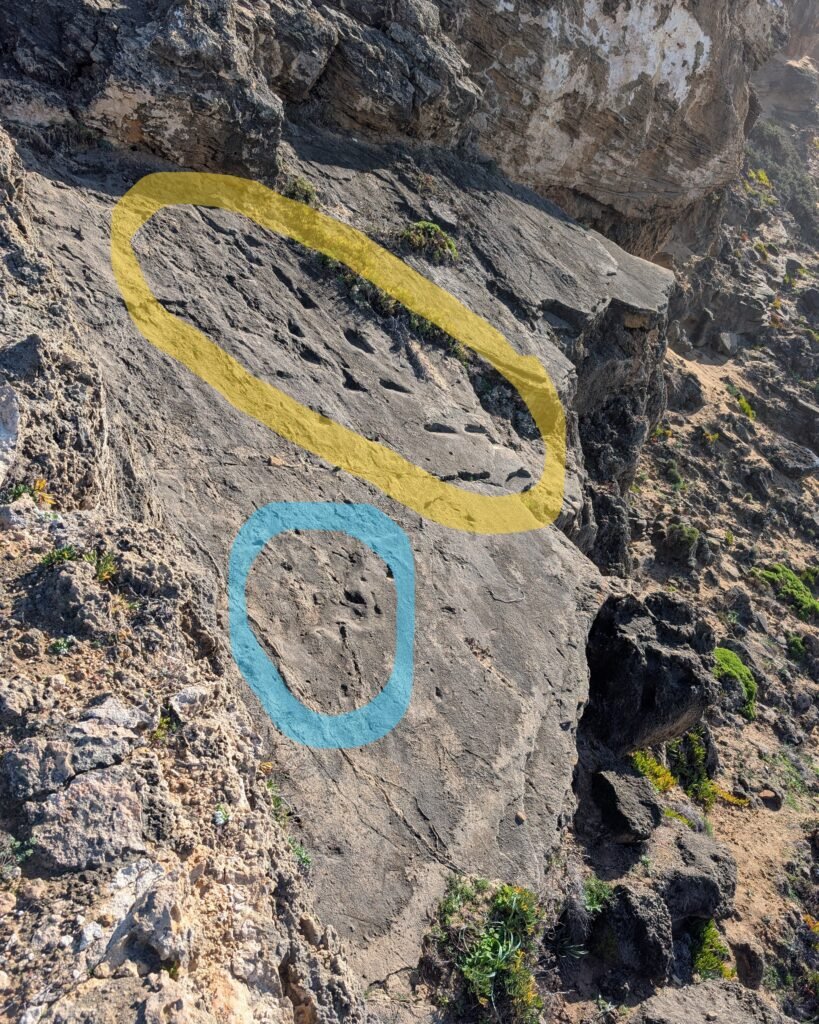
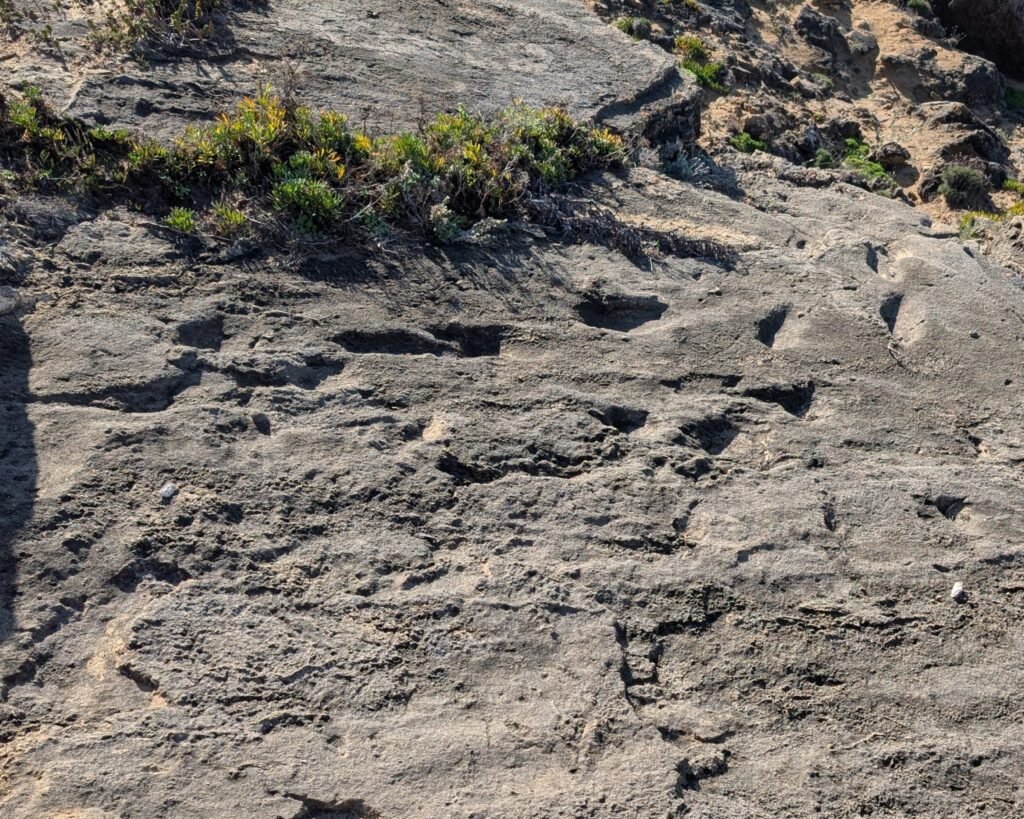
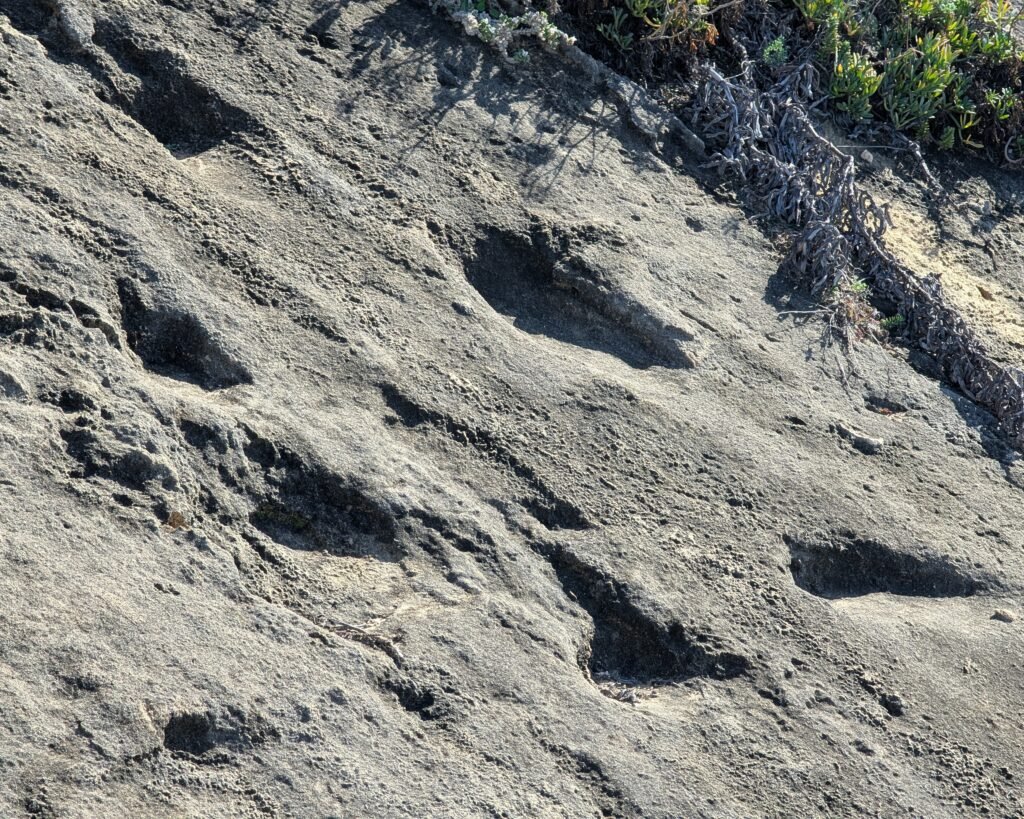
In 2020, archaeologist Carlos Neto de Carvalho and his Geographer wife, Yilu Zhang, discovered these fossilized footprints while exploring Monte Clérigo beach.1 After careful study of the site by a team of archaeologists and other scientists, their findings were published in 2025.2
The fossils are technically “ichnofossils,” or trace fossils showing the effects of the Neanderthal’s movements rather than a fossil of the Neanderthal themselves. They can be dated using optically stimulated luminescence (OSL), a technique which is used to date non-organic material. Quartz crystals in the sandstone contain stored energy which is released on exposure to light. Stone was removed (covered with black plastic) and the energy measured, dating to about 78,000 years ago (with a margin of error of five thousand years). Since the first homo sapiens only arrived in the territory around 35,000 years ago, these must have been Neanderthals.
Several trackways were identified, each containing multiple prints. There are three tracks (two going up the slope, and one going down) of an adult, and two shorter tracks of children: one aged about 9 years old and the other a toddler of around 2 years old. (The size and shape of the prints determines the age.) As these were all laid down at the same time (the trackways have the same preservation condition and are near to each other), the adult must have been with the children. Tracks of red deer were also identified in the same site, leading the archaeologists to conclude that the Neanderthal was hunting, including the children on the hunt. The sea was at more or less the same level as it is today3, so these Neanderthals were living and hunting near the coast and walking in sandy soil.
This was one of two sites discovered in Portugal and reported in 2025. This brought the world-wide total of Neanderthal footprint sites to 8.
The second Portuguese site is about 36km further south along the coast, at Praia do Telheiro near Cabo de São Vicente.
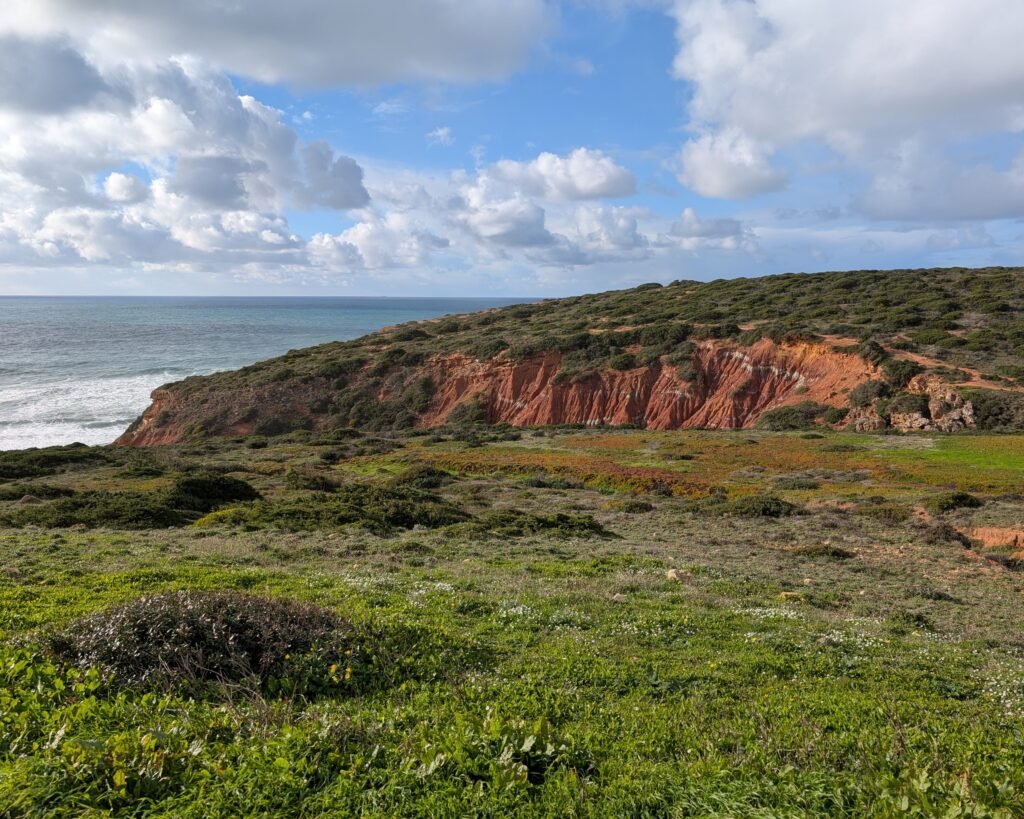
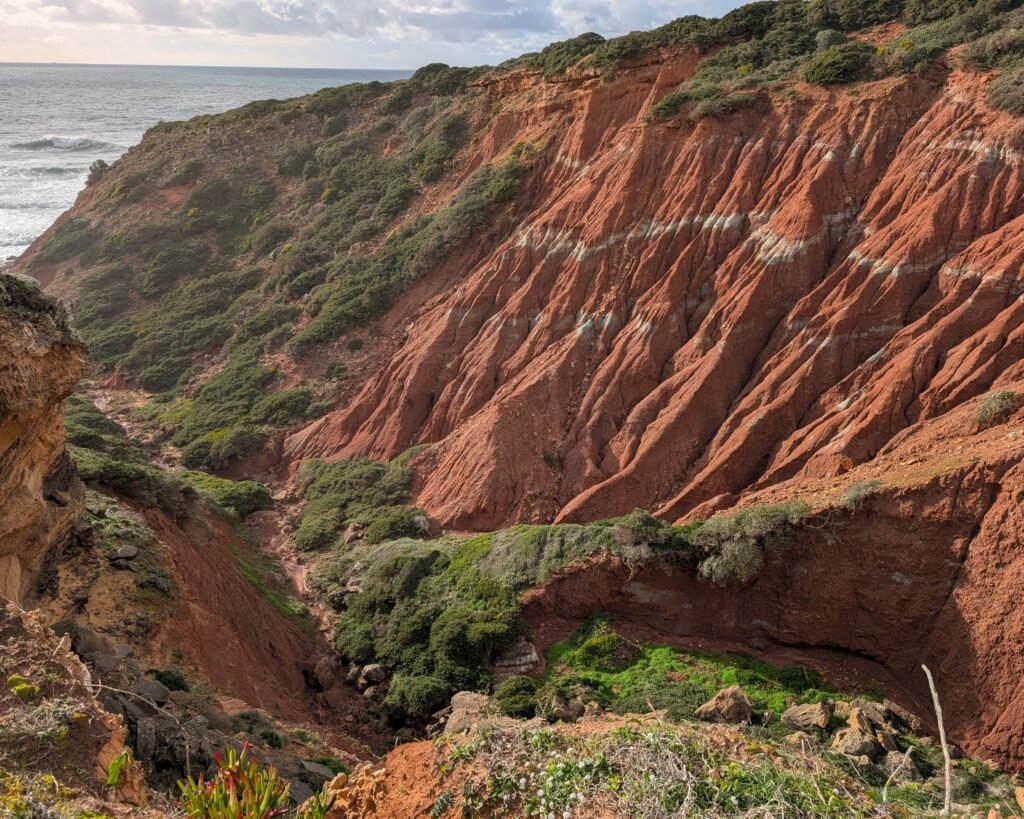
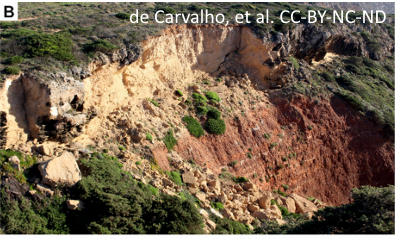
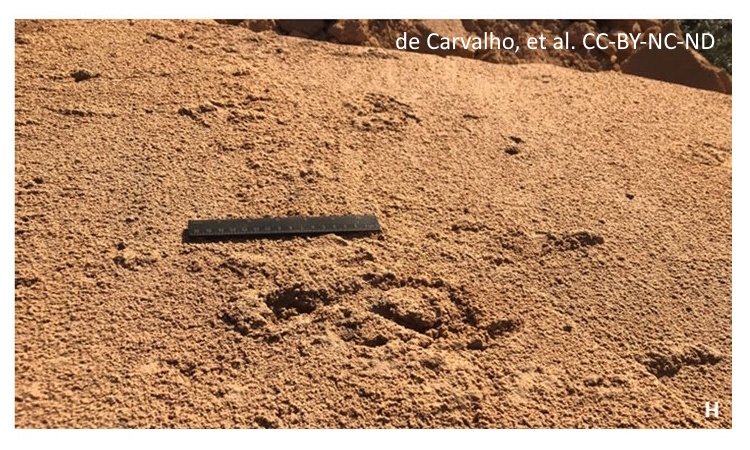
The site at Praia do Telheiro, near Sagres, has a single footprint, the size indicating it was an adult female or a youth. It was dated to about 82 thousand years ago (again, plus or minus five thousad). It is located in a creek bed in a valley leading to the beach. (I did not go down to the creek bed. The photos above are reproduced from the scientific report.6)
Video Visit
Location
The footprints are all in the Algarve region, district of Faro.
The site with multiple trackways is in the municipality of Aljezur, on the rocks above Praia (“beach”) de Monte Clérigo.
The site with a single footprint is in the municipality of Vila do Bispo, in a creek bed leading down to Telheiro Beach, just north of Cabo de São Vicente, the southwesternmost tip of Portugal (and of continental Europe).
In the Locator Map below, the two sites are shown with a footprint icon:
The archaeologists published the GPS coordinates of each site:
- The Monte Clérigo trackways are at 37.344917, -8.850583
- The Praia do Telheiro single footprint is at 37.047698, -8.977547
Protected Zone
Please note: both sites are in the protected area of the Natural Park of Southwest Alentejo and Vicentine Coast. Visitors to this area must be very careful about protecting the environment and heritage. Picking of plants is forbidden, as is making fires. Use trails whenever possible, leave no litter behind, and take away only photographs and memories.
Access
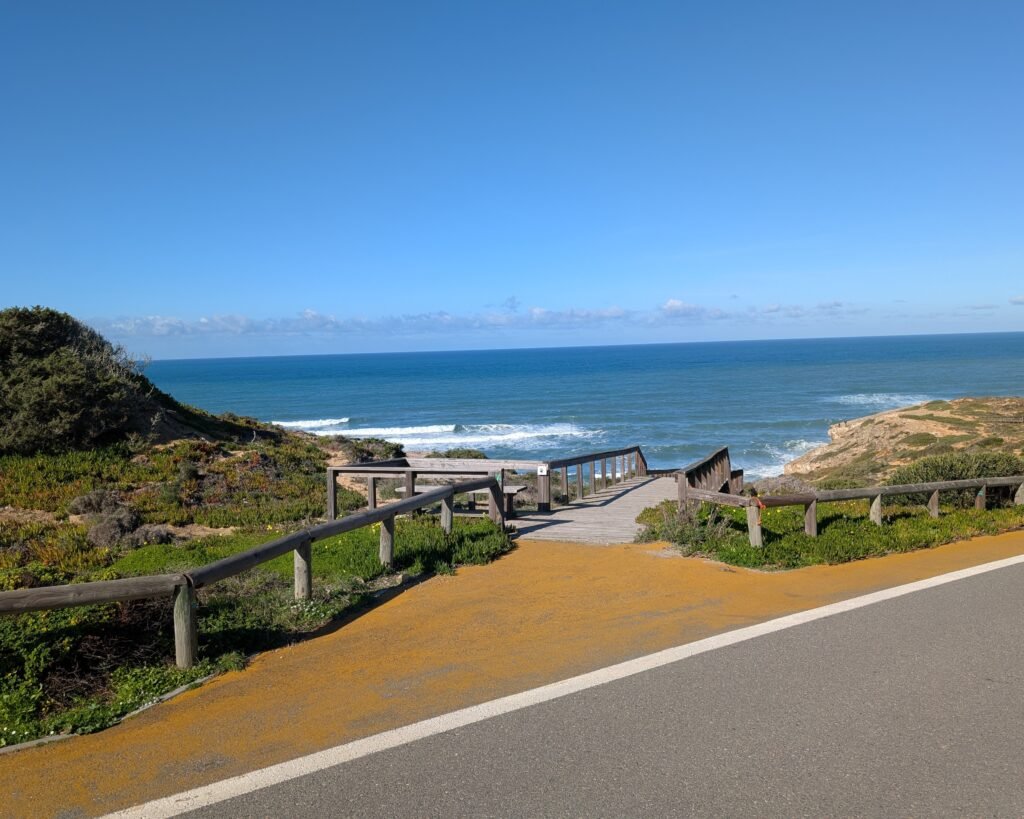
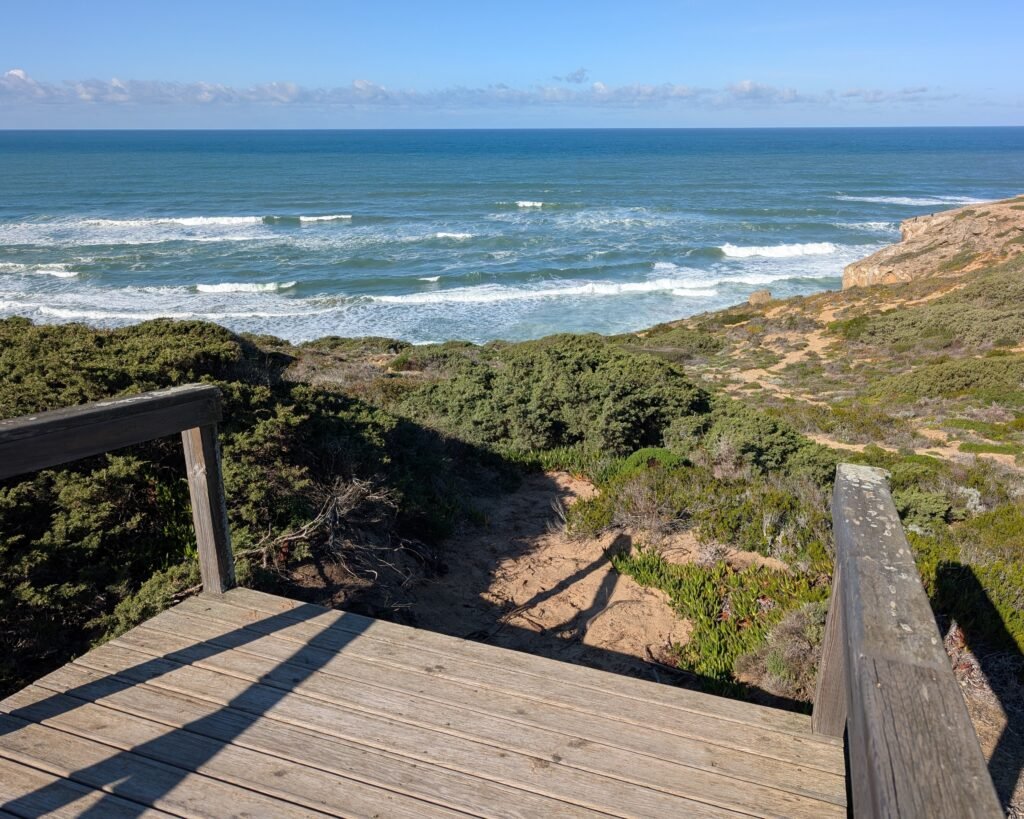
The Praia de Monte Clérigo site (with multiple trackways) is accessible, although not for people with mobility issues. From the road above Praia de Monte Clérigo (heading north towards Praia da Amoreira), you walk down a wooden ramp (coordinates 37.344307, -8.849790) and then climb down over sand and stones to the cliff edge over the beach. From there you can easily see the fossilized footprints, and if you are steady of foot and very brave you can climb down onto the stone. Please treat the fossils with great care!
The Praia do Telheiro site (with a single print) is hard to get to. You can drive to a viewpoint overlooking Praia do Telheiro, but it’s a challenging climb down to the beach. From there, you will have to scramble up the creek bed to the fossil site. (It may be possible to climb down to the creek from above.) I did not attempt the climb. Again, if you go to the site, please treat the fossil with great care!
Signage
There are no signs indicating the footprints. There are signs directing you to each beach.
Links
- Article (in Portuguese) from Faculty of Sciences, University of Lisboa
- Scientific article (in English) from the journal Nature
- News article (in English) from Algarve Daily News
- News article including story about discovery (in English) from Live Science
- Site pages (in English) for Monte Clérigo and Praia do Telheiro from the Megalithic Portal
Nearby
The two sites are about 36km away from each other (about 50km to drive). There are many prehistoric sites near Vila do Bispo (40km from Praia de Monte Clérigo, and about 9km from Praia do Telheiro), including the monumental Menir do Padrão.
Sources
- Killgrove, Kristina. “78,000-Year-Old Footprints from Neanderthal Man, Child and Toddler Discovered on Beach in Portugal.” Live Science, 22 July 2025, www.livescience.com/archaeology/human-evolution/78-000-year-old-footprints-from-neanderthal-man-child-and-toddler-discovered-on-beach-in-portugal. Accessed 8 Aug. 2025. ↩︎
- de Carvalho, Carlos Neto, et al. “Neanderthal Coasteering and the First Portuguese Hominin Tracksites.” Scientific Reports, vol. 15, no. 1, 3 July 2025, pp. 23785–23785, https://doi.org/10.1038/s41598-025-06089-4. Accessed 14 Nov. 2025. ↩︎
- A. Ouammou, A. Weisrock, Sanda Balescu, A. El Ouahidi, B. Ghaleb, et al.. Paléorivages, dunes côtières et occupations humaines à l’embouchure de l’Oued Tamri, Maroc Atlantique, au Pléistocène Supérieur (SIM 5). Journal of Water and Environmental Sciences, 2019, 3 (RQM9), pp.391-406. ⟨hal-02366290⟩ ↩︎
- (de Carvalho et al.) ↩︎
- (de Carvalho et al.) ↩︎
- (de Carvalho et al.) ↩︎