
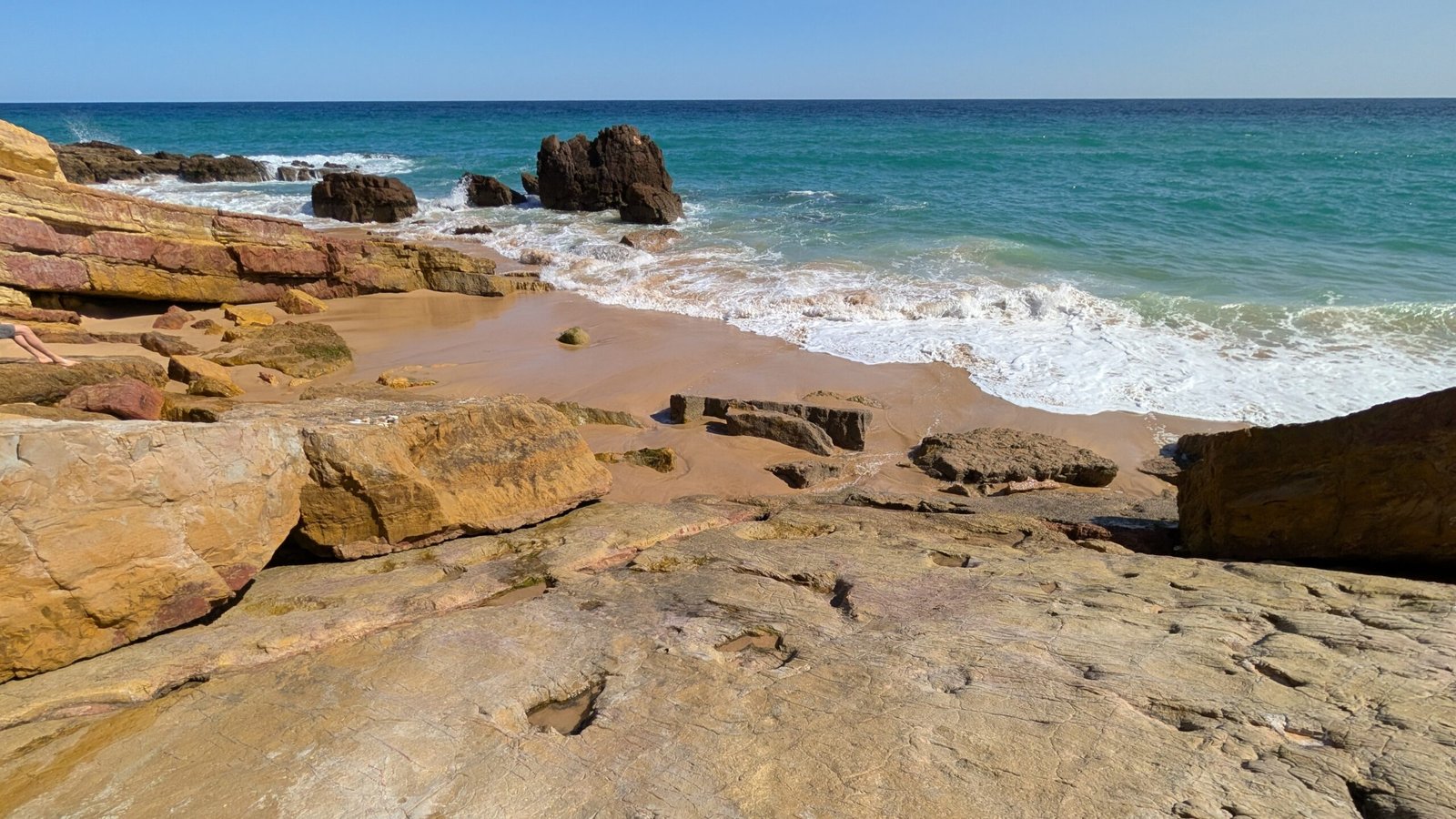

Stand on the rock ledge as the waves crash beneath you. The strange holes in the rock ledge weren’t created by an accident of geology. They are the footprints that a dinosaur made, a hundred million years ago. Careful: don’t let the yawning chasm of time make you dizzy, or you’ll fall into the sea below!
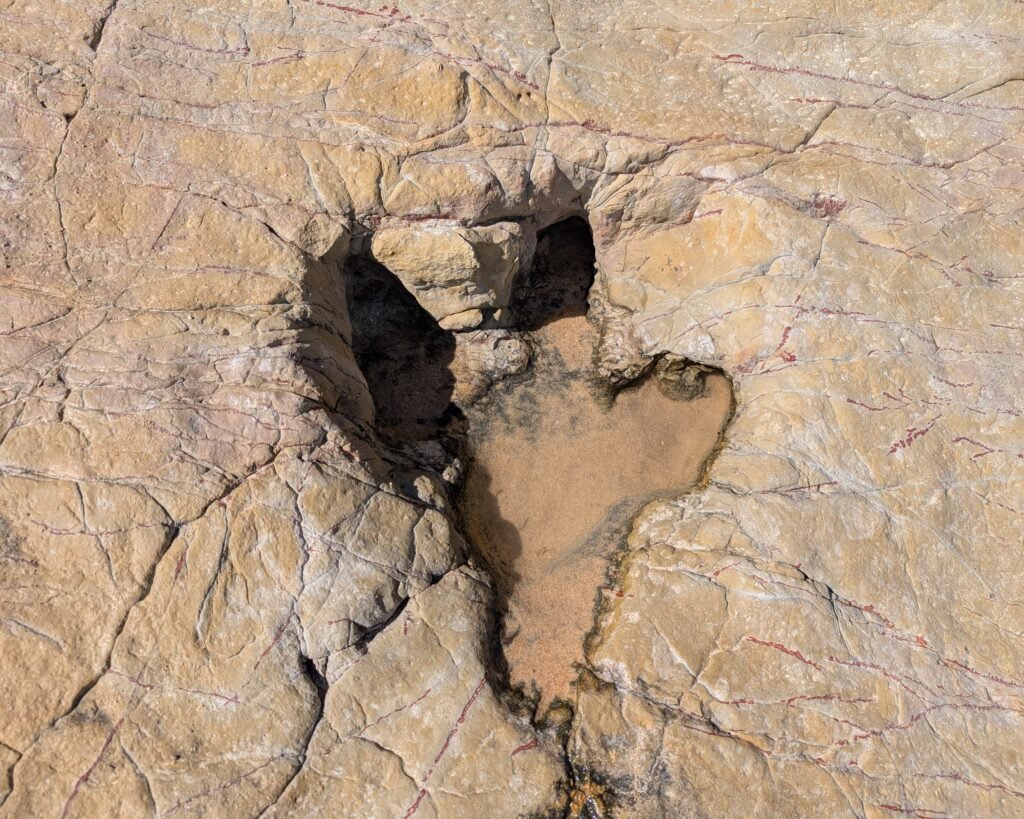
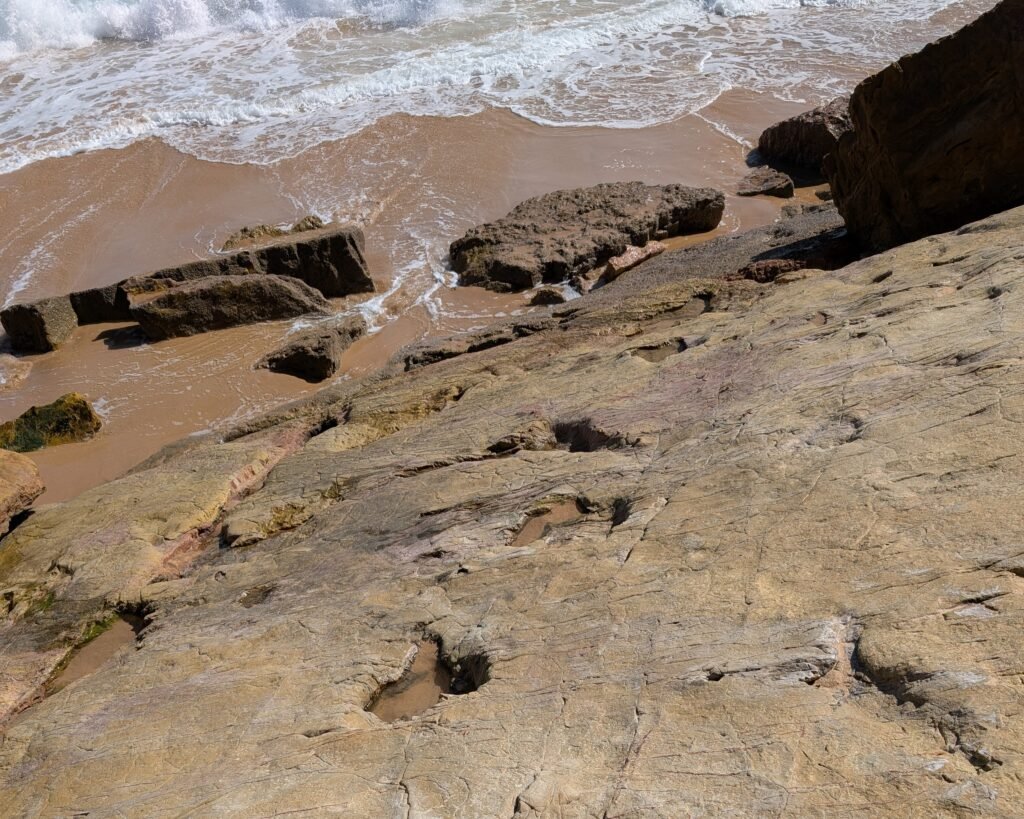
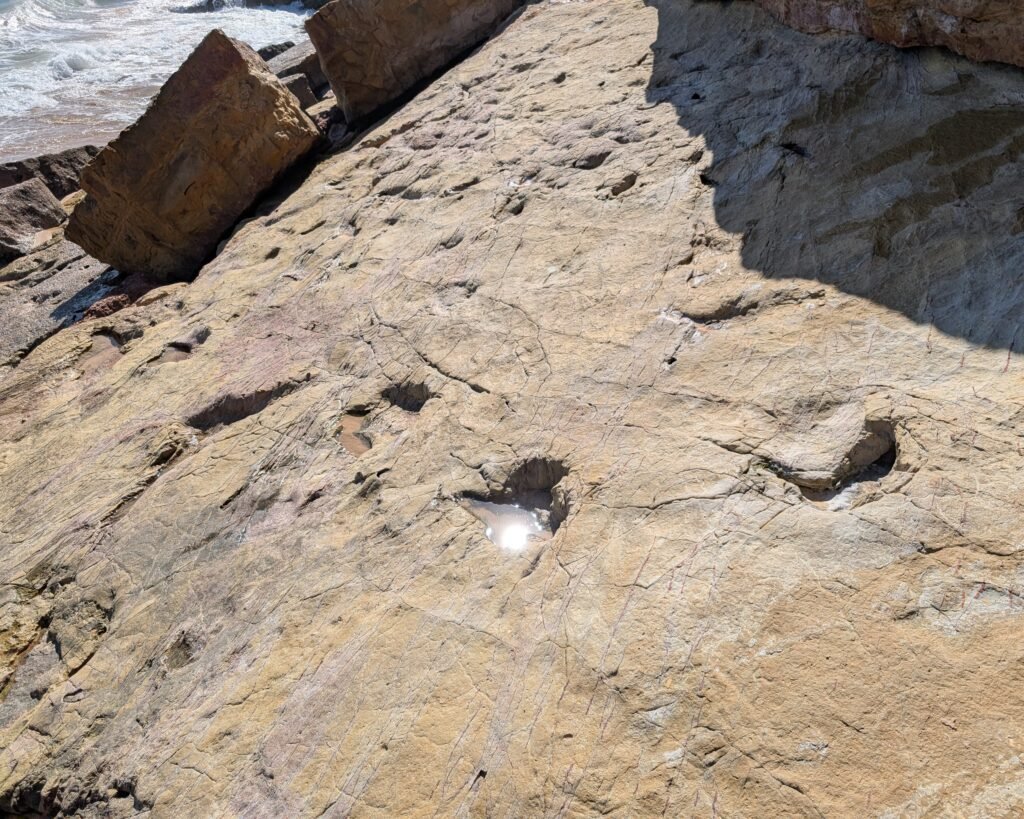
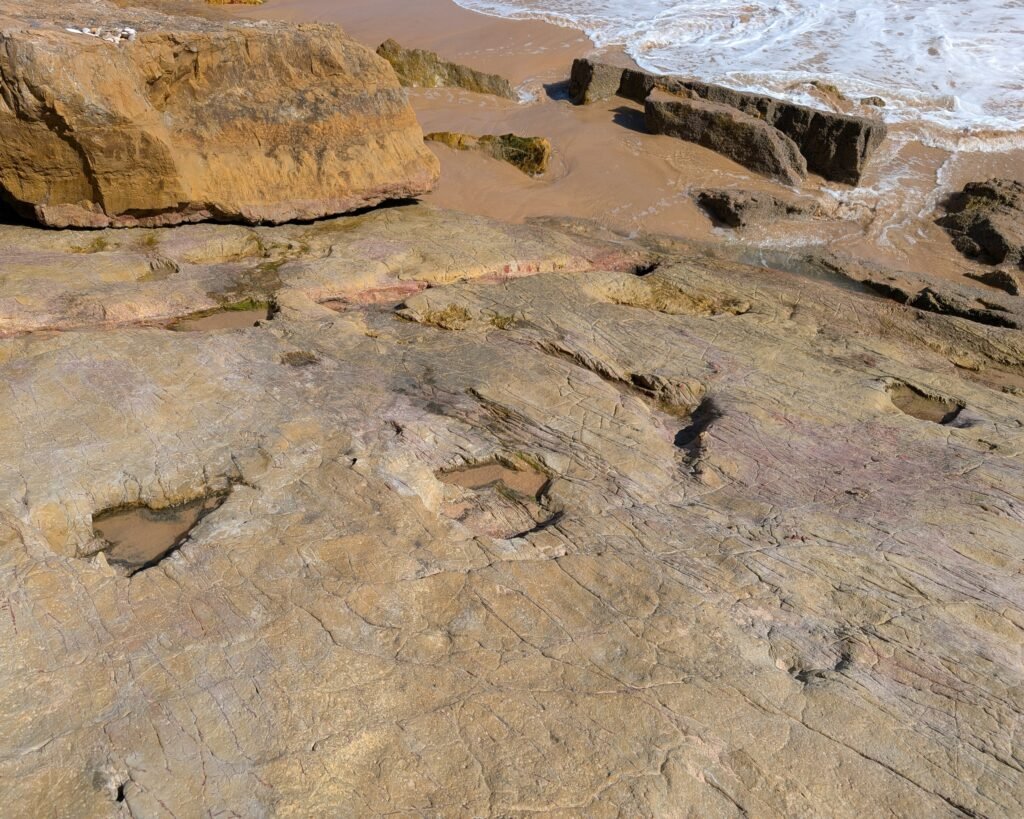
There are three track levels at the eastern edge of Praia Santa (Santa Beach). There are very well preserved and clear prints that have characteristic shape of ornithopod footprints, and are very similar to prints which have been attributed to Iguanodontipus.
Iguanodons were bipedal herbivores who lived in the Lower Cretaceous, about 100 to 150 million years ago.
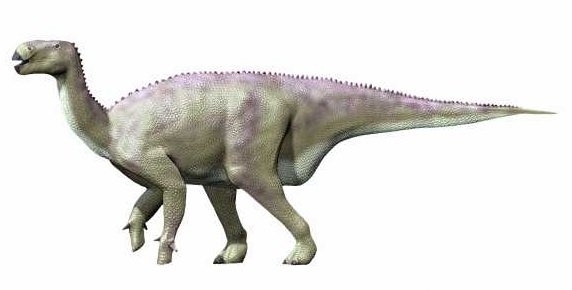
A formal study of these prints show that the dinosaur which made them had a hip height between 1.8 and 2.4m, and were walking at a speed of about 3.1 to 4.4 km/h.1
There are also some individual prints and short tracks further east.
Location
Santa Beach is in the Algarve, district of Faro. It’s in the municipality of Lagos, to the East of Lagos. The tracksite is to the east of the main beach.
Access
Praia Santa is only accessible by walking trails. It’s about 2Km from Salema to the East. The trail is not very difficult, but I wouldn’t recommend it for people with mobility issues. There are various trail maps, including this one from AllTrails.
Signage
There are no signs for the tracksite. It’s on the Eastern side of the beach.
Links
- Description (in Portuguese) from Portugal em Pedra
- Video (no language) from Portugal em Pedra
- Video (in Portuguese) from Ciência Viva Lagos
- 3D models (no language) on Sketchfab from Ciência Viva Lagos
- Article (in Portuguese) with a nice illustration of the iguanodons by National Geographic Portugal
- Explanation (in English) of how dinosaur footprints were fossilized by the UK’s Natural History Museum
Nearby
There are more dinosaur footprints on the Praia da Salema (Salema Beach), about 1 km to the East.
Sources
- Santos, V. F. (2016). Dinosaur tracks in the southwest Algarve Basin. Comunicacoes Geologicas, 103, 117-120. https://www.lneg.pt/wp-content/uploads/2020/03/11-Dinosaurs-at-the-southwest-Mesozoic-b_Layout-1.pdf accessed 31 March 2026 ↩︎