
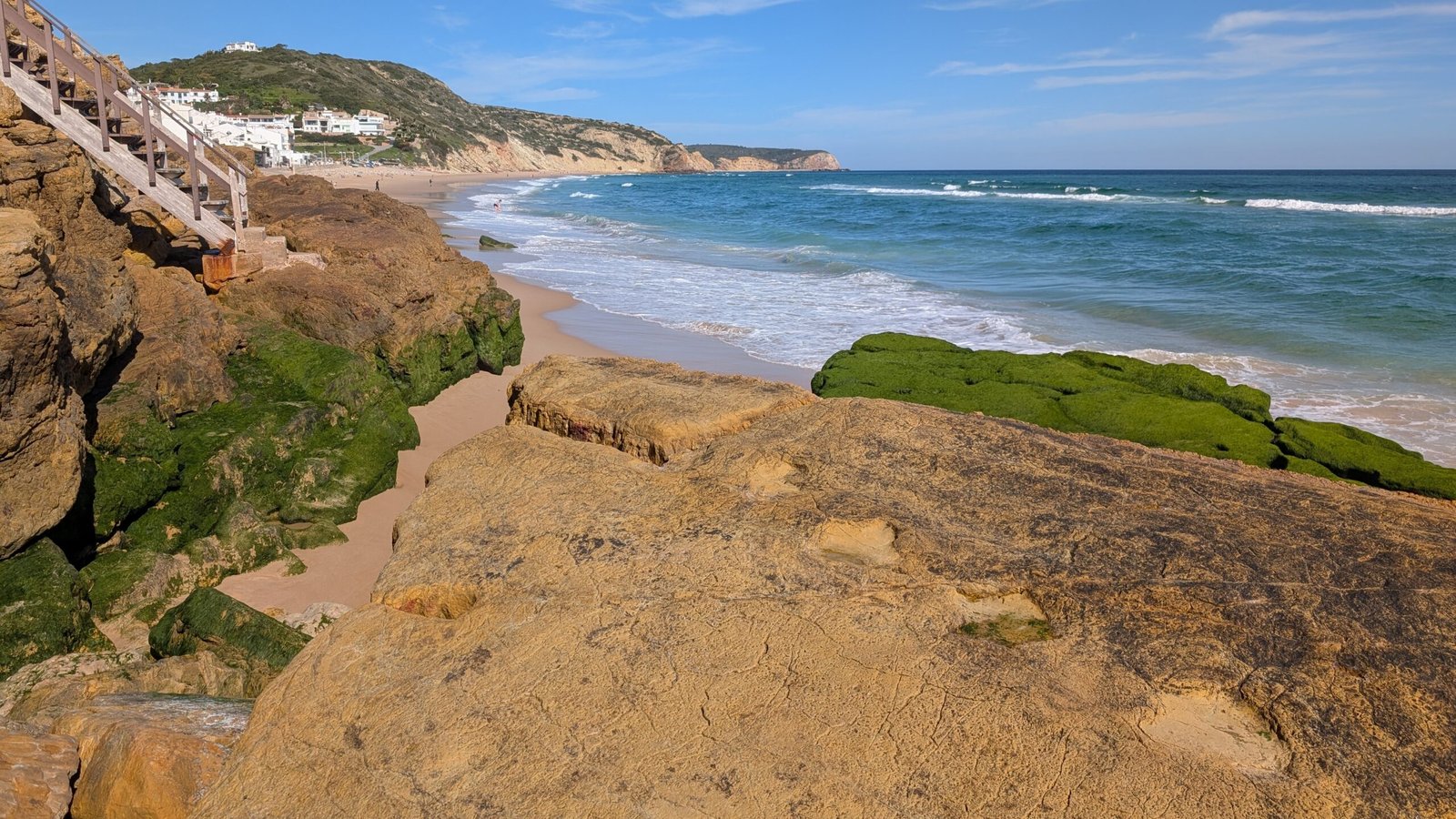

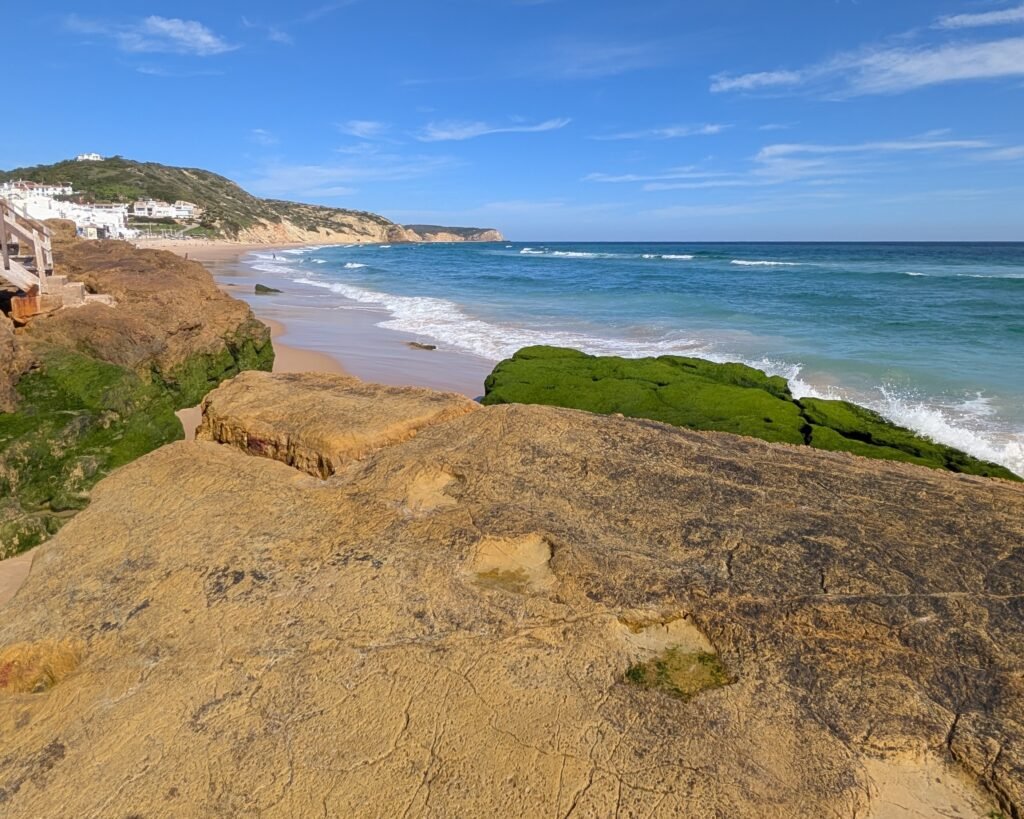
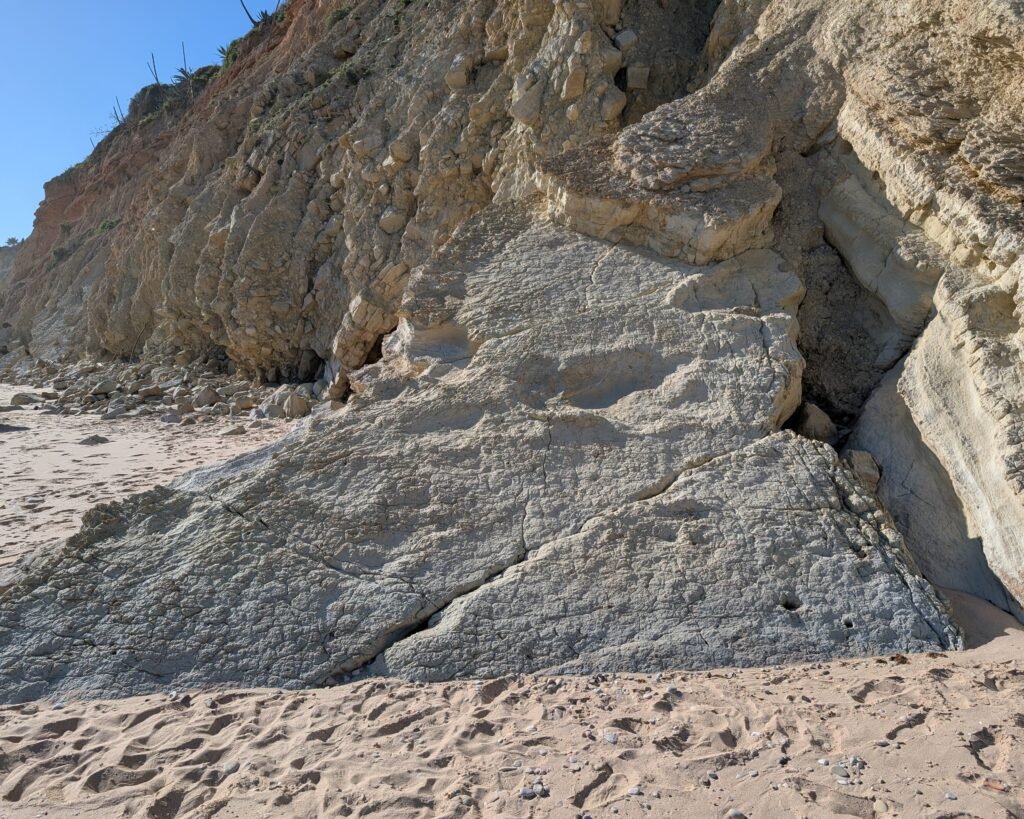
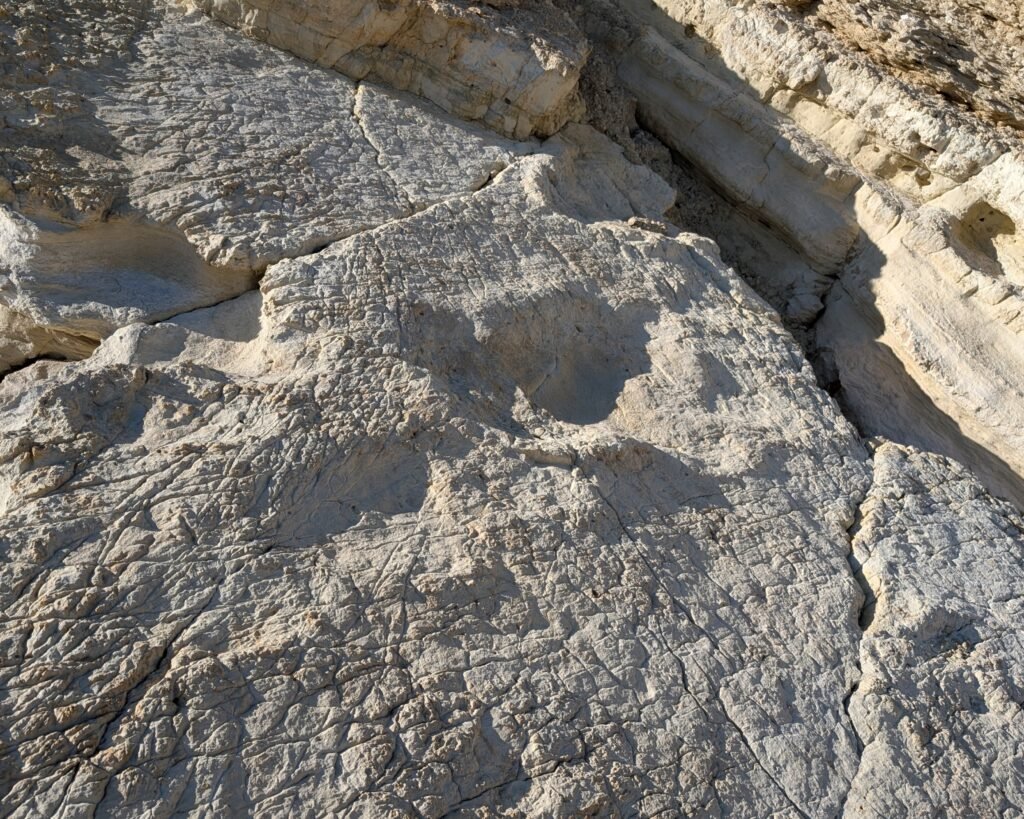
Standing on the huge rock slab, you can see most of the beach. People walking up and down, leaving footprints that get washed away by the waves. Down at your feet, marvel at the footprints that won’t get washed away. They’ve lasted millions of years, and will no doubt still be there long after you are gone. These are dinosaur footprints, made in mud that became stone long ago.
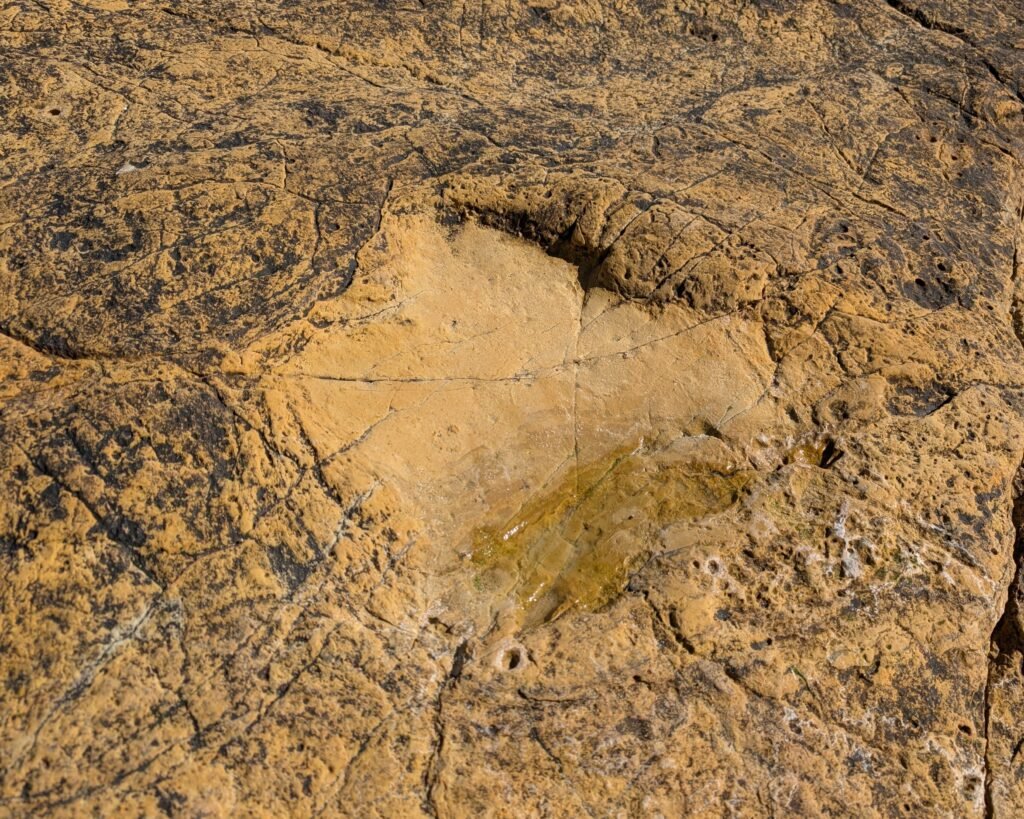
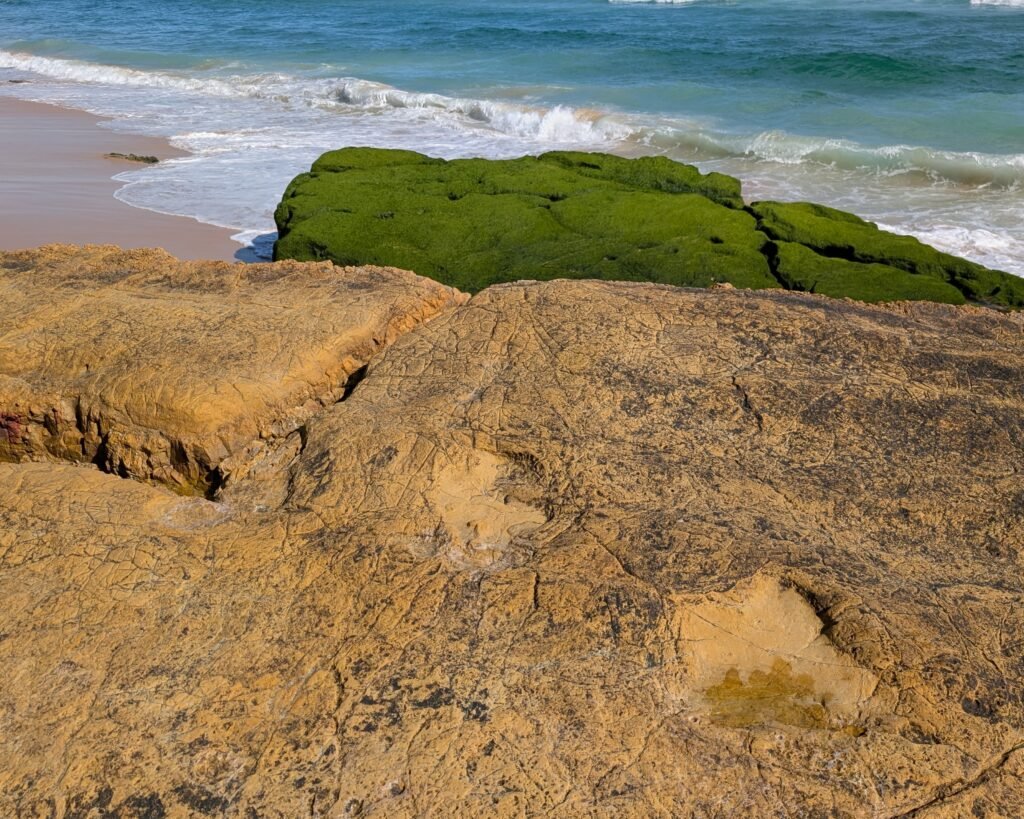
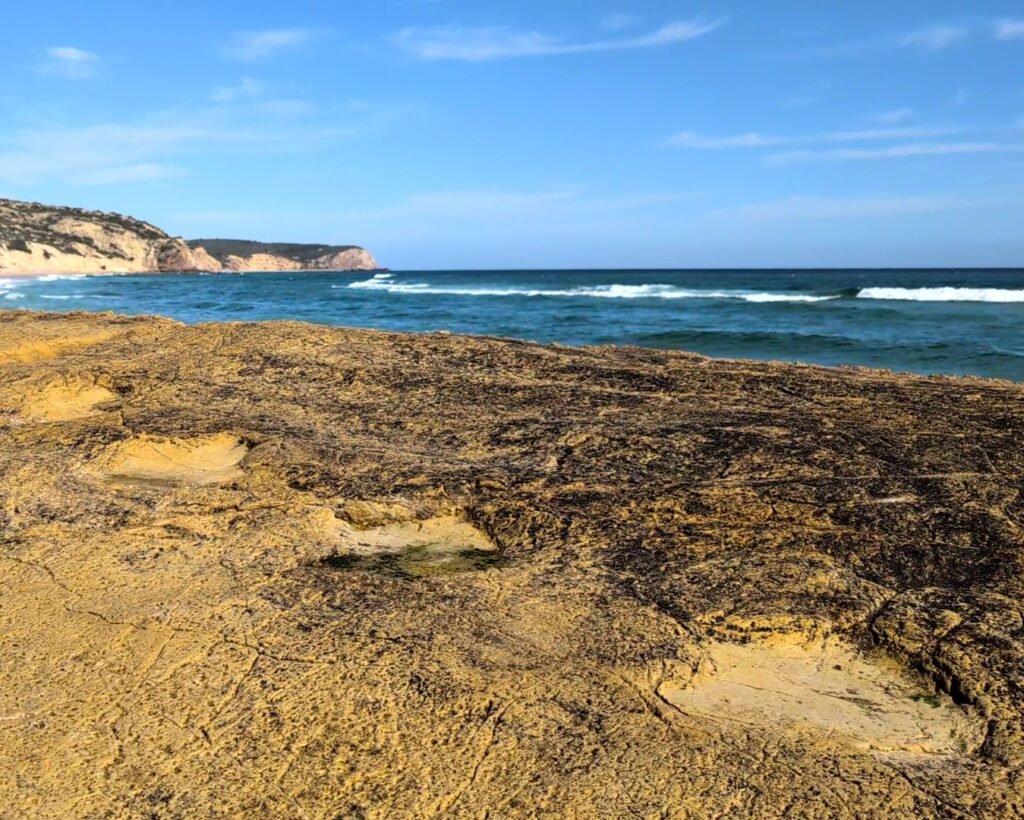
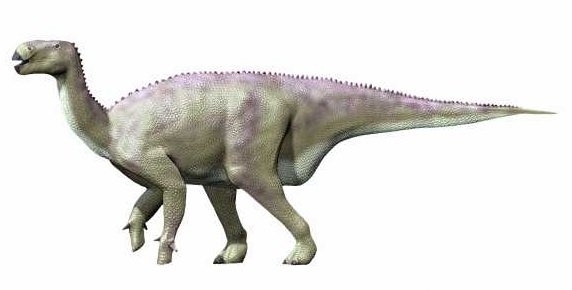
This is a tracksite of dinosaur footprints from the Lower Cretaceous period, dating back to about 100-150 million years ago. 13 lined-up footprints were identified, with several clear three-toed prints that can be identified as an ornithopod (the name means “bird-feet” in reference to the toe structure), possibly an iguanodon.
The fossils were locally known, but were formally documented by geologist Carlos Coke in 1995, and then further studied by paleontologist V.F. Santos. This was the first well-preserved ornithopod dinosaur footprints discovered in Portugal.1
Analysis of the measurements of the prints and their positions indicate that this was a dinosaur with a hip height of about 2.2m moving at about 1.7km/h.
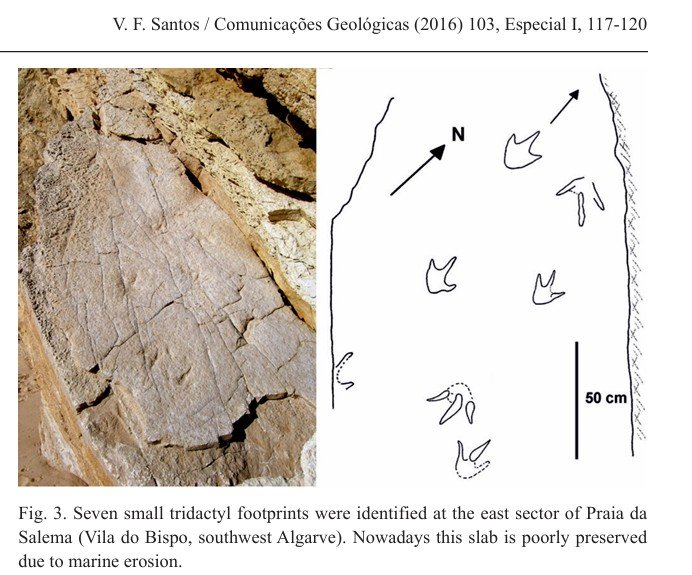
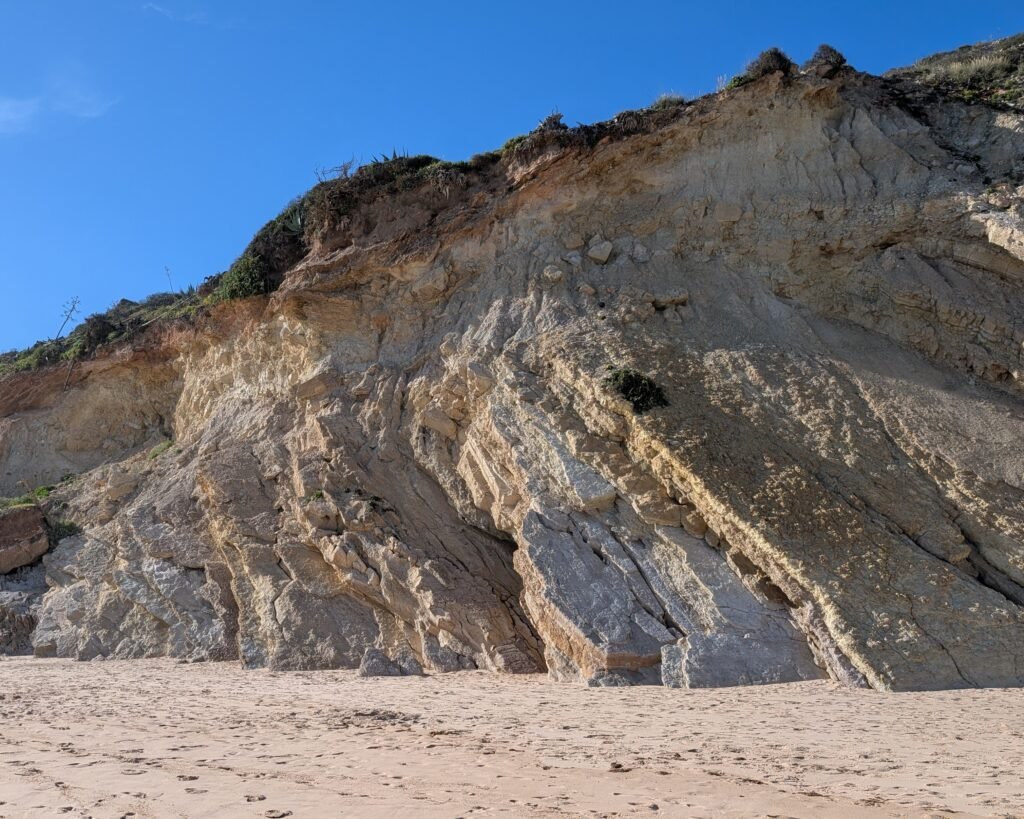
There are other tracksites identified at the eastern edge of the beach. Paleontologist Vanda Santos documented therapod prints (therapods also had three toes, but were carnivorous), but said that they are weathering and nearly obliterated. (I’ve pasted a screenshot from her report – linked in the image and below.) I couldn’t find them at all. Other sites have suggested that there are sauropod prints2, and I saw what looked like tracks of a sauropod.
Location
Salema Beach is in the Algarve, district of Faro. It’s in the municipality of Lagos, to the East of Lagos. There are two tracksites on the beach. The main one is on the Western edge of the beach, while there are other tracks on the Eastern end.
Access
The trackway on the Western edge of the beach is on top of a large rock, which requires a bit of climbing. You’d need to visit at low tide.
The tracks on the Eastern end of the beach are visible from the sand.
Signage
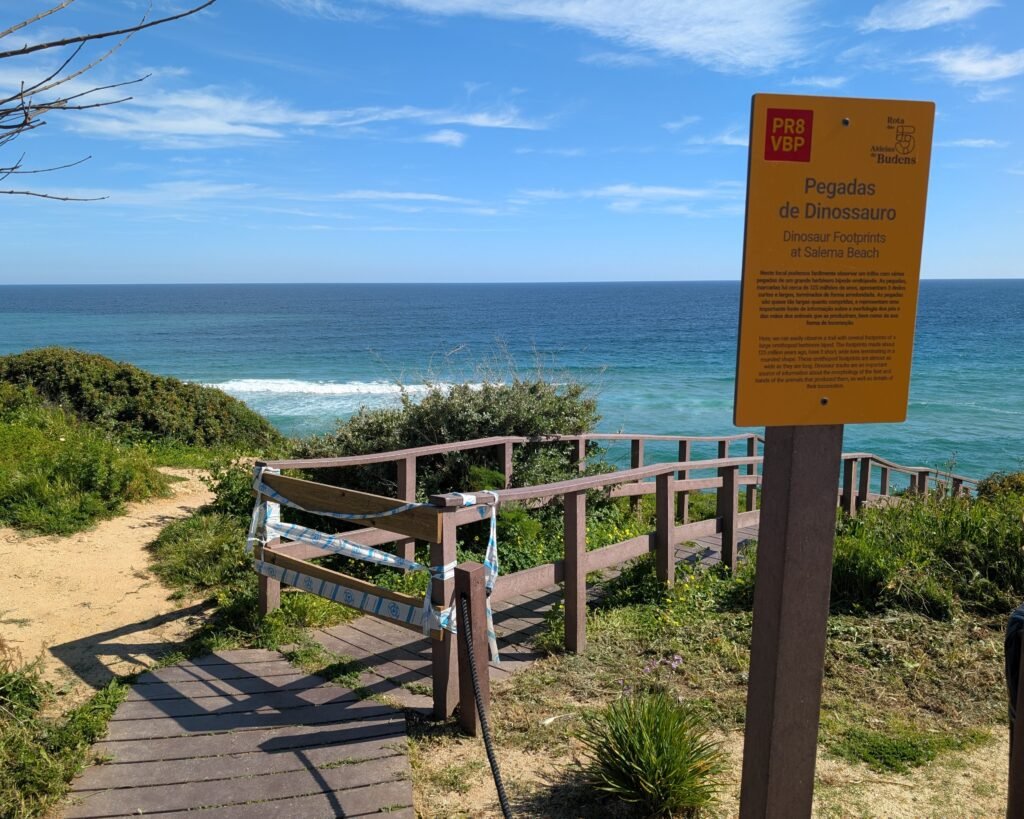
There is a sign at the top of the wooden staircase leading to the main trackway, but the stairway is closed because of erosion on the beach below.
Links
- Description and Video (in Portuguese) from RTP Ensino
- Description (in Portuguese) from Portugal em Pedra
- Video (no language) from Portugal em Pedra
- Video (in Portuguese) from Ciência Viva Lagos
- Video (in Portuguese) from Ciência Viva Lagos
- 3D models (no language) on Sketchfab from Ciência Viva Lagos
- Description (in Portuguese) of the site on the GeoPortal of LNEG (National Laboratory of Energy and Geology)
- Article (in Portuguese) with a nice illustration of the iguanodons by National Geographic Portugal
- Explanation (in English) of how dinosaur footprints were fossilized by the UK’s Natural History Museum
Nearby
There are more dinosaur footprints on the Praia Santa (Santa Beach), about 1 km to the West.
Sources
- Santos, V. F. (2016). Dinosaur tracks in the southwest Algarve Basin. Comunicacoes Geologicas, 103, 117-120. https://www.lneg.pt/wp-content/uploads/2020/03/11-Dinosaurs-at-the-southwest-Mesozoic-b_Layout-1.pdf accessed 31 March 2026 ↩︎
- “Pegadas de Dinossauros No Algarve.” Portugal Em Pedra, Oct. 2018, portugal-em-pedra.blogspot.com/2018/10/pegadas-de-dinossauros-no-algarve.html. Accessed 3 Apr. 2026. ↩︎